Hiring outside engineers is the easy part. The hard part shows up three months later, when your best lead spends half the week managing people she didn't hire, or a vendor delivers code nobody on your team can explain. The model you pick decides which problem you get. Here is how to choose before you sign.
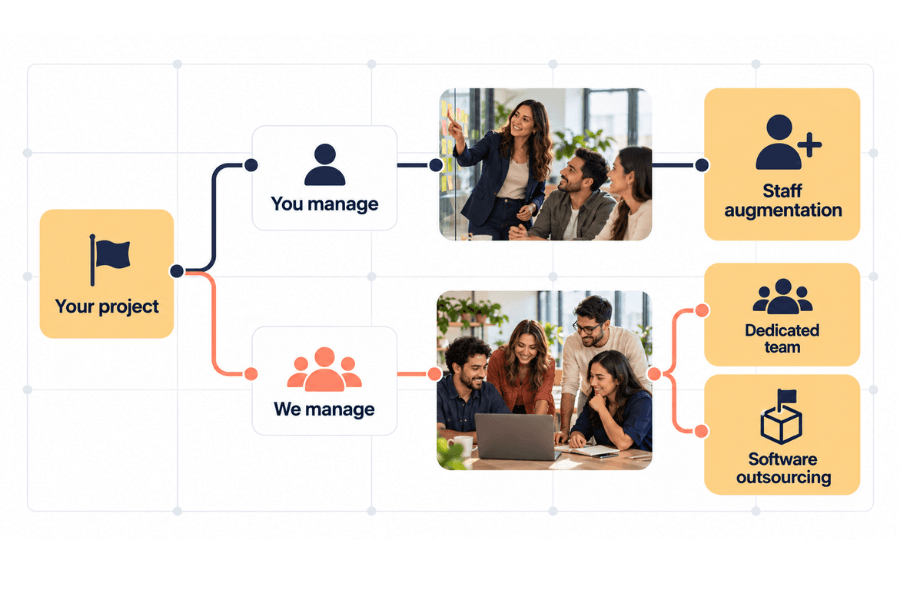
Staff augmentation vs managed services comes down to one question: who manages the work? If your own leads will direct the engineers day to day, staff augmentation fits. If you want a provider to own delivery, choose a dedicated team for ongoing product work or software outsourcing for a defined project.
Demand for engineers is not easing. The US Bureau of Labor Statistics projects 10% growth in jobs for software developers, QA analysts and testers from 2025 to 2035, with about 106,100 openings a year and a median pay of $134,040 in May 2025. Most engineering leaders will bring in outside capacity at some point. The model decides how much of your own time it costs.
The question that decides it: who manages the work?
Every model gives you access to the same kind of engineers. What changes is where management sits, and three things follow from that:
- Who sets priorities every day
- Who is accountable when a deadline slips
- How you pay for the work
The reasons for outsourcing are also changing. Deloitte's 2024 Global Outsourcing Survey found that skilled talent and agility now join cost reduction as key drivers, and that 83% of the executives surveyed use AI as part of their outsourced services. That shifts how leaders compare software outsourcing models: not only on rate, but on how much control and speed each one gives.
Staff augmentation: when you have the leadership and need the hands
You add individual engineers to your existing team. They join your standups, use your tools and report to your leads.
- Management: yours, day to day.
- Accountability: you own delivery. The provider is accountable for the person: skills, performance and replacement.
- Pricing: a monthly or hourly rate per engineer.
- Best fit: strong engineering leadership, a clear backlog, and a skill gap or a temporary peak.
With nearshore staff augmentation from Latin America, engineers work in the same time zone as your team or with a one- to two-hour difference, so they join the same meetings. Under Talentus Global's Smart Sourcing, Talentus Global is the employer of record. You do not handle recruitment, benefits, health insurance or office costs.
The catch: augmentation adds hands, not management. If your leads are already stretched, more people can slow the team down.
Dedicated teams: when you need steady velocity on a product
A dedicated development team is a cross-functional group that works on your product for the long term. It can include software engineers, QA, DevOps, UX/UI designers and a project manager.
- Management: shared. You set priorities and the roadmap; the team runs its own day-to-day execution.
- Accountability: you own what gets built; the team owns how and when it ships.
- Pricing: a monthly rate for the team.
- Best fit: ongoing product work with a roadmap that runs for quarters, not weeks, and limited time to manage individuals.
Judge a dedicated team on delivery, not hours. DORA's software delivery metrics give you a shared scorecard: change lead time, deployment frequency, change fail rate and failed deployment recovery time. Talentus Global's dedicated teams are built around this kind of steady cadence.
Plan for onboarding. Even a strong team needs a few weeks to learn your codebase, your release process and your definition of done. Give it one product owner on your side who answers questions quickly; that single role does more for velocity than any contract clause.
Software outsourcing: when you need a defined outcome
The provider takes a defined scope from design to production. It assembles and manages the team, and you approve the work at agreed milestones.
- Management: the provider's.
- Accountability: the provider delivers against the agreed scope.
- Pricing: usually fixed price or milestone-based, sometimes time and materials.
- Best fit: a well-defined project outside your core product, such as a migration, a new portal or a first version, when your team has no spare capacity.
The catch: changes in scope cost time and money, so clear acceptance criteria matter more here than in any other model. See how Talentus Global approaches software outsourcing.
Staff augmentation vs managed services: side-by-side comparison
Who manages the work
- Staff augmentation: your leads
- Dedicated team: shared; you set priorities, the team runs execution
- Software outsourcing: the provider
Who is accountable for delivery
- Staff augmentation: you
- Dedicated team: shared
- Software outsourcing: the provider, against the agreed scope
How you pay
- Staff augmentation: per engineer, monthly or hourly
- Dedicated team: a monthly team rate
- Software outsourcing: fixed price or milestones
Your time required
- Staff augmentation: high
- Dedicated team: medium
- Software outsourcing: low, concentrated at milestones
Best fit
- Staff augmentation: skill gaps and peaks, with strong leadership
- Dedicated team: long-term product work
- Software outsourcing: a defined project with a clear scope
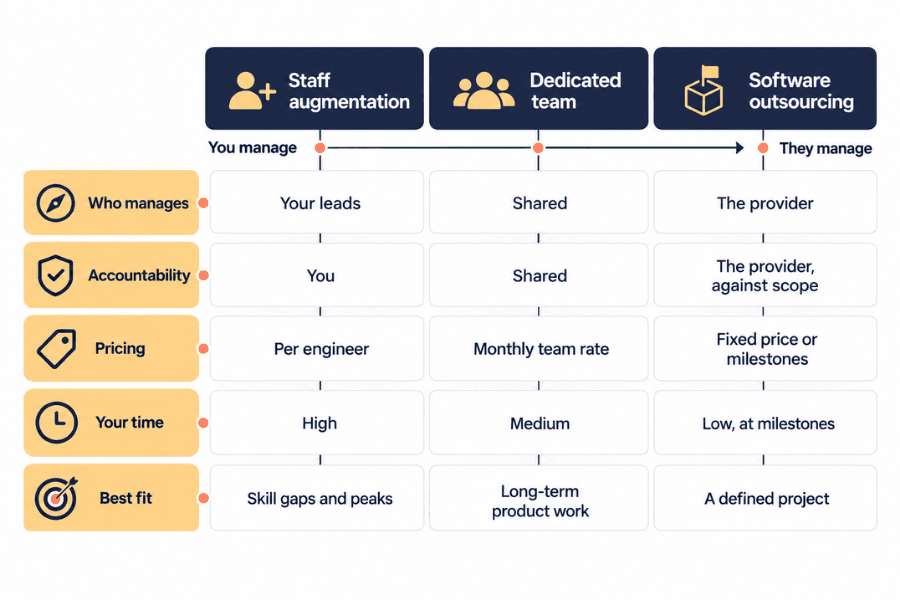
Read the comparison as a scale of control. As you move from staff augmentation to software outsourcing, you give up day-to-day control and get back management time. Neither end is better. The right point on the scale depends on how much leadership capacity you have and how clearly you can define the work.
A fourth model, Managed IT Services, covers running and supporting existing systems on a monthly subscription rather than building new ones.
A five-question decision guide
Use these questions as a quick IT outsourcing framework. Answer them in order.
- Do your engineering leads have time to direct more people? If yes, staff augmentation is an option. If not, look at the managed models.
- Is this ongoing product work or a project with an end date? Ongoing points to a dedicated team. An end date points to software outsourcing.
- How stable is the scope? If it changes every sprint, avoid fixed-price outsourcing.
- Who must own the knowledge when the engagement ends? If it has to be your team, keep the work close, or require documentation and a handover plan.
- How much daily collaboration do you need? Heavy collaboration needs overlapping hours, which is where nearshore teams help.
Many companies use more than one model at once, for example augmenting the core team while outsourcing a migration. To compare costs by role and seniority, try the nearshore cost calculator.
FAQ
What is the difference between staff augmentation and managed services?
With staff augmentation, you add individual engineers to your team and your leads manage their work. With managed services, the provider manages the team and shares or owns accountability for delivery, either as a dedicated team on your product or as an outsourced project. The real difference is who directs the work every day.
Is staff augmentation cheaper than a dedicated team?
Per person, the rates are often similar. The difference is the time your own leaders spend. Staff augmentation needs your managers to direct each engineer, while a dedicated team includes its own project management. Compare the total cost, including management time, not only the hourly or monthly rate.
What does employer of record mean in staff augmentation?
The provider is the legal employer of the engineers who work on your team. It handles contracts, payroll, benefits and local compliance in the engineer's country, so you direct the work without setting up a foreign entity. With Smart Sourcing, Talentus Global acts as the employer of record.
Can we switch models later?
Yes, and many companies do. A common path is to start with one or two augmented engineers, then grow into a dedicated team once the work turns into a steady product roadmap. Agree on switch terms at the start, including how people, knowledge and code ownership move over.
Next step
Not sure which model fits your roadmap?
Schedule a consultation to find the right model for your team.