Enterprise Retrieval-Augmented Generation (RAG) architectures rely on vector databases like Pinecone, Qdrant, Milvus, and pgvector to store and retrieve proprietary business intelligence.
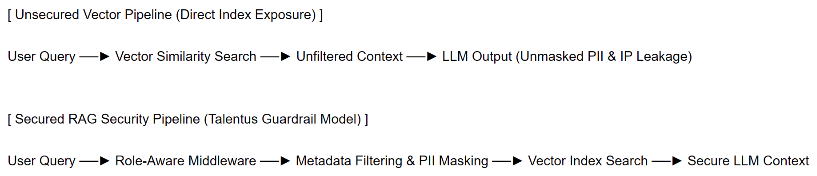
However, vector stores introduce unique security vulnerabilities: semantic similarity searches naturally bypass traditional database row-level security, exposing sensitive intellectual property, employee PII, and confidential records to unauthorized LLM queries.
Securing enterprise RAG pipelines requires embedding-level access controls, role-aware metadata filtering, and real-time sanitization guardrails at the vector retrieval layer.
The High Risk of Unsecured Vector Databases
Deploying vector databases without specialized AI governance controls exposes enterprise networks to severe data leaks and indirect prompt injection attacks:
- Cross-Tenant Data Bleed: Standard mathematical similarity algorithms (like cosine similarity) evaluate vector distance, not user authorization. Without explicit pre-filtering, a general employee query can retrieve executive financial projections or confidential legal documents.
- Indirect Prompt Injection via Ingestion: Poisoned or unvetted PDF and text documents ingested into the vector pipeline can contain hidden instructions that manipulate the downstream LLM when retrieved as context.
- Opaque Data Auditing: Traditional database logs record SQL queries, but vector databases store mathematical float arrays, making it difficult to audit which text chunks were exposed to whom.
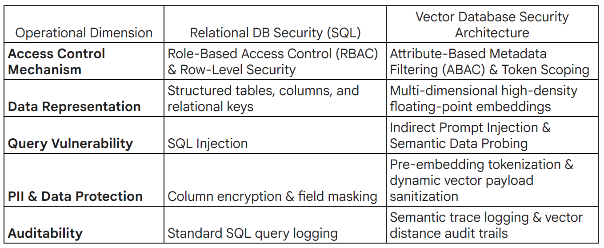
Relational DB Security vs. Vector Database Security Architecture
Upgrading your GenAI architecture requires replacing static database permissions with dynamic vector security controls:
Upgrading your GenAI architecture requires replacing static database permissions with dynamic vector security controls:
3 Pillars of Enterprise Vector Database Security
Constructing a secure, enterprise-grade RAG data pipeline requires three core architectural guardrails:
1. Role-Aware Pre-Filtering and Metadata Scoping
Never run unstructured vector searches against a global index. Enforce strict Attribute-Based Access Control (ABAC) by attaching encrypted metadata tags (e.g., user_role, department_id, clearance_level) to every vector payload. Vector queries must apply deterministic pre-filters so embeddings outside a user’s permission scope are never evaluated.
2. Payload Sanitization and PII Redaction
Scan incoming documents and outgoing retrieval chunks for sensitive data before vector embedding occurs. Deploying an automated PII sanitization proxy ensures that Social Security numbers, financial account details, and private identifiers are tokenized before entering the vector index.
3. Isolated Single-Tenant Vector Indexing
Prevent multi-tenant data contamination in cloud Environments. For highly regulated industries, deploy single-tenant, isolated vector database clusters behind private VPC endpoints with customer-managed encryption keys (CMEK) for data at rest and in transit.
Secure Your GenAI Architecture with Talentus Global
Deploying secure, enterprise-grade RAG pipelines and vector database infrastructure requires specialized DevSecOps expertise, cloud data engineering, and disciplined AI governance.
Talentus Global provides dedicated nearshore LATAM software engineering pods to design, harden, and scale your AI vector infrastructure.
For over 30 years, Talentus Global has been a trusted leader in enterprise digital transformation, cloud architecture, and data security. Our nearshore developers specialize in vector database security (Pinecone, Qdrant, Milvus, pgvector), LLMOps telemetry, API guardrails, and enterprise systems integration.
Operating 100% synchronously in your US timezone (EST/CST), our pre-vetted LATAM engineering pods deploy in as little as 48 hours to accelerate your secure AI roadmap.
- 100% US Timezone Alignment: Collaborate in real time with senior engineers during standard EST/CST working hours.
- Deploy in 48 Hours: Bypass domestic hiring bottlenecks and launch specialized AI security pods immediately.
- 95% Developer Retention Rate: Protect institutional context and codebase stability across long-term initiatives.
Protect your enterprise knowledge base. Partner with Talentus Global AI by clicking here today