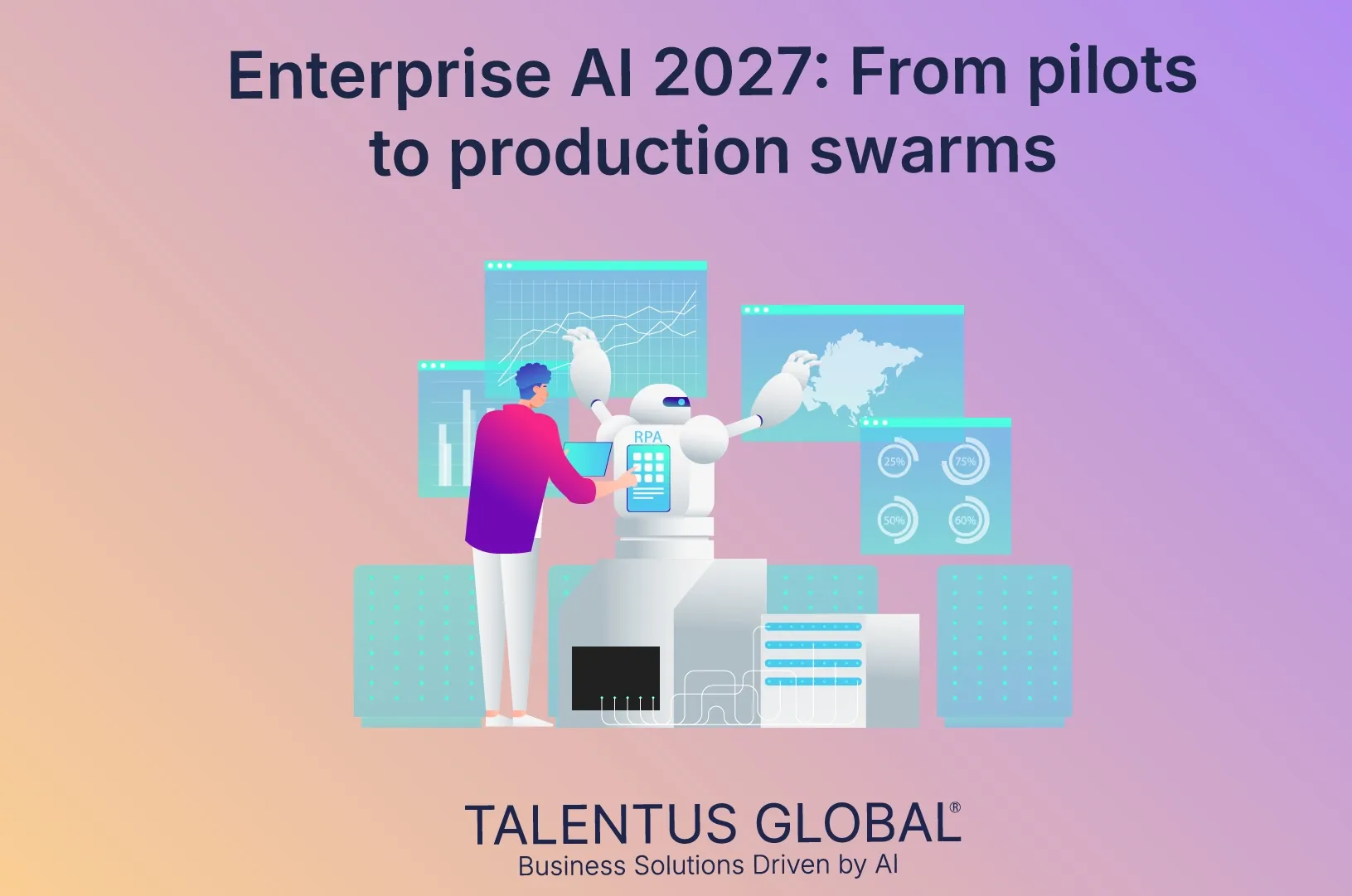
The enterprise artificial intelligence landscape has undergone a massive paradigm shift. Over the past few years, the primary focus was on conversational AI, deploying generative chatbots to draft emails, answer basic customer service queries, or summarize internal documents. While valuable, these tools remained passive assistants reliant on constant, manual human prompts.
In 2026, progressive technology leaders are shifting their capital investments toward Autonomous Workflow Agents.
Unlike passive AI models, autonomous workflow agents don't just generate text or respond to static prompts, they reason, plan multi-step actions, interact dynamically with enterprise software stacks, and execute end-to-end operational processes with minimal supervision. They represent the leap from simple text generation to true operational agency.
For CIOs and CTOs, unlocking enterprise value with agentic workflows isn't about replacing human talent; it is about decoupling operational output from headcount growth, eliminating administrative friction, and accelerating business velocity at scale.
1. Passive AI vs. Autonomous Workflow Agents
Understanding the strategic value of agentic systems requires examining how they fundamentally differ from traditional software and passive AI assistants:
Goal-Oriented Reasoning: Instead of requiring step-by-step instructions, an autonomous agent is given an objective (e.g., "Onboard this vendor and audit their compliance documentation"). It breaks down the goal into logical sub-tasks independently.
Dynamic System Interoperability: Autonomous agents read, write, and execute actions across disparate software platforms, connecting your ERP, CRM, cloud storage, and communication tools without human intervention.
Self-Correction & Adaptive Execution: If an API call fails or a document contains missing fields, an autonomous agent doesn't throw a static system error. It evaluates alternative logic paths, attempts alternative queries, or routes an alert to a human supervisor for targeted resolution.
Passive Chatbot: [ Human Prompt ] ──> [ Static AI Response ] ──> [ Manual Human Execution ]
Autonomous Agent: [ Executive Goal ] ──> [ Reason ➔ Query APIs ➔ Execute ➔ Validate ]
2. High-Impact Enterprise Use Cases
Where are organizations seeing the highest return on investment (ROI) from agentic deployments? The most effective use cases involve high-volume, cross-system operational workflows:
1. Automated Supply Chain & Vendor Onboarding
Agents extract data from incoming vendor contracts, run automated compliance checks against global databases, create tenant profiles in your ERP (like Odoo or SAP), and generate dynamic onboarding sequences in your CRM, reducing onboarding cycles from weeks to minutes.
2. Self-Healing IT Operations & Incident Response
Instead of waiting for an engineer to respond to an off-hours server alert, an autonomous IT agent detects a memory spike, traces logs across cloud environments, executes diagnostic scripts, provisions temporary container instances, and drafts a detailed incident post-mortem for the DevOps team to review.
3. Enterprise Data Reconciliation & Reporting
Autonomous agents continuously cross-reference financial records, invoice databases, and payment gateways, flagging anomalies, executing ledger updates, and ensuring regulatory compliance across complex global subsidiaries in real time.
3. Engineering the Agentic Control Layer with Talentus
[ Unstructured Data / Triggers ] ──> [ Agent Reasoning Loop ] ──> [ API Gateway ] ──> [ Secure Enterprise Execution ]
Building, deploying, and governing autonomous agent swarms is not a simple out-of-the-box software installation. It requires robust system architecture, secure API integration layers, and real-time observability frameworks to prevent behavioral drift and logic loops.
The Talentus Velocity: At Talentus Global, we bridge the gap between AI ambition and production-grade execution. Through our dedicated AI and automation division https://talentusglobal.ai/ , we design and deploy specialized, agentic architectures tailored to your enterprise needs.
Our managed nearshore software development pods integrate directly into your Agile workflows, giving you the elite technical capacity required to build custom API middleware, configure deterministic governance gateways, and maintain absolute control over your autonomous systems. Synchronized in your exact time zone, our LATAM engineering clusters allow you to scale your technological roadmap without friction.
Transform your enterprise from passive automation to active execution.