Software developer churn costs organizations far more than agency placement fees and open-headcount vacancies. When a senior developer leaves, they take unwritten system architecture, edge-case histories, and critical domain context with them, leaving behind fragile codebases and compounding technical debt.
The Invisible Financial Drain of Turnover
While HR departments calculate churn based on recruiting expenses, technology executives pay a much higher operational price when turnover is high:
Erosion of Institutional Context: Essential knowledge about complex API dependencies, legacy workarounds, and database quirks walks out the door, forcing remaining engineers to guess.
Velocity Collapse: A new developer requires three to six months to reach full productivity. Continuous turnover keeps engineering teams in a permanent onboarding state.
Architectural Fragility: Replacement developers often rewrite functional code simply because they do not understand the original design patterns, introducing regression bugs.
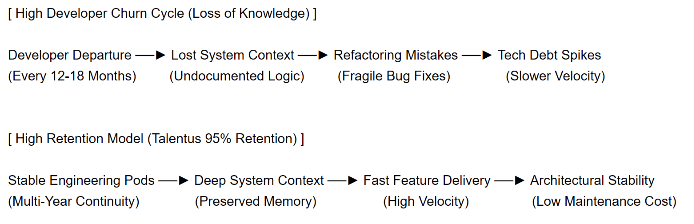
Industry Average Churn vs. High-Retention Engineering Pods
Maintaining long-term team continuity directly correlates with software reliability and engineering throughput:
3 Pillars for Preserving Institutional Memory
Protecting your codebase from the hidden tax of turnover requires an intentional retention strategy built into your talent pipeline:
1. Dedicated, Cohesive Engineering Units
Assigning entire pre-assembled pods rather than isolated contractors builds collective memory. Knowledge is distributed across a close-knit team rather than isolated within a single individual, eliminating single-point-of-failure risks.
2. Multi-Year Career Continuity
High turnover often stems from a lack of long-term engagement. Partnering with nearshore providers that invest in developer growth, competitive compensation, and strong team culture ensures developers stay engaged on your product for years.
3. Active Knowledge Transfer and Architectural Guardrails
Stable teams naturally maintain better documentation, automated test suites, and pull request standards. When developers know they will maintain the code they write today two years from now, code quality increases automatically.
Protect Your Tech Stack with Talentus Global
Scaling software engineering capacity shouldn't mean constantly rebuilding your team or losing critical system knowledge.
Talentus Global provides dedicated nearshore LATAM software engineering pods backed by an industry-leading 95% retention rate.
For over 30 years, Talentus Global has helped enterprise organizations scale technical capabilities without sacrificing architectural stability. Our LATAM developers operate 100% synchronously in your US timezone (EST/CST), functioning as a seamless, long-term extension of your engineering department.
- 100% US Timezone Alignment: Real-time collaboration, joint daily standups, and instant communication during standard working hours.
- 95% Developer Retention Rate: Protect institutional knowledge and preserve codebase integrity over multi-year product roadmaps.
- Deploy in 48 Hours: Skip months of recruiting and deploy pre-vetted, high-performing engineering pods immediately.
Preserve your institutional memory and maintain peak velocity. Explore our outsourcing options here