As we move through 2026, the tech recruitment landscape has shifted from a "growth at all costs" mindset to one of Value-Driven Efficiency. The "Keyword Era" is officially dead, replaced by a market that demands proof of execution, AI orchestration, and financial literacy.
By Q4 2026, the gap between traditional hiring and Smart Sourcing will reach its widest point. Here are our top three predictions for the final quarter of the year and the steps you need to take today to stay ahead.
1. The Collapse of the "Generalist" Junior Role
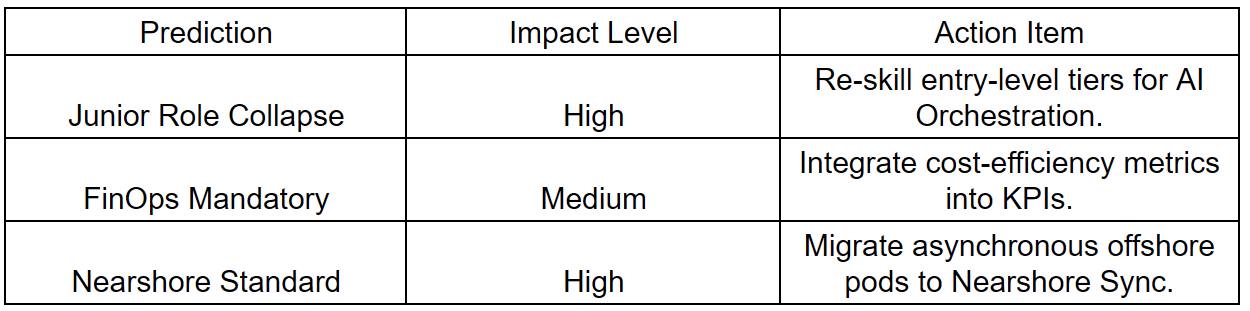
For years, companies hired junior developers with "broad but shallow" skill sets. In Q4 2026, this category will effectively disappear. AI-agentic workflows now handle 80% of entry-level tasks like boilerplate coding, basic QA, and documentation.
The Prediction: Hiring will pivot exclusively toward "AI-Native Juniors", entry-level talent that doesn't just know how to code, but knows how to prompt, audit, and orchestrate AI agents to deliver senior-level output.
How to Prepare: If you are hiring, stop looking for "Java Basics." Start looking for Agentic AI proficiency. If you are a candidate, build a portfolio that showcases how you used AI to solve a complex architectural problem, not just a simple app.
2. "FinOps" Becomes a Mandatory Engineering Skill
By the end of 2026, the "Cloud Sprawl" of the early 2020s has come home to roost. Companies are facing massive inference bills from AI models and unoptimized cloud clusters.
The Prediction: Every Senior Engineer, Architect, and DevOps Lead will be expected to be a FinOps Specialist. Employers will no longer hire someone who can "build it"; they will only hire someone who can "build it profitably."
How to Prepare: Audit your current engineering team’s awareness of cloud unit economics. Ensure your upcoming job descriptions for Q4 include "Cloud Cost Optimization" and "Resource Allocation Efficiency" as core requirements.
3. The Nearshore "Synchronization" Standard
The 12-hour "Time-Zone Tax" of offshore outsourcing has become too expensive for the high-velocity requirements of 2026. As companies push for faster release cycles, the friction of asynchronous communication is a non-starter.
The Prediction: Q4 2026 will see a record-breaking migration toward Latin American Nearshore hubs. Companies will prioritize "Real-Time Sync" over "Lowest Hourly Rate," moving their center of gravity to time zones that allow for instant collaboration.
How to Prepare: Evaluate your current "Productivity Latency." If your leadership is waiting 12 hours for a PR review, it's time to transition to a Dedicated Nearshore Cluster.
Conclusion: Efficiency is the New Innovation
The winners of Q4 2026 won't be the companies with the largest headcounts, but those with the most synchronized and AI-augmented teams. By shifting your strategy toward value-driven hiring and time-zone alignment now, you ensure your roadmap is ready for the year-end push.
Is your talent strategy ready for the Q4 shift?
Find your AI-augmented leads or synchronized Nearshore pods in 48 hours at the Talentus Marketplace.