
For Chief Technology Officers and VP of Engineering leaders, technical debt is often discussed in abstract terms, fragile codebases, legacy workarounds, and delayed release cycles. However, without a concrete financial framework to quantify its impact, tech debt remains an invisible tax that steadily consumes engineering velocity.
When up to 40% of an engineering team's capacity is spent servicing legacy code and patching fragile integrations, product roadmaps slip and innovation halts.
By implementing a Tech Debt Remediation Calculator, measuring interest paid in wasted developer hours against the cost of refactoring, CTOs can transform technical debt from a vague engineering complaint into a compelling business case for board-level investment.
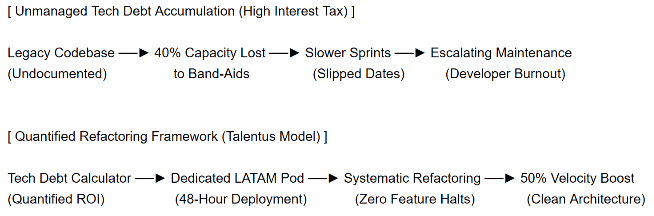
The Hidden Financial Overhead of Unquantified Debt
Ignoring technical debt creates systemic financial drain across technology organizations:
- Elevated Sprint Costs: Simple feature enhancements require twice as many story points due to complex, tightly coupled code dependencies.
- Inflated Onboarding Timelines: New software engineers take up to six months to become productive while trying to navigate undocumented legacy systems.
- High Regression Risk: Patching bugs in aging infrastructure frequently breaks downstream APIs, triggering emergency firefighting sessions.
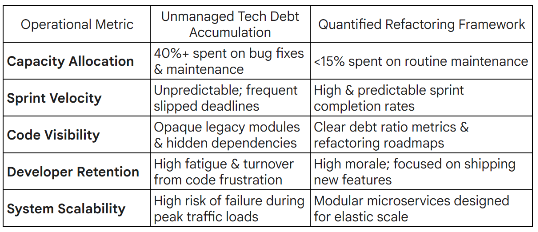
Unmanaged Tech Debt vs. Quantified Refactoring Framework
Quantifying technical debt allows leadership to treat code refactoring as a high-ROI architectural investment:
3 Pillars of Slicing Tech Debt in Half
Successfully reducing technical debt without freezing feature development requires three core strategies:
1. The Tech Debt Interest Calculator
Quantify your technical debt ratio (TDR = Remediation Cost/Rebuild Cost) Calculate the monthly "interest" paid by multiplying developer hourly rates by the time spent fixing preventable bugs. Demonstrating that paying down debt yields a 2x ROI within two quarters secures executive alignment.
2. Parallel Refactoring Tracks
Never freeze feature delivery to rewrite a system from scratch. Instead, deploy parallel engineering tracks: maintain your core product team on feature delivery while utilizing dedicated refactoring pods to systematically modernise modules via domain-driven design and microservices.
3. Dedicated Nearshore Pod Execution
Accelerate debt reduction without pulling internal developers away from core business logic. Augmenting your team with pre-vetted nearshore LATAM software pods allows you to tackle backlog technical debt immediately, operating synchronously during your exact working hours.
Slice Your Tech Debt with Talentus Global
Reducing technical debt requires specialized engineering bandwidth and disciplined execution.
Talentus Global provides dedicated nearshore LATAM engineering pods built to modernize legacy stacks.
For over 30 years, Talentus Global has helped enterprise organizations scale engineering capacity and eliminate technical debt. Our nearshore software pods specialize in full-stack modernization, cloud migration, and API middleware integration, connecting modern frameworks with core platforms like Element451, Thesis Elements, Canvas, and Banner.
Our LATAM developers work 100% synchronously in your US timezone (EST/CST), integrating seamlessly into your internal workflow to slice technical debt in half without disrupting current sprint commitments.
- 100% US Timezone Alignment: Collaborate in real time with senior developers during standard EST/CST working hours.
- Deploy in 48 Hours: Skip 60-day recruitment cycles and launch dedicated refactoring pods immediately.
- 95% Developer Retention Rate: Preserve architectural continuity across multi-quarter modernization initiatives.
Stop letting legacy code drain your engineering budget. Calculate and slice your tech debt with Talentus Global today. Explore our LATAM pods here