Universities are currently facing a cybersecurity crisis. With vast repositories of highly sensitive data, from financial aid records and social security numbers to proprietary research, higher education institutions have become prime targets for ransomware and data breaches.
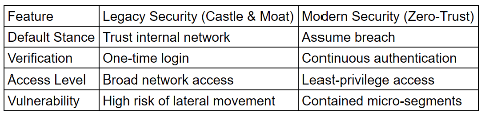
Historically, university IT departments relied on a "castle-and-moat" security model. They built a strong firewall around the campus network and implicitly trusted any user or device inside it. But in 2026, the perimeter has vanished. Students access the Learning Management System (LMS) from off-campus coffee shops, faculty log into the Student Information System (SIS) from personal devices, and applications are hosted across decentralized cloud environments.
When the perimeter disappears, traditional network security fails. To protect student data and institutional integrity, EdTech infrastructure must adopt a Zero-Trust Architecture.
The End of Implicit Trust
The core philosophy of Zero-Trust is simple: Never trust, always verify.
Core Pillars of Zero-Trust in Higher Ed
Transitioning a legacy university network to a Zero-Trust model requires a strategic overhaul of how identity and data are managed. IT leaders must focus on three architectural shifts:
1. Identity as the New Perimeter
Passwords are no longer sufficient. A resilient EdTech ecosystem requires centralized Identity and Access Management (IAM) utilizing advanced Multi-Factor Authentication (MFA) and Single Sign-On (SSO). By leveraging adaptive authentication, the system evaluates the context of every login, flagging anomalous behavior, such as a student attempting to access the SIS from a foreign country at 3:00 AM.
2. Network Micro-Segmentation
In a legacy system, compromised student credentials can allow a hacker to move laterally across the network and access the core financial database. Zero-Trust breaks the network into isolated micro-segments. If a bad actor breaches a lower-level portal like the campus housing app, micro-segmentation acts as a blast door, completely blocking lateral movement to the core Student Information System.
3. Continuous Agentic AI Monitoring
Human security teams cannot manually review millions of daily access logs. Modern universities are deploying Agentic AI systems to serve as autonomous sentinels. These AI networks continuously monitor data flow, automatically revoke session access the moment suspicious behavior is detected, and dynamically update access policies without requiring manual IT intervention.
Build Your Defense with Talentus Global
Transitioning from a legacy firewall to a comprehensive Zero-Trust architecture requires deep DevSecOps expertise that most university IT helpdesks simply do not have the bandwidth to execute.
At Talentus Global, we provide the architectural firepower to secure your digital campus. Our synchronized nearshore engineering pods embed directly with your IT leadership. Operating in your timezone (EST/CST), our LATAM-based cybersecurity engineers, cloud architects, and IAM specialists design, build, and deploy the Zero-Trust frameworks required to lock down your EdTech infrastructure.
Protect your students. Protect your reputation. Modernize your security architecture today by diving into our EdTech Solutions clicking here