Transfer students represent one of the largest growth opportunities for higher education institutions.
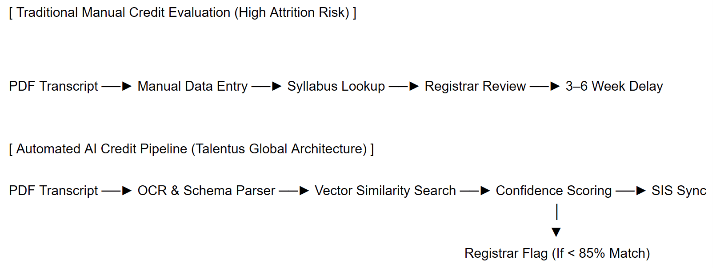
However, the traditional credit evaluation process remains a major operational bottleneck. Registrars and admissions offices often take 3 to 6 weeks to manually review transcripts, match course syllabi, and establish credit equivalencies.
This delay creates severe friction during student onboarding. Prospective students cannot register for classes, estimate their time-to-graduation, or finalize financial aid packages without knowing which credits will transfer. As a result, universities lose qualified transfer candidates to institutions that provide immediate, transparent credit evaluations.
Automating credit transfer evaluation with AI pipelines transforms this slow, manual audit into a real-time workflow. By combining multimodal OCR, LLM-driven entity extraction, and semantic vector matching with enterprise Student Information Systems (SIS) like Thesis Elements, universities can evaluate transfer credits in seconds while keeping registrars in full control.
The High Cost of Delayed Credit Evaluations
Relying on manual transcript processing across higher ed admissions introduces severe growth and operational hurdles:
- Student Attrition Before Enrollment: Delayed credit evaluations force transfer students to make enrollment decisions in the dark, driving them toward competitors with faster onboarding times.
- Registrar Backlog & Burnout: Peak transfer cycles inundate administrative teams with hundreds of multi-page transcripts and unstructured course descriptions, leading to processing bottlenecks and human error.
- Inconsistent Equivalency Mapping: Without a centralized, AI-driven credit matrix, different evaluators may assign varying credit values to the exact same incoming course, creating compliance and governance risks.
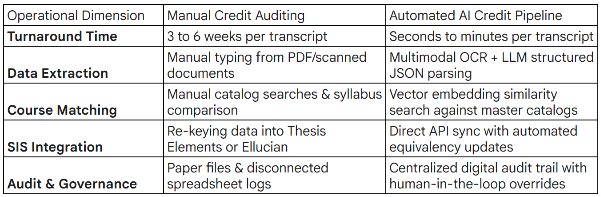
Manual Credit Auditing vs. Automated AI Pipelines
Modernizing transcript evaluation bridges the gap between admissions outreach and registrar compliance:
3 Pillars of AI-Driven Credit Evaluation Pipelines
Building an enterprise-grade transcript evaluation pipeline requires three core technical components:
1. Multimodal Parsing & Document Intelligence
Ingest paper scans, PDF transcripts, and digital records automatically. Use multimodal document processing and structured LLM extraction to convert unstructured transcript data into validated JSON payloads containing course codes, course titles, letter grades, and credit hours.
2. Semantic Vector Search for Course Equivalency
Go beyond exact string matching. Generate vector embeddings for incoming course titles and descriptions, comparing them against the university's master course catalog using vector databases (such as Qdrant or Pinecone). The pipeline assigns a semantic confidence score to each proposed course match.
3. Human-in-the-Loop Orchestration & SIS Sync
Maintain strict registrar oversight without sacrificing speed. High-confidence matches (e.g., >85% match score) route directly into central platforms like Thesis Elements SIS. Lower-confidence matches or novel course descriptions flag automatically in a registrar dashboard for one-click human approval.
Accelerate Your Campus AI Roadmap with Talentus Global
Building automated document extraction pipelines, vector matching systems, and custom SIS integrations requires senior AI engineers, cloud integration architects, and higher ed software specialists.
Talentus Global provides dedicated nearshore LATAM software engineering pods to design, build, and deploy your campus AI workflows.
For over 30 years, Talentus Global has been a trusted technical partner in enterprise software engineering, cloud architecture, and higher ed digital transformation. Our nearshore LATAM engineering teams specialize in full-stack AI development, vector database architectures, document processing middleware, and seamless integrations across Thesis Elements, Jenzabar, Ellucian, and custom campus databases.
Operating 100% synchronously in your US timezone (EST/CST), our pre-vetted LATAM engineering pods deploy in as little as 48 hours to accelerate your product roadmap without domestic recruitment friction.
- 100% US Timezone Alignment: Collaborate synchronously with senior AI developers during standard EST/CST working hours.
- Deploy in 48 Hours: Bypass domestic hiring bottlenecks and scale specialized AI pods immediately.
- 95% Developer Retention Rate: Retain institutional technical knowledge and codebase stability across long-term modernization efforts.