Multi-agent AI architectures represent the next frontier in generative AI engineering.
By breaking down complex enterprise tasks into autonomous, specialized agents, such as planners, coders, reviewers, and executioners, multi-agent systems solve reasoning challenges that single LLM prompts cannot touch.
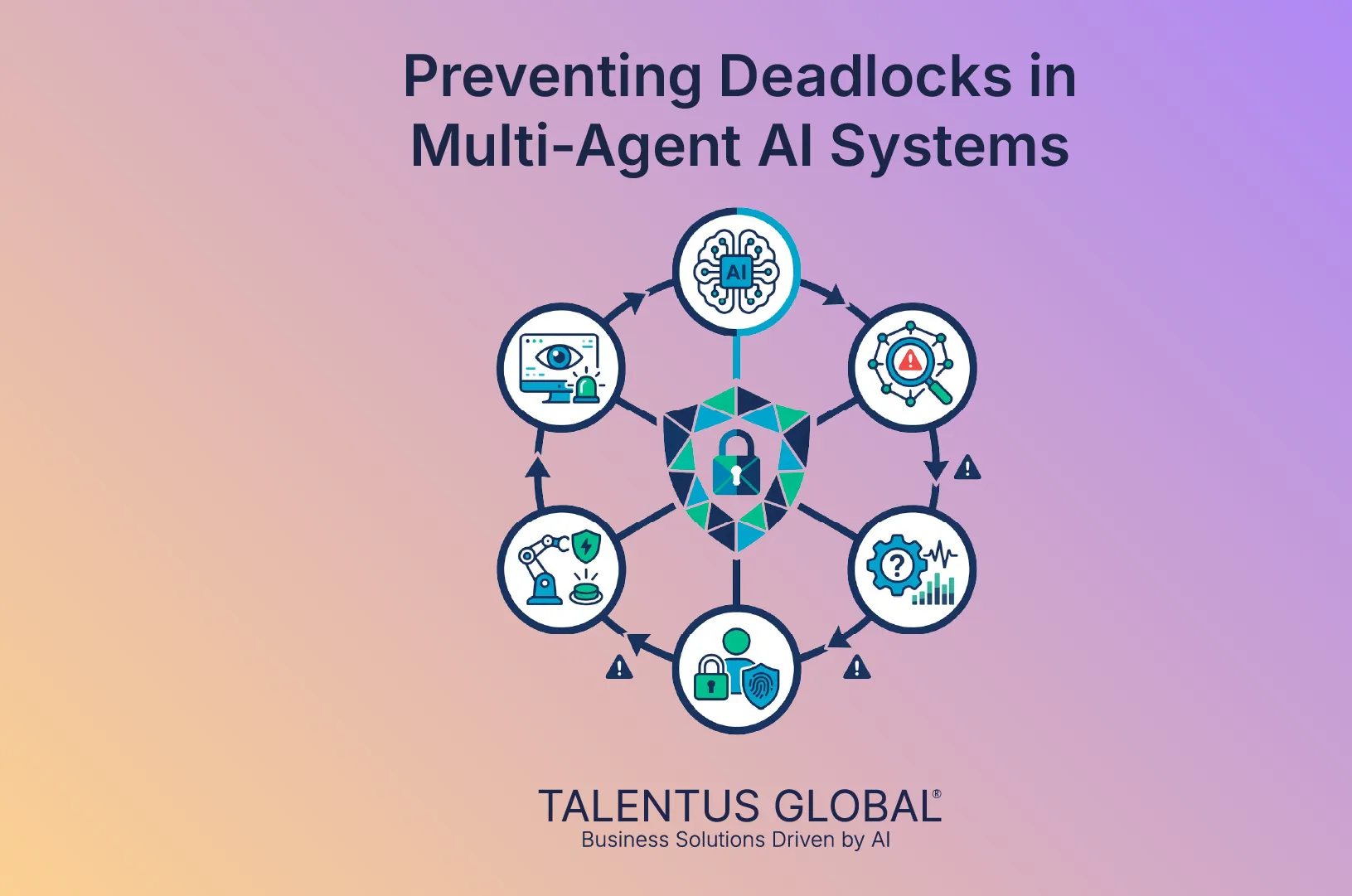
However, as agent swarms increase in complexity, unmanaged inter-agent communication introduces a severe structural flaw: circular reasoning deadlocks.
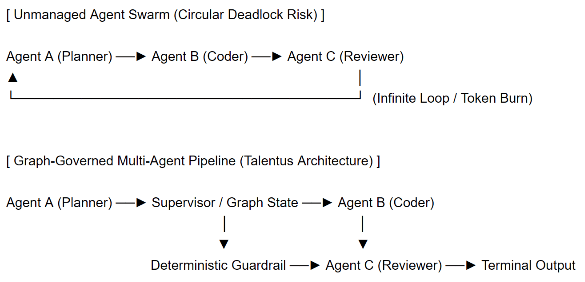
When Agent A delegates a task to Agent B, who queries Agent C, who then passes conflicting feedback back to Agent A, the system enters an infinite loop. Left unchecked, circular delegation burns millions of tokens, spikes latency, and locks up background pipelines.
Preventing multi-agent deadlocks requires moving from free-form, ad-hoc agent delegation to deterministic, graph-governed orchestration frameworks.
The High Cost of Unmonitored Agent Swarm Deadlocks
Deploying autonomous agent networks without deterministic cycle controls creates major operational vulnerabilities:
- Exponential API Cost Spikes: A single multi-agent infinite loop can execute hundreds of LLM calls in minutes, consuming millions of input/output tokens before hitting timeout limits.
- Cascading Service Outages: Unresolved agent deadlocks tie up cloud infrastructure resources, causing upstream queue backing and system-wide latency degradation.
- State Drift & Output Corruption: In cyclic loops, agents continually re-parse and modify shared memory state, corrupting context and degrading the final output quality.
Free-Form Agent Swarms vs. Graph-Governed Orchestration
Transitioning from ad-hoc agent loops to deterministic state machines brings true software engineering control to multi-agent AI systems:
3 Pillars of Deadlock-Free Multi-Agent Architecture
Eliminating circular reasoning in complex AI systems relies on three core engineering practices:
1. Directed Acyclic Graph (DAG) State Enforcement
Replace open-ended agent communications with structured state machines using frameworks like LangGraph or AutoGen. Express agent interactions as explicit nodes and conditional edges within a DAG structure, ensuring execution flows forward toward a clear termination state rather than looping indefinitely.
2. Recursion Limits & Cycle Detection Guardrails
Implement real-time graph traversal monitoring. Set strict execution depth limits on conditional edges and enforce semantic similarity checks across sequential agent outputs. If two agents exchange near-identical feedback loops more than twice, middleware automatically breaks the cycle.
3. Supervisor Arbitration & Deterministic Fallbacks
Deploy a dedicated Supervisor Agent or rule-based arbiter node. When cyclic feedback is detected, control redirects to the supervisor to evaluate the impasse, select the best candidate output, or terminate execution with a structured error log rather than continuing to consume API tokens.
Scale Your AI Agent Infrastructure with Talentus Global
Architecting deadlock-free multi-agent swarms, custom state graphs, and production LLMOps middleware requires senior MLOps engineers, cloud specialists, and full-stack AI developers.
Talentus Global provides dedicated nearshore LATAM software engineering pods to design, build, and deploy your enterprise AI agent pipelines.
For over 30 years, Talentus Global has been a trusted technical partner in enterprise software engineering, cloud architecture, and production AI development. Our nearshore LATAM engineering teams specialize in multi-agent orchestration, LangGraph architecture, vector storage, and production MLOps middleware.
Operating 100% synchronously in your US timezone (EST/CST), our pre-vetted LATAM engineering pods deploy in as little as 48 hours to accelerate your AI engineering roadmap without timezone or communication friction.
- 100% US Timezone Alignment: Collaborate synchronously with senior MLOps developers during standard EST/CST working hours.
- Deploy in 48 Hours: Bypass domestic hiring bottlenecks and scale specialized AI pods immediately.
- 95% Developer Retention Rate: Retain deep architectural knowledge and codebase stability across long-term AI initiatives.
Eliminate multi-agent deadlocks and build resilient AI systems. Partner with Talentus Global today clicking here.