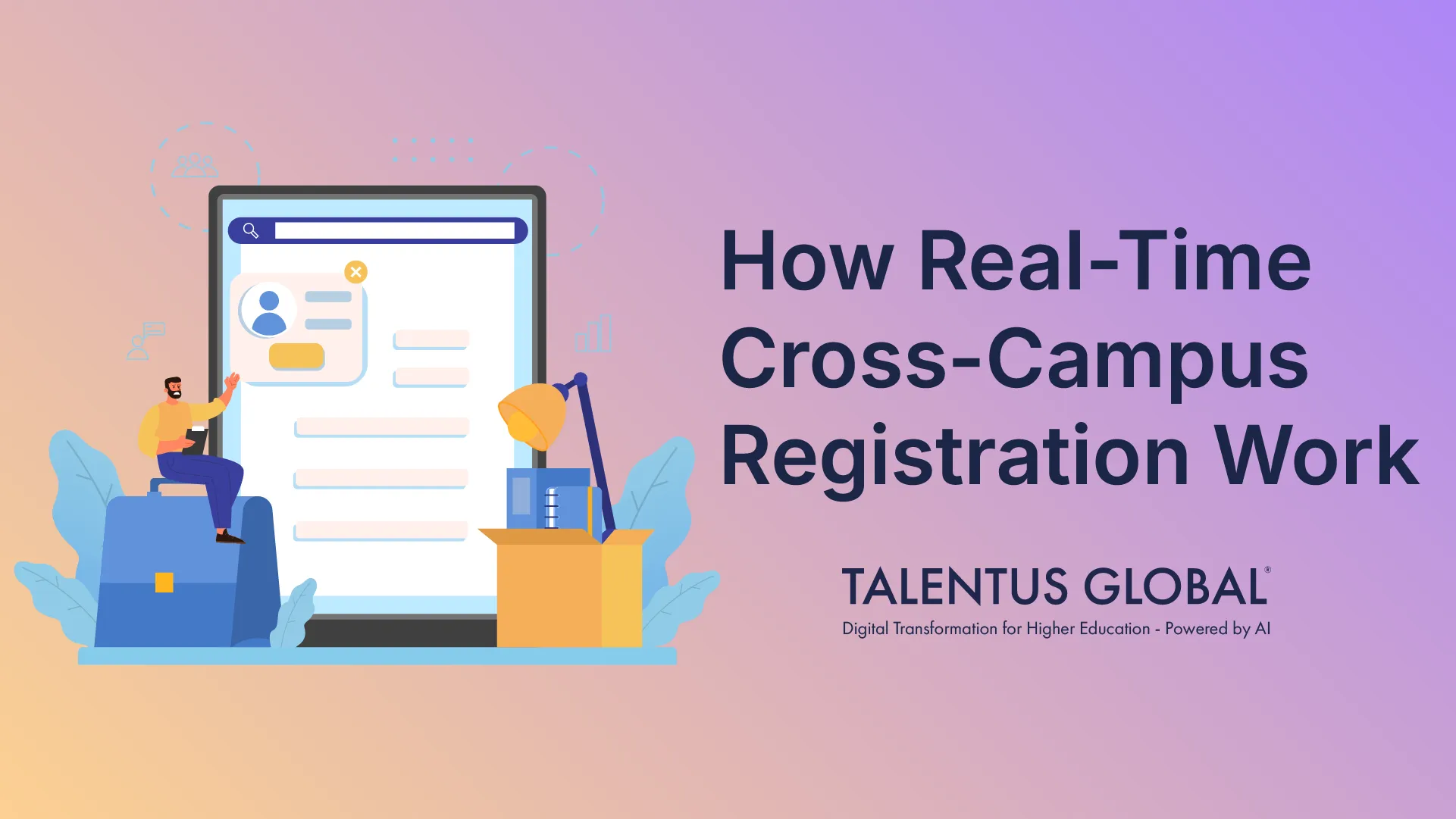
Higher education consortiums and multi-campus systems face a major enrollment barrier: cross-institutional course registration.
When students attempt to take courses at partner institutions to complete degree requirements, legacy workflows rely on manual paper forms, email approvals, and nightly batch file syncs.
When cross-campus registration lacks real-time synchronization, seat availability updates stall, prerequisites fail to validate instantly, and student progress halts. Modernizing consortium course sharing requires shifting to real-time, event-driven API integration layers that sync seat capacity, student records, and financial ledger data instantly across distinct Student Information Systems (SIS) like Thesis Elements.
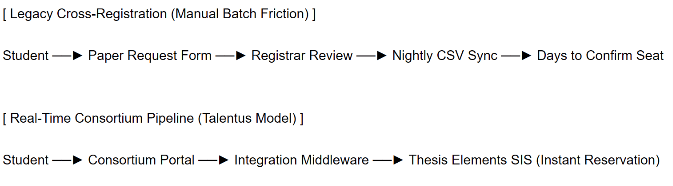
The High Friction of Legacy Cross-Registration
Operating cross-campus enrollment via legacy systems introduces critical administrative and academic roadblocks:
- Seat Hoarding and Double Booking: Delayed capacity updates mean students register for filled classes or get turned away from open seats due to stale catalog data.
- Prerequisite and Compliance Gaps: Academic advisors must manually cross-reference transfer equivalencies and course prerequisites across different campus catalogs, delaying approvals by days or weeks.
- Financial Aid and Billing Mismatches: Tuition allocation, credit-hour counts, and financial aid disbursements become administrative headaches when student course loads are split across separate billing systems.
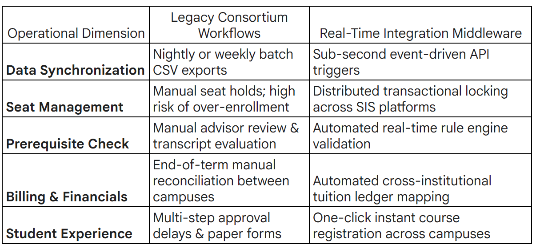
Legacy Consortium Workflows vs. Real-Time Integration Middleware
Upgrading cross-campus registration infrastructure transforms multi-college course sharing into a frictionless student experience:
3 Pillars of Real-Time Cross-Campus Registration
Constructing a scalable, multi-college course-sharing engine requires three core technical components:
1. Interoperable API Abstraction Layer
Build an API-first middleware layer that bridges disparate campus architectures. Whether partner institutions use Thesis Elements SIS, Ellucian, or custom databases, unified GraphQL/REST endpoints allow systems to communicate instantly without altering core legacy databases.
2. Distributed Transactional Seat Locking
Prevent double-booking and seat capacity errors. Implement distributed locking mechanisms that hold class seats in real time while verifying student eligibility, prerequisite completion, and cross-campus credit caps.
3. Automated Transcript and Financial Ledger Sync
Streamline post-registration workflows. Automate credit-hour reporting and tuition transfer rules directly between central finance systems, while triggering automated grade transfer to the student's home institution upon course completion.
Build Your Consortium Infrastructure with Talentus Global
Scaling multi-college course sharing and real-time SIS integration requires senior EdTech data engineers, API middleware architects, and deep Higher Ed domain expertise.
Talentus Global provides dedicated nearshore LATAM software engineering pods to build, integrate, and scale your cross-campus registration systems.
For over 30 years, Talentus Global has been a trusted technical partner in enterprise software engineering and Higher Ed digital transformation. Our nearshore LATAM developers specialize in SIS integrations (Thesis Elements, Ellucian, Canvas LMS), real-time API middleware, event streaming, and secure data architecture.
Operating 100% synchronously in your US timezone (EST/CST), our pre-vetted LATAM engineering pods deploy in as little as 48 hours to streamline your consortium technology without domestic recruitment friction.
- 100% US Timezone Alignment: Collaborate synchronously with senior engineers during standard EST/CST working hours.
- Deploy in 48 Hours: Bypass domestic hiring bottlenecks and launch specialized integration pods immediately.
- 95% Developer Retention Rate: Preserve deep institutional knowledge and codebase stability across long-term initiatives.
Enable seamless cross-campus registration. See our solutions clicking here