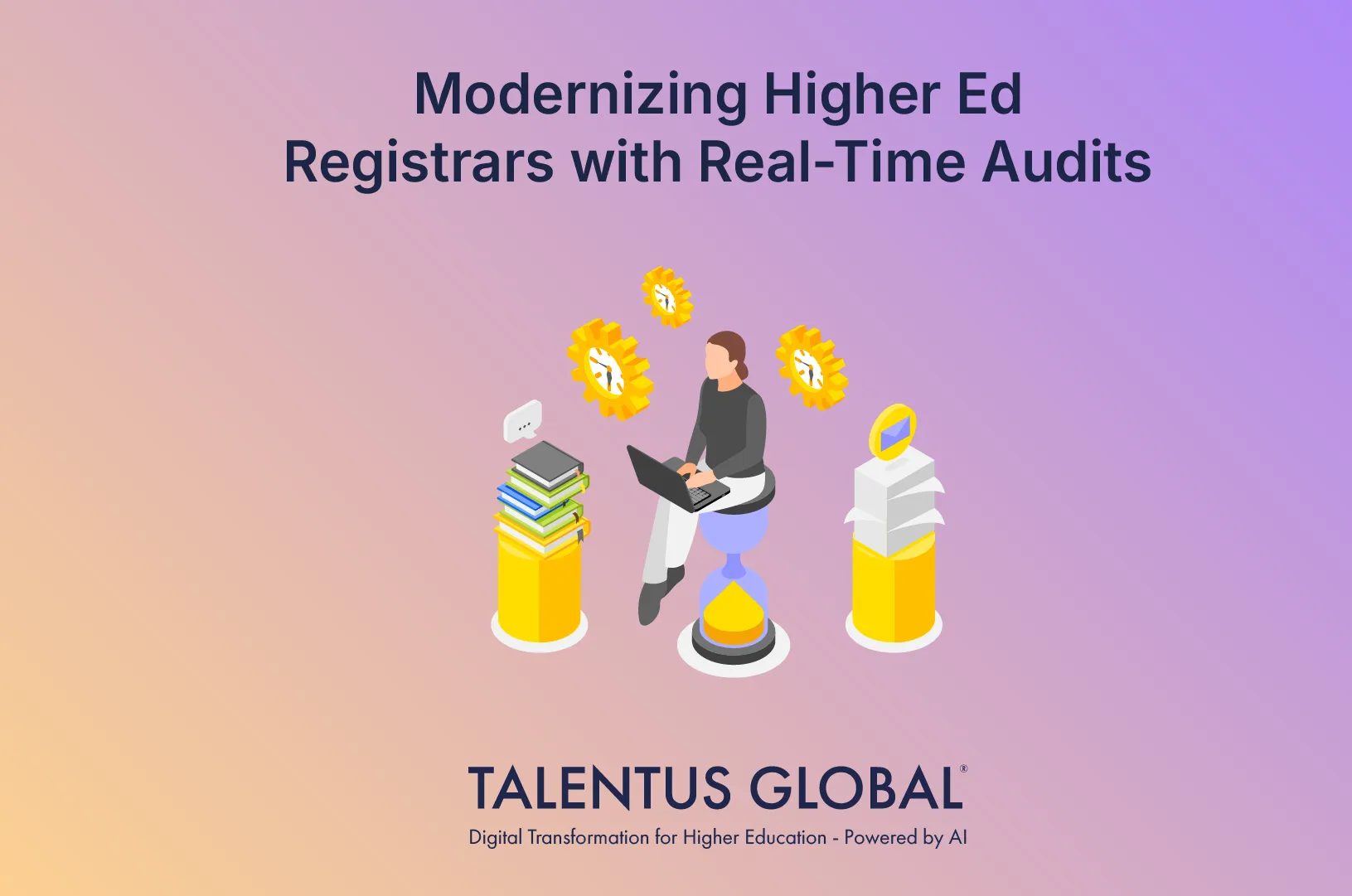
For higher education registrars and academic advisors, graduation clearance is traditionally one of the most labor-intensive periods of the academic calendar.
Evaluating degree completion across multi-college requirements, major tracks, electives, and transfer credits often relies on batch processing jobs and manual transcript re-evaluations.
When degree audit engines operate on stale, batch-updated data, students face delayed graduation approvals, unexpected prerequisite roadblocks, and excess credit hour accumulation.
Modernizing registrar operations requires shifting from retrospective batch audits to real-time, event-driven degree audit engine integrations. By pairing core Student Information Systems (SIS), such as Thesis Elements, with real-time evaluation engines, higher ed institutions deliver instant degree progress visibility, automate transfer credit mapping, and streamline graduation clearance.
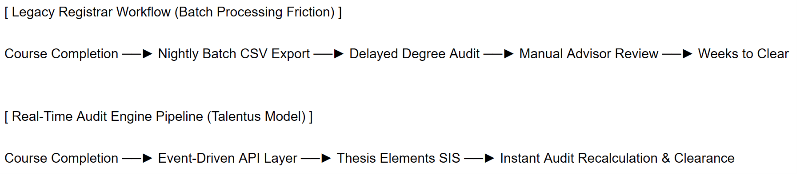
The Operational Strain of Batch-Processed Degree Audits
Relying on legacy batch processing for degree evaluation introduces severe administrative and academic roadblocks:
- Graduation Clearance Bottlenecks: Manual audit reviews force registrars to inspect thousands of student records individually, leading to delayed diploma issuing and post-graduation reporting errors.
- Advising Friction & Excess Credits: When degree progress reports lag behind completed coursework, advisors and students lack real-time visibility into remaining requirements, frequently leading to unnecessary course enrollment.
- Transfer Credit Delays: Processing transfer transcripts manually creates multi-week backlogs during peak enrollment, preventing incoming students from registering for appropriate upper-level requirements on time.
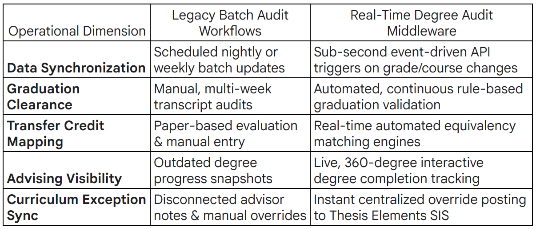
Legacy Batch Audits vs. Real-Time Degree Audit Middleware
Integrating real-time evaluation engines directly into central campus systems transforms academic advising and registrar workflows:
3 Pillars of Real-Time Degree Audit Engine Integration
Constructing an enterprise-grade degree evaluation architecture requires three core technical pillars:
1. Event-Driven Middleware & Real-Time SIS Sync
Establish an asynchronous API middleware layer that listens for grade postings, course drops, and substitution approvals within Thesis Elements SIS. Instantly trigger recalculation events across the degree audit engine to reflect updated completion percentages without waiting for off-peak batch windows.
2. Automated Transfer Credit Equivalency Engines
Deploy automated equivalency rules engines that process incoming transfer course data against institutional articulation tables. Automatically map transferred credits directly into the student's degree audit tree, flagging unmapped courses for expedited advisor review.
3. Dynamic Rule Engines & Curricular Exception Pipelines
Decouple degree requirement logic from legacy database schemas. Use centralized policy engines to evaluate major/minor requirements, catalog year rules, and custom advisor overrides dynamically—ensuring accurate evaluation even as degree plans evolve.
Modernize Your Registrar Architecture with Talentus Global
Building real-time degree audit pipelines, automated transfer engines, and enterprise SIS integrations requires senior EdTech data architects, API integration developers, and deep Higher Ed domain expertise.
Talentus Global provides dedicated nearshore LATAM software engineering pods to design, integrate, and scale your university registrar systems.
For over 30 years, Talentus Global has been a trusted technical partner in enterprise software engineering and Higher Ed digital transformation. Our nearshore LATAM developers specialize in SIS integrations (Thesis Elements, Ellucian, etc), real-time API middleware, event-driven data streaming, and degree audit engine integrations.
- Operating 100% synchronously in your US timezone (EST/CST), our pre-vetted LATAM engineering pods deploy in as little as 48 hours to accelerate your registrar modernization roadmap without domestic recruitment friction.
- 100% US Timezone Alignment: Collaborate synchronously with senior developers during standard EST/CST working hours.
- Deploy in 48 Hours: Bypass domestic hiring bottlenecks and launch specialized EdTech engineering pods immediately.
- 95% Developer Retention Rate: Retain deep institutional knowledge and codebase stability across multi-year modernization initiatives.
Streamline graduation clearance and degree audit pipelines. Explore Talentus Global EdTech Connectors here today.