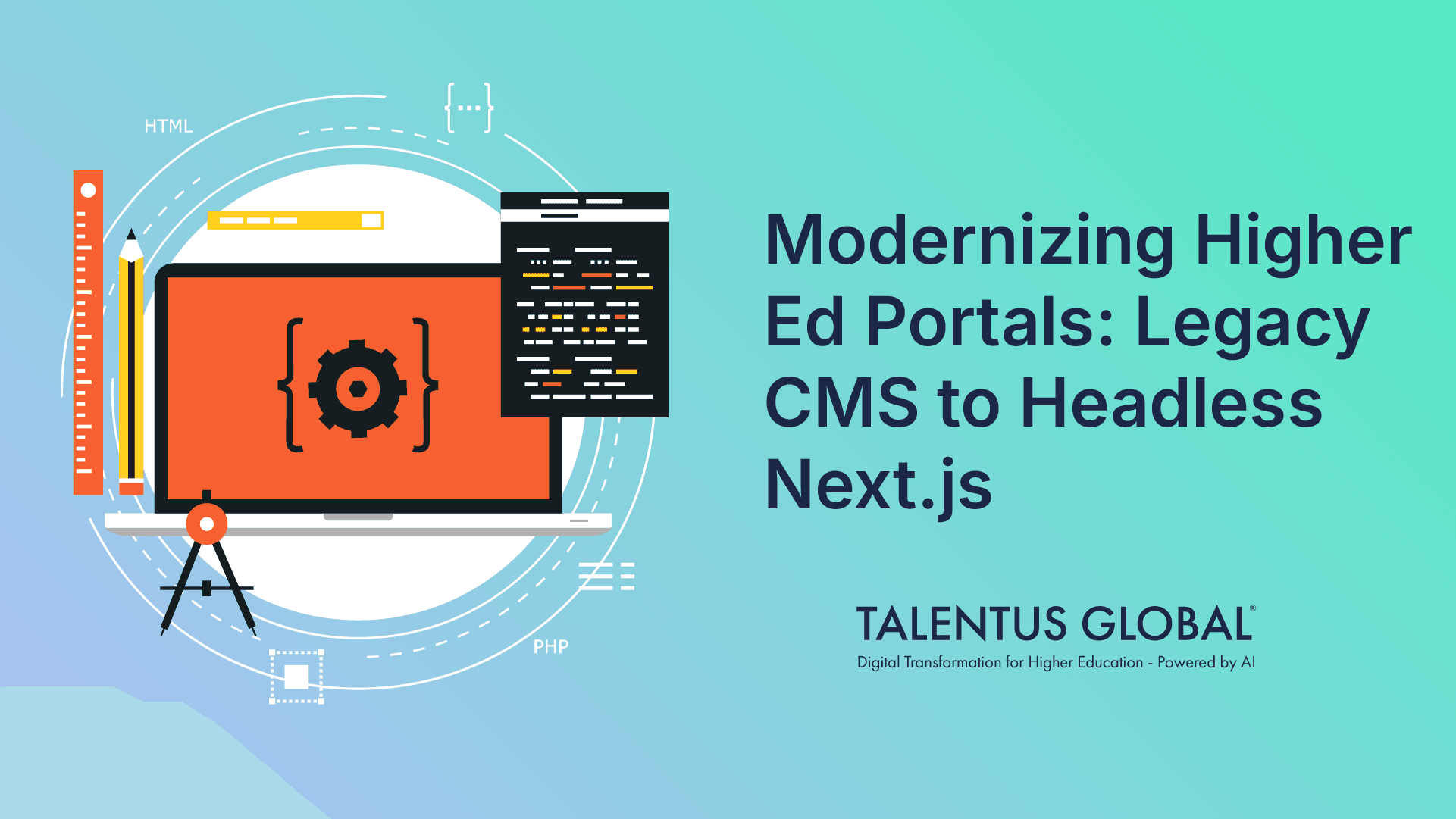
Legacy monolithic campus websites suffer from slow speeds, mobile friction, and accessibility flaws, driving away prospective students before admissions can connect.
To improve student recruitment, boost Core Web Vitals, and guarantee strict WCAG 2.1 Level AA compliance, progressive higher education technology leaders are abandoning monolithic architectures in favor of Decoupled Headless Next.js Frameworks.
By pairing Next.js on the frontend with a modern headless content layer and EdTech Connectors, institutions deliver sub-second, accessible web portals seamlessly integrated with Canvas LMS, Element451 CRM, and Thesis Elements SIS.
The High Cost of Legacy Campus Web Monoliths
Relying on traditional monolithic enterprise CMS platforms creates significant operational friction for marketing, IT, and admissions teams:
Poor Mobile Core Web Vitals: Heavy, server-rendered pages loaded with legacy plugins result in high Largest Contentful Paint (LCP) times and poor First Input Delay (FID), directly suppressing organic search rankings.
Accessibility and Compliance Liabilities: Federal accessibility mandates require strict adherence to WCAG standards. Legacy monolithic templates frequently break semantic HTML structures, exposing institutions to legal scrutiny.
Disconnected Lead Capture: Inquiry forms embedded on legacy sites often rely on nightly batch synchronization to push prospective student leads into Element451 CRM or Thesis Elements SIS, stalling admissions follow-up.
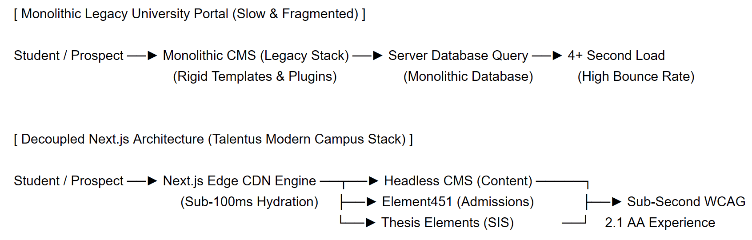
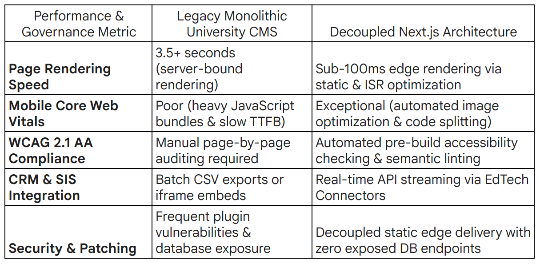
Legacy Monolithic CMS vs. Decoupled Next.js Architecture
Upgrading your web infrastructure to a modern React-based static and server-rendered model transforms your web portal into a high-converting digital campus asset:
3 Pillars of Higher Ed Web Modernization
Transitioning to a high-velocity, accessible campus portal requires three core architectural strategies:
1. Edge-Delivered Next.js with Incremental Static Regeneration (ISR)
Utilize Next.js to pre-render static HTML pages at the edge while employing Incremental Static Regeneration (ISR). This allows marketing teams to publish real-time content updates from their headless CMS without triggering full site rebuilds or sacrificing sub-second page performance.
2. Built-in WCAG 2.1 AA Accessibility Guardrails
Establish automated accessibility linting directly inside your continuous integration (CI/CD) deployment pipeline. By enforcing semantic HTML, ARIA labels, keyboard navigation, and contrast standards at the code level, developers ensure that every published component complies with federal accessibility guidelines before hitting production.
3. Native Integration via EdTech Connectors
Eliminate generic iframe forms and broken lead capture scripts. Utilizing EdTech Connectors links Next.js frontend forms directly to Element451 CRM for instant lead routing and Thesis Elements SIS for real-time application tracking, delivering a frictionless prospective student experience.
Modernize Your Digital Campus with Talentus Global
Upgrading legacy university web platforms and constructing decoupled Next.js architectures requires specialized frontend engineering, cloud infrastructure expertise, and deep Higher Ed domain knowledge.
Talentus Global provides dedicated nearshore LATAM software engineering pods to build, modernize, and scale your campus web infrastructure.
For over 30 years, Talentus Global has been a trusted leader in enterprise digital transformation and Higher Ed system engineering. Our nearshore LATAM developers specialize in Next.js frontend engineering, headless CMS integrations (Contentful, Sanity, Strapi), web accessibility compliance (WCAG 2.1 AA), and seamless API connections across Canvas, Element451, Thesis Elements, and Banner.
- Operating 100% synchronously in your US timezone (EST/CST), our pre-vetted LATAM engineering pods deploy in as little as 48 hours to accelerate your web modernization roadmap.
- 100% US Timezone Alignment: Collaborate synchronously with senior engineers during standard EST/CST working hours.
- Deploy in 48 Hours: Bypass domestic recruiting delays and scale specialized engineering capacity immediately.
- 95% Developer Retention Rate: Protect institutional knowledge and preserve codebase quality across long-term initiatives.
Transform your digital campus experience. Partner with Talentus Global today clicking here