As market dynamics evolve, user behaviors shift, and upstream data schemas change, the statistical distribution of live input data drifts away from the baselines used during model training.
When model performance silently degrades, algorithms produce inaccurate predictions, flawed risk assessments, and corrupted automated decisions. Detecting and mitigating model drift requires shifting from retrospective, periodic batch evaluations to continuous, real-time performance telemetry.
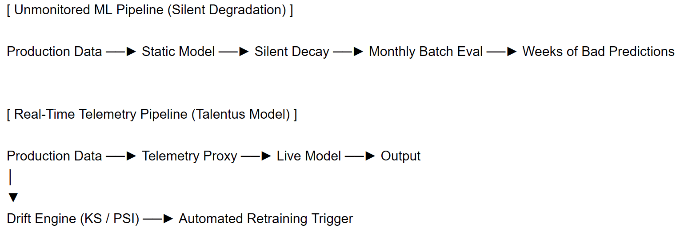
The High Cost of Silent Model Decay
Deploying production AI without real-time observability creates severe operational and financial vulnerabilities across enterprise workflows:
- Data Drift: Changes in incoming feature distributions, caused by seasonal shifts, hardware changes, or modified upstream data pipelines, invalidate model assumptions without throwing explicit code errors.
- Concept Drift: Changes in the mathematical relationship between input features and target variables render historical predictions inaccurate even when input distributions appear normal.
- Delayed Incident Response: Relying on scheduled weekly or monthly batch evaluations allows degraded models to run unmonitored for weeks, driving bad business decisions and corrupting downstream analytics.
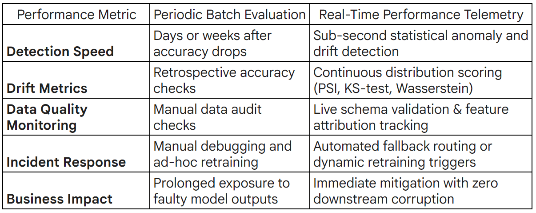
Periodic Batch Evaluation vs. Real-Time Performance Telemetry
Upgrading your MLOps architecture establishes proactive, real-time boundary controls across all production inference endpoints:
3 Pillars of Real-Time AI Telemetry
Building a resilient, self-correcting MLOps telemetry infrastructure relies on three core technical pillars:
1. Statistical Distribution & Covariate Shift Tracking
Monitor incoming feature vectors against training baseline distributions in real time. Deploy low-latency drift detection algorithms—such as Kolmogorov-Smirnov (KS) tests, Population Stability Index (PSI), and Wasserstein distance, at the API proxy layer to detect statistical drift before it degrades outputs.
2. High-Dimensional Vector & Concept Drift Observability
Track semantic drift in complex deep learning and LLM architectures. By evaluating embedding distance metrics, vector density shifts, and confidence score decay across production inferences, MLOps teams catch subtle concept drift that simple schema validators miss.
3. Closed-Loop Retraining & Automated Fallback Routing
Connect telemetry alerts directly to automated orchestration pipelines. When feature drift or prediction confidence breaches defined thresholds, the telemetry proxy automatically routes traffic to a stable fallback model while triggering an automated retraining and validation pipeline in the background.
Secure Your Enterprise AI Stack with Talentus Global
Building real-time MLOps telemetry pipelines, drift monitoring engines, and cloud AI architecture requires senior data engineers, MLOps specialists, and disciplined software architects.
Talentus Global provides dedicated nearshore LATAM software engineering pods to build, observe, and scale your production AI systems.
For over 30 years, Talentus Global has been a trusted technical partner in enterprise software engineering, cloud architecture, and MLOps modernization. Our nearshore LATAM developers specialize in real-time telemetry pipelines, feature store architecture, vector database observability, and automated model retraining frameworks.
- Operating 100% synchronously in your US timezone (EST/CST), our pre-vetted LATAM engineering pods deploy in as little as 48 hours to accelerate your AI observability and cloud roadmaps without domestic hiring friction.
- 100% US Timezone Alignment: Collaborate synchronously with senior developers during standard EST/CST working hours.
- Deploy in 48 Hours: Bypass domestic recruitment delays and launch specialized MLOps engineering pods immediately.
- 95% Developer Retention Rate: Retain deep institutional context and codebase stability across long-term AI initiatives.
Mitigate model drift and safeguard your production AI. Partner with Talentus Global AI clicking here today.