Every semester during the drop/add period, a familiar operational crisis plays out inside university finance departments.
Thousands of students add lab-intensive courses, drop specialized electives, or purchase digital course materials embedded directly within the Learning Management System (LMS) like Canvas or Blackboard. Meanwhile, the bursar and finance teams are tasked with ensuring every course fee, material surcharge, and tuition adjustment accurately reflects inside the Enterprise Resource Planning (ERP) platform, such as Workday, Banner, or SAP.
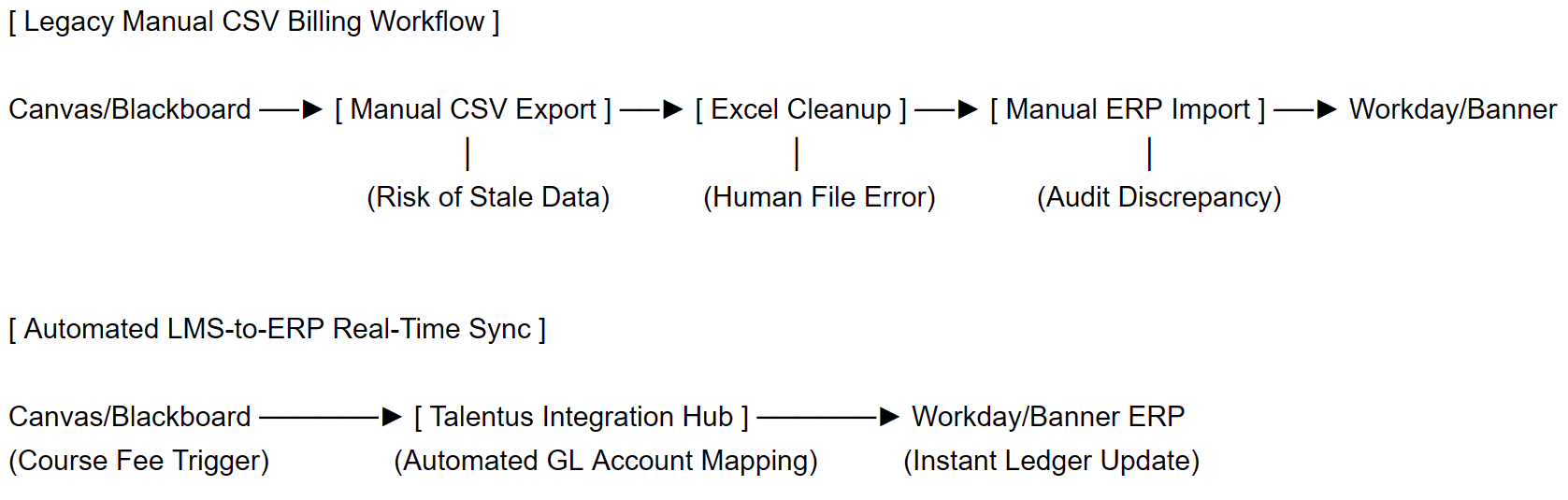
In surprisingly many institutions, the bridge between academic engagement and financial accounting relies on manual CSV exports and spreadsheets.
A financial administrator exports a massive .csv file from the LMS, cleans the columns manually in Excel, cross-references student IDs against the registrar's database, and uploads the formatted file into the ERP.
This manual bottleneck creates compliance vulnerabilities, delays financial aid disbursements, and burns hundreds of administrative hours every academic term. To establish financial integrity, higher education institutions must automate LMS-to-ERP synchronization through event-driven middleware.
The Heavy Cost of Spreadsheet Juggling in Campus Finance
Relying on manual file transfers between academic systems and financial ledgers exposes institutions to operational risks that extend far beyond administrative fatigue.
The major vulnerabilities of manual financial exports include:
- Human Data Corruption: Manually altering spreadsheet columns, stripping leading zeros from student ID numbers, or misaligning General Ledger (GL) account codes leads to billing inaccuracies and unapplied student payments.
- Audit Failures and Compliance Risks: Federal financial aid guidelines (including Title IV regulations) and GAAP accounting standards demand clear, traceable audit trails. Spreadsheets passed between local desktop drives lack immutable access logging and version control.
- Delayed Financial Aid & Refund Processing: When course fee adjustments take days or weeks to process manually, student accounts remain locked in pending status, delaying financial aid disbursements and generating unnecessary student support tickets.
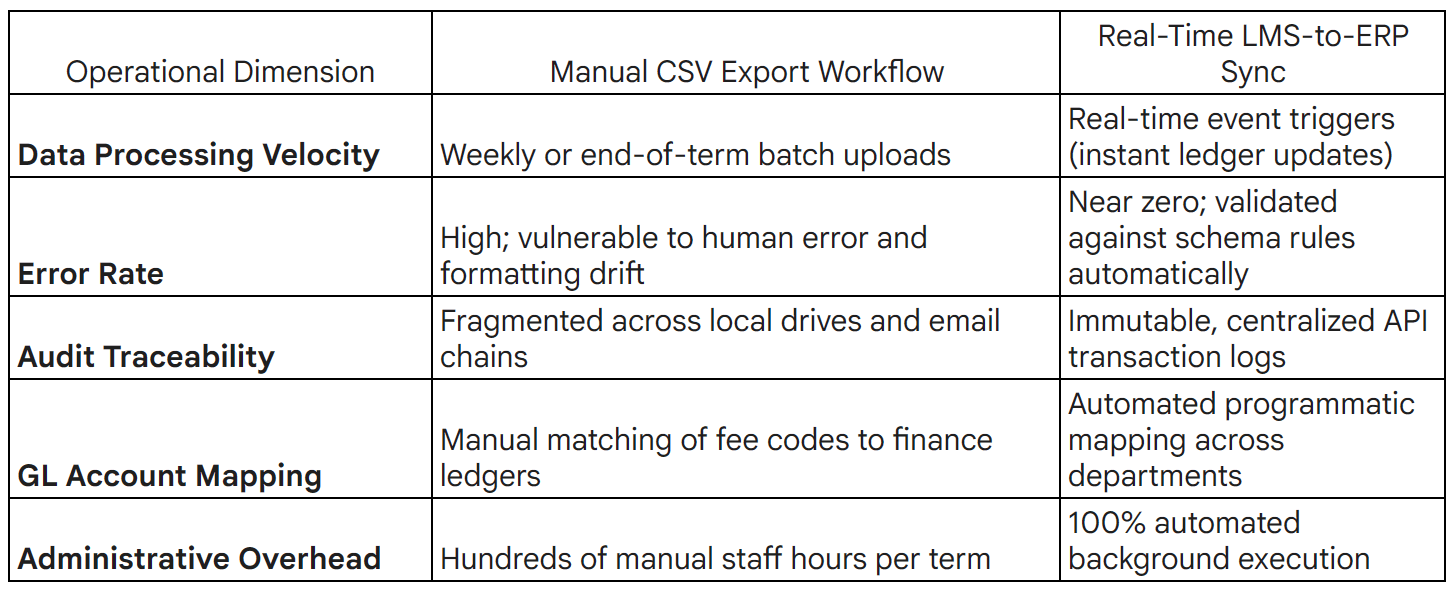
Manual CSV Exports vs. Real-Time LMS-to-ERP Synchronization
Automating the data pipeline between your academic LMS and financial ERP converts batch-processed guesswork into continuous operational precision.
Building an Event-Driven Financial Integration Pipeline
Modernizing your campus finance architecture requires moving away from scheduled file transfers to an event-driven integration framework.
When a student enrolls in a course with an associated lab or software fee inside Canvas or Blackboard:
- Webhook Trigger: The LMS immediately emits a secure webhook payload containing the student ID, course code, and fee itemization.
- Middleware Transformation: An enterprise middleware layer (or pre-engineered EdTech Connector) ingests the payload, validates student enrollment status against the SIS, and maps the fee to the correct General Ledger (GL) account code.
- ERP Ledger Posting: The fee posts automatically to the student's account inside Workday, Banner, or PeopleSoft—updating their balance in real time and triggering exact billing notifications.
- Dead-Letter Queues: If the destination ERP experiences a temporary service disruption, the payload enters an encrypted retry queue, guaranteeing zero dropped financial transactions.
Automate Your Campus Infrastructure with Talentus Global
Eliminating manual CSV workflows requires specialized integration bandwidth that internal IT teams, already stretched thin by daily campus support, rarely have time to build from scratch.
Talentus Global provides the architectural muscle to modernize your university data pipelines.
For over 30 years, Talentus Global has helped higher education institutions and EdTech enterprises eliminate technical debt and build resilient digital ecosystems. Through our pre-vetted nearshore LATAM software engineering pods, we deliver dedicated integration teams proficient in API management, middleware modernization, and Higher Ed system architectures.
- 100% Timezone Synchronization: Our LATAM engineering pods work in your exact US hours (EST/CST), attending standups and integrating seamlessly into your repository workflows.
- Zero Recruitment Friction: Bypass domestic 60-day hiring delays and deploy pre-vetted integration developers in days.
- Institutional Memory: Maintain long-term project continuity with our industry-leading 95% developer retention rate.
Stop letting manual spreadsheets disrupt your university's financial operations. Eliminate manual CSV exports and automate your LMS-to-ERP pipelines with Talentus Global today by clicking here