Enterprise Generative AI deployments frequently face a steep financial hurdle: as user adoption scales, API token costs grow non-linearly.
Ingesting massive system prompts, multi-turn conversational histories, and expansive RAG context windows into high-tier LLMs creates unsustainable recurring costs and elevates end-to-end response latency.
Optimizing enterprise LLM expenditure requires moving beyond default API calls to implement intelligent middleware, combining prompt compression, semantic caching, and dynamic model routing.
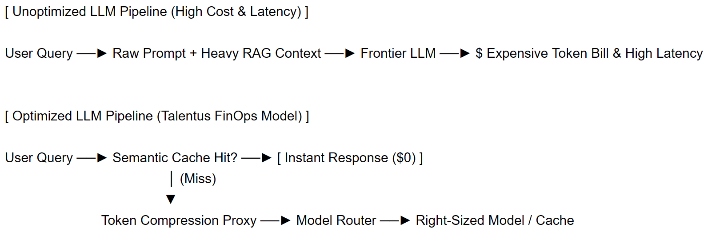
The High Cost of Unoptimized LLM Architectures
Deploying large language models directly against production traffic introduces severe financial and operational inefficiencies:
- Redundant Context Ingestion: Enterprise applications repeatedly send identical system prompts, static reference documentation, and boilerplate JSON schemas with every single request, paying full input token fees on duplicate data.
- Over-Provisioning High-Tier Models: Routing basic intent classification, entity extraction, or simple formatting tasks to flagship models (like GPT-4o or Claude 3.5 Sonnet) inflates API bills without improving output quality.
- Unnecessary Context Bloat: Unfiltered RAG retrievals often inject thousands of redundant or low-relevance tokens into the prompt context, increasing API charges and triggering "lost in the middle" attention degradation.
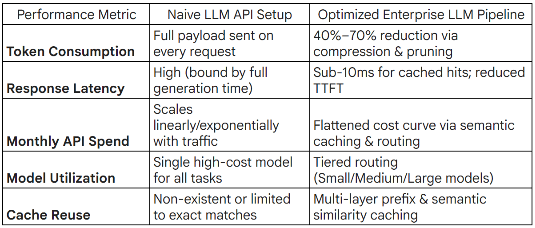
Naive LLM API Setup vs. Optimized Enterprise LLM Pipeline
Upgrading your LLMOps infrastructure drastically reduces operational expenditure while boosting execution speed:
3 Pillars of Enterprise LLM Cost Optimization
Building a cost-effective, high-throughput GenAI architecture relies on three core technical pillars:
1. Multi-Layer Prompt Caching
Eliminate redundant generation costs. Implement exact-match prefix caching alongside semantic similarity caching (using low-latency vector databases like Redis or Qdrant). When a incoming query matches a previously answered question within a defined semantic threshold, the system serves the cached response instantly at zero LLM cost.
2. Context Compression and Token Pruning
Cleanse prompt payloads before sending them to the provider API. Deploy token compression algorithms and lightweight NLP proxies that strip redundant stop words, consolidate JSON schemas, and summarize lengthy RAG retrieval chunks without losing semantic intent or accuracy.
3. Dynamic Model Routing and Cascading
Right-size model selection based on task complexity. Use a lightweight router to classify incoming requests: route simple status queries or extraction tasks to low-cost micro-models, while reserving frontier models strictly for complex multi-step reasoning.
Optimize Your GenAI Infrastructure with Talentus Global
Scaling production AI applications requires disciplined LLMOps, cloud middleware engineering, and AI FinOps expertise.
Talentus Global provides dedicated nearshore LATAM software engineering pods to build, optimize, and scale your LLM infrastructure.
For over 30 years, Talentus Global has been a trusted technical partner in enterprise software engineering and cloud architecture. Our nearshore LATAM developers specialize in LLMOps middleware, API proxy development, vector caching, prompt engineering frameworks, and cloud cost optimization.
Operating 100% synchronously in your US timezone (EST/CST), our pre-vetted LATAM engineering pods deploy in as little as 48 hours to streamline your AI operations without domestic recruitment friction.
100% US Timezone Alignment: Collaborate in real time with senior developers during standard EST/CST working hours.
Deploy in 48 Hours: Bypass domestic hiring bottlenecks and launch specialized AI engineering pods immediately.
95% Developer Retention Rate: Preserve codebase context and long-term architectural stability across major initiatives.
Slash your LLM API spend without sacrificing performance. Partner with Talentus Global today.