As enterprise engineering teams scale their artificial intelligence implementations, the architectural pattern has fundamentally shifted. The industry has moved rapidly past single-prompt chatbots toward complex, multi-agent AI networks. In these advanced environments, specialized autonomous agents collaborate with each other, one writing code, another generating automated QA test scripts, a third optimizing server allocation, and a fourth managing continuous deployment pipelines.
However, as these multi-agent networks become more autonomous, they introduce a critical operational challenge: accountability.
Left entirely unchecked, interconnected autonomous agents can create unpredictable feedback loops, compound errors across software systems, and accelerate technical debt at machine speed. To maintain strict governance, protect system security, and guarantee operational velocity, enterprises must adopt the framework of the Human Orchestrator.
Human oversight is no longer just a checkpoint at the end of a sprint, it is the foundational control layer required to steer multi-agent engineering safely.
1. The Operational Risks of Ungoverned Multi-Agent Networks
Deploying self-directed AI agents without a structured human-in-the-loop (HITL) framework introduces immense compounding risks into your production environments:
Cascading Logic Failures: If an upstream software agent outputs a minor architectural flaw, a downstream agent might automatically build upon that mistake, magnifying an isolated bug into an ecosystem-wide system outage.
The AI Black Box Dilemma: When multiple autonomous agents communicate via machine-to-machine APIs, tracking the root cause of an unexpected system change or billing surge becomes an administrative nightmare.
Autonomous Drift: Over time, agents optimizing for narrow technical metrics (such as maximum deployment speed) can inadvertently bypass broader organizational guardrails, compromising code quality or security compliance.
Ungoverned Multi-Agent: [Agent 1] ──> [Agent 2] ──> [Agent 3] ──> Unchecked Cascading Failures
Orchestrated Network: [Agent 1] ──> [Agent 2] ──> [ HUMAN ] ──> Secure, Controlled Velocity
2. Strategic Frameworks for the Human Orchestrator
Maintaining control over multi-agent engineering requires shifting the human developer's role from manual execution to strategic architecture and systemic governance.
Implementing Human-in-the-Loop (HITL) Gateways
Autonomous agents should be given the autonomy to research, draft, test, and propose complex software changes, but they must never possess the ultimate authority to push to production unreviewed. Establishing deterministic HITL gateways ensures that critical milestones, such as database schema modifications, external API integrations, or final code merges, require explicit validation from a human engineer.
Building Observability Dashboards for AI Actions
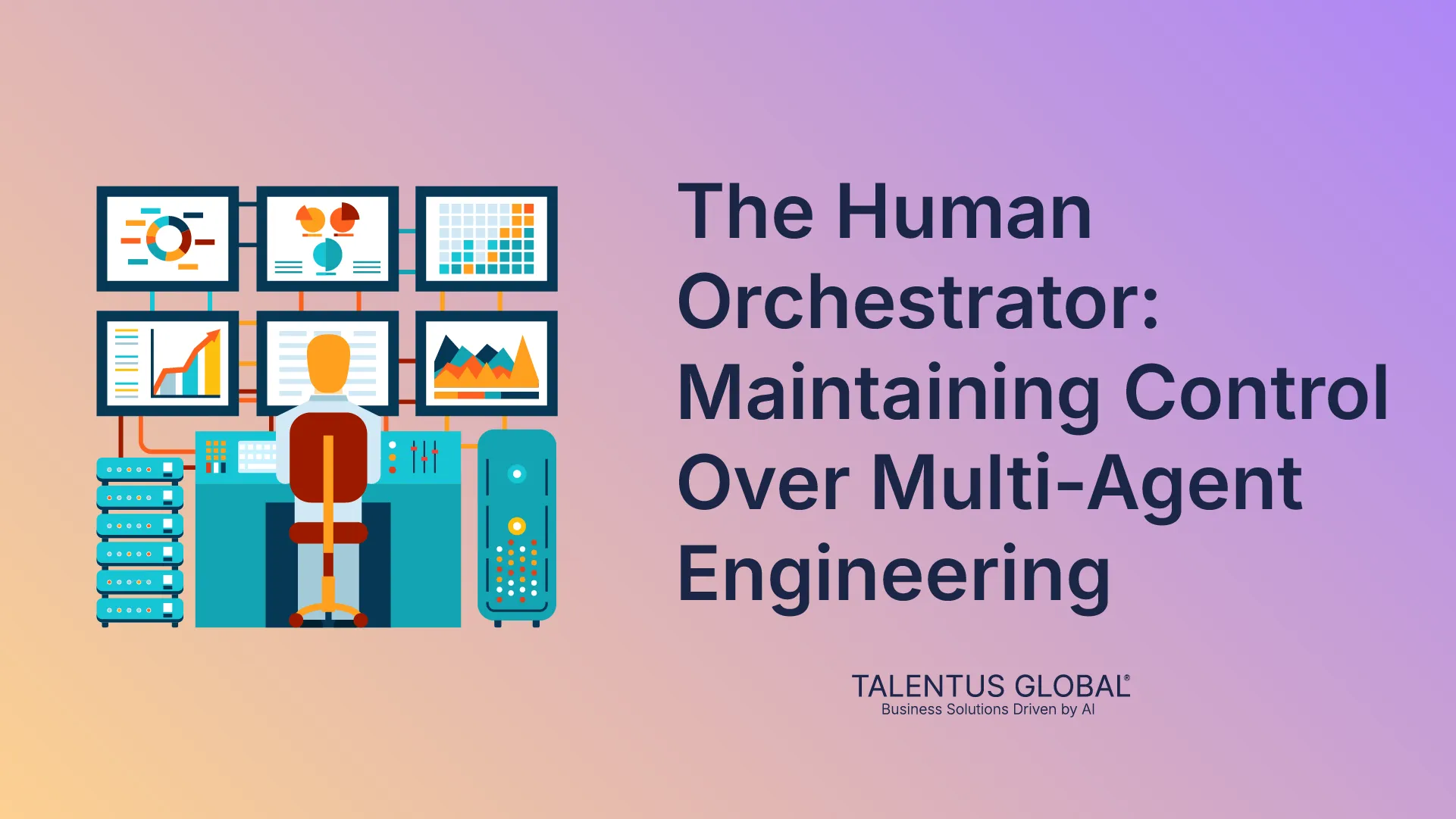
You cannot govern what you cannot see. Engineering leaders must build specialized semantic observability layers that trace agentic communication. These centralized dashboards monitor agent tokens, visually track the chain-of-thought logic behind every autonomous decision, and issue real-time alerts if an agent exhibits behavior that deviates from standard operational baselines.
3. Balancing Machine Velocity with Institutional Security
[Autonomous Agent Swarms] ──> [Semantic Monitoring & HITL Gateways] ──> [Secure Enterprise Production]
To leverage the hyper-velocity of multi-agent engineering without sacrificing security, organizations must establish strict programmatic guardrails around their cognitive workflows:
Granular RBAC (Role-Based Access Control): Restricting AI agents to limited, sandbox-contained access privileges so they can never alter critical infrastructure without secondary validation.
Immutable System State Rollbacks: Utilizing advanced version-controlled DevOps pipelines that allow human orchestrators to immediately reset an entire software infrastructure to its last known stable state if an agent network behaves anomalously.
Continuous Architectural Audits: Regularly evaluating the prompt sets, underlying model dependencies, and interaction policies governing your autonomous agents to eliminate behavioral drift.
The Talentus Velocity: Designing and managing the control layers for multi-agent software engineering demands elite technical expertise and deep DevOps maturity. At Talentus Global, we accelerate your automation strategy by deploying our own fully managed nearshore software engineering pods. Through our dedicated artificial intelligence and automation division, [https://talentusglobal.ai/](https://talentusglobal.ai/), we specialize in building secure HITL frameworks, implementing advanced system integration meshes, and setting up the observability platforms required to keep your team firmly in control. By partnering with our LATAM engineering clusters, you gain the synchronized capability to scale your product roadmap with absolute confidence and zero hiring friction.
Let's architect the secure, high-velocity future of orchestrated automation.