When scaling Generative AI features into enterprise production, engineering teams quickly run into two structural bottlenecks: unpredictable API bills and inconsistent latency.
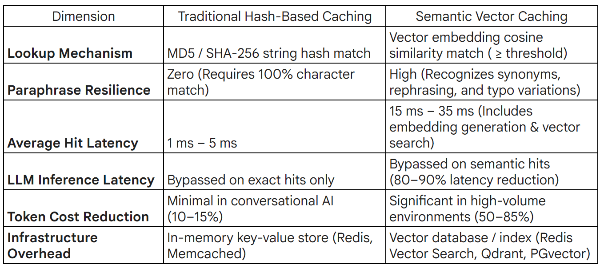
While traditional web caching relies on exact string hashing, user queries in AI applications are inherently messy and non-deterministic. A student asking "When is my tuition payment due?" triggers the exact same computational intent as "What's the deadline for paying my fees?" Standard cache key lookups fail completely on these semantic variations, sending duplicate queries to foundation models and incurring full token inference costs every time.
Semantic Caching bridges this gap by evaluating the intent of a request rather than its raw string literal. By converting incoming prompts into mathematical vector embeddings and running vector similarity checks against previously answered queries, applications can intercept repeated intent before it reaches the model provider.
Architectural Comparison: Traditional vs. Semantic Pipeline
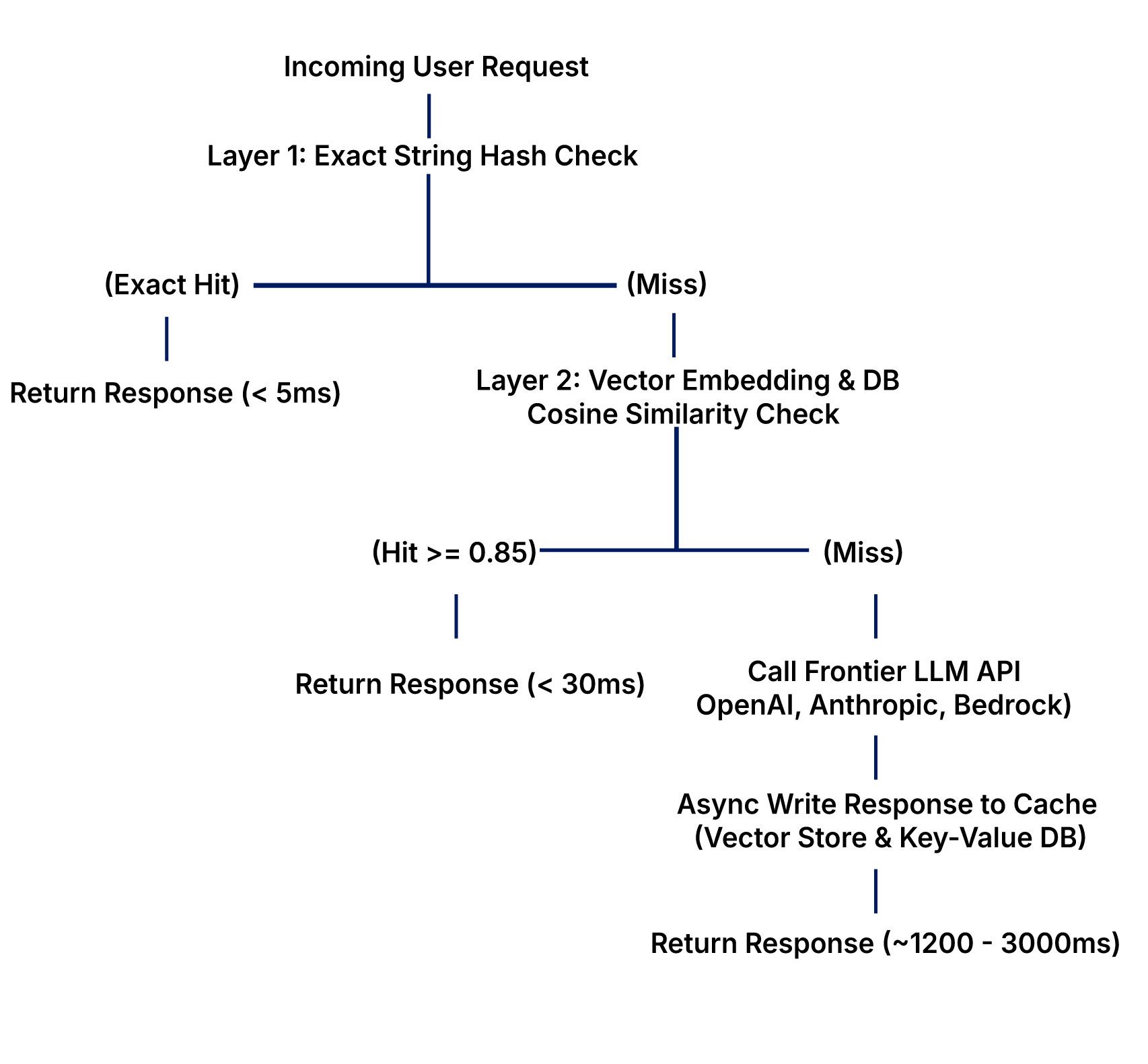
In high-traffic applications, a two-layer hybrid caching strategy delivers the optimal balance between speed, precision, and cost.
The 3 Pillars of a Production Semantic Caching Architecture
1. Vector Embeddings & Similarity Thresholding
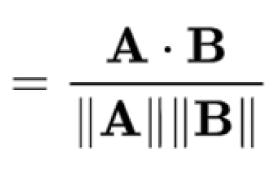
- Threshold Tuning: A threshold between 0.82 and 0.88 typically achieves the best balance between precision and recall. Values above 0.90 act almost like exact matching, while values below 0.78 risk serving false positives (returning answers to unrelated queries).
- Semantic Noise Reduction: Stripping out domain-specific filler words (e.g., "Hello," "Can you tell me," "Thanks") before generating embeddings prevents vector drift and isolates the core intent.
2. Multi-Layer Routing & Conversation Awareness
A single query layer is rarely sufficient for multi-tenant enterprise systems.
- Layer 1 (Exact Hash): Checks key-value memory for immediate string hits to bypass embedding overhead entirely for automated scripts and repeat queries.
- Layer 2 (Semantic Vector Match): Embeds the prompt and searches a vector index.
- Context Isolation: In multi-turn chat applications, caching must account for session state and prompt history. Inverting system prompts or tenant parameters into the cache metadata prevents cross-tenant data leakage or outdated contextual responses.
3. Eviction Policies & Data Freshness (TTL Strategy)
Cached LLM outputs can quickly become stale if underlying enterprise systems update.
- Volatile Data (30s – 15m TTL): Real-time transactional statuses, live scheduling, and financial updates.
- Static Data (24h – 30d TTL): Documentation, onboarding answers, institutional policies, and static course syllabi.
- Invalidation Hooks: Triggering cache purges via webhooks whenever record states change in core systems (such as updating enrollment records or user profiles) ensures data integrity without sacrificing speed.
Enterprise Application: Scaling High-Traffic Platforms
Consider an AI-powered student services assistant integrating across enterprise Higher Ed systems:
[ User Prompt ] ──► [ AI Gateway / Semantic Cache ]
                          ├── Thesis Elements (SIS) [Academic History]
                          ├── Canvas (LMS) [Course Material]
                          ├── Element451 / Salesforce (CRM) [Admissions]
                          └── PowerFAIDS (Financial Aid) [Aid Packages]
When 10,000 students log into their portal during finals week asking variations of "Where do I find my exam schedule?", standard architecture invokes 10,000 separate LLM calls, costing hundreds of dollars per hour and inducing latency spikes above 2 seconds.
By placing a semantic caching gateway in front of integrations connecting Thesis Elements (SIS), Canvas (LMS), and PowerFAIDS (Financial Aid), the application resolves up to 80% of repetitive inquiries locally in under 30 milliseconds. The underlying frontier model is called only when a genuinely novel or complex query occurs.
Build High-Performance AI Systems with Talentus Global
Optimizing AI latency and managing token budgets requires seasoned MLOps, vector database expertise, and tight cloud integration.
At Talentus Global, we engineer custom Generative AI middleware, high-throughput semantic caching layers, and scalable enterprise integrations.
Engineers Ready in 48 Hours: Scale your engineering capabilities immediately with dedicated LATAM tech talent.
- 100% EST/CST Synchronous Overlap: Real-time collaboration with zero timezone friction.
- 95% Retention Rate: Senior software developers and MLOps architects committed to long-term project success.
- 30+ Years of Combined Expertise: Deep experience building enterprise integrations across cloud platforms, data pipelines, and AI systems.
Ready to cut your LLM API spend and drop response latency? Contact Talentus Global today