As the third quarter of the academic and fiscal year comes to a close, higher education technology leaders are reflecting on a summer of intense technical execution.
Driven by regional university system mergers, shared services mandates, and the urgent need to optimize operational overhead, multi-campus system consolidation emerged as a dominant priority across IT departments in Q3.
Consolidating distinct university campuses, each possessing legacy tech debt, unique business logic, and independent software licenses, into a single, unified enterprise architecture is rarely just a software migration. It is an enterprise overhaul.
Looking back at Q3 deployment cycles across public and private university systems, engineering leaders faced consistent friction around data schema misalignment, identity management collisions, and cross-campus financial reconciliation.
Here are the key technical lessons learned from Q3 multi-campus system consolidations and the architectural strategies required to succeed in upcoming quarters.
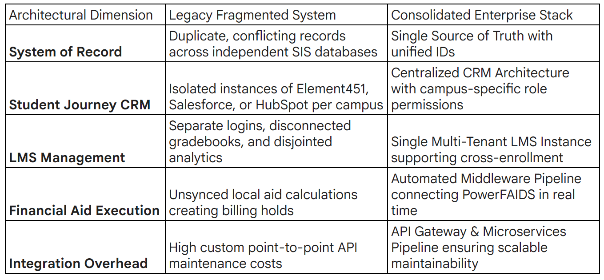
[ ARCHITECTURAL TRANSFORMATION: REGIONAL SILOS TO UNIFIED ENTERPRISE HUB ]

LEGACY FRAGMENTED SYSTEM (Pre-Consolidation)
  Campus Alpha:  Legacy SIS ──► Custom CRM ──► Separate LMS Instance
  Campus Beta:   Disparate ERP ──► Third-Party Tool ──► Isolated Database
  Campus Gamma:  Manual Spreadsheets ──► Local Financial Aid Software
  (Result: Data Inconsistency, Billing Collisions, High Maintenance Overhead)

CONSOLIDATED ENTERPRISE ARCHITECTURE (Post-Consolidation)
  ┌─────────────────────────────────────────────────────────────────────────┐
  │                   CANONICAL MIDDLEWARE & API LAYER                      │
  │                                                                         │
  │  Core SIS           Core CRM           Financial Aid       Unified LMS  │
  │                                                                         │
  └─────────────────────────────────────────────────────────────────────────┘
  (Result: Real-time Multi-Campus Telemetry, Unified Student ID, Single Sign-On)
3 Critical Lessons Learned in Q3 Consolidations
1. Canonical Data Schemas Must Precede Database Mergers
The most frequent bottleneck during Q3 consolidations occurred when teams attempted to directly map and migrate heterogeneous database tables from multiple campuses into a single central database. Campus A might classify a student status as "Active-Enrolled", while Campus B uses "Enrolled_In_Status_A".
The Lesson: Successful consolidations create a Canonical Data Model (CDM) first. Instead of forced direct migrations, build an intermediary middleware layer that normalizes incoming data into standardized JSON/GraphQL schemas before writing to central platforms like Thesis Elements (SIS) or Salesforce / Element451 (CRM).
2. Federated Identity (IAM) Drives Cross-Campus Mobility
Multi-campus consolidation fails at the user experience level if students, faculty, and administrative staff must manage multiple sets of credentials to access cross-registered courses, campus libraries, or auxiliary services (housing and dining).
The Lesson: Deploying a unified Identity and Access Management (IAM) framework using SAML 2.0 / OpenID Connect (OIDC) with dynamic Role-Based Access Control (RBAC) is non-negotiable. Identity providers must dynamically resolve multi-institution affiliations, allowing a student taking courses at both Campus A and Campus B to access their unified Canvas or D2L dashboard using a single SSO login.
3. Asynchronous Financial Aid and Billing Creates Revenue Blind Spots
Consolidating student financial accounts across multiple campuses using legacy overnight batch jobs resulted in significant billing discrepancies during early fall registration cycles. Delayed updates between financial aid engines (PowerFAIDS) and central student billing modules caused incorrect holds on student accounts and delayed aid disbursements.
The Lesson: Financial aid and auxiliary billing pipelines must rely on event-driven, synchronous API webhooks rather than scheduled batch files. Real-time telemetry ensures that as soon as aid is verified in PowerFAIDS, student ledger statuses in the primary SIS update instantly across all campus locations.
Accelerate Your Multi-Campus System Consolidation with Talentus Global
Consolidating legacy software platforms, mapping complex data schemas, and integrating higher ed platforms requires specialized software engineering and cloud architecture expertise.
Talentus Global provides dedicated nearshore LATAM software engineering pods to execute complex multi-campus consolidations and systems integrations.
For over 30 years, Talentus Global has been a trusted technology partner delivering enterprise software development, cloud engineering, and technical staffing solutions for higher education and enterprise platforms. Our nearshore LATAM development teams specialize in custom API middleware, database harmonization, identity management, and real-time data pipelines.
Operating 100% synchronously within your US working hours (EST/CST), our pre-vetted LATAM pods deploy in as little as 48 hours to help you meet critical institutional deadlines without communication friction or recruitment delay.
- 100% US Timezone Alignment: Collaborate synchronously with senior software developers during standard EST/CST business hours.
- Deploy in 48 Hours: Bypass domestic recruiting delays and scale specialized higher ed engineering pods immediately.
- 95% Developer Retention Rate: Preserve institutional codebase familiarity and data integration momentum across multi-year modernization initiatives.
Streamline your campus technology architecture. Partner with Talentus Global today.