For Higher Education Chief Information Officers (CIOs), maintaining legacy on-premises Student Information Systems (SIS) is one of the highest technical and operational risks on campus.
Monolithic, decades-old database architectures strain IT budgets, create severe security vulnerabilities, and stall digital transformation initiatives.
When campus registrars, financial aid offices, and recruitment teams rely on fragile PL/SQL scripts and legacy servers, rolling out modern student experiences, such as real-time CRM syncing or seamless cloud workflows, becomes nearly impossible.
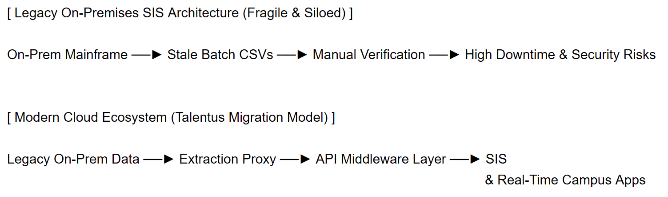
Decommissioning legacy on-premises SIS platforms requires an enterprise strategy: decoupling custom business logic, establishing an API-first integration middleware layer, and executing a phased data migration to modern cloud ecosystems like Thesis Elements SIS.
The High Risk of Maintaining Legacy On-Premises SIS
Operating legacy, self-hosted campus software creates compounding technical debt and organizational vulnerability:
- Knowledge Drain and Aging Talent: Decades-old custom code relies on legacy programming languages and un-documented PL/SQL routines. As senior campus developers retire, institutions lose the institutional knowledge required to maintain core database schemas.
- Severe Security and Compliance Liabilities: Legacy on-prem databases often run on unsupported operating systems and hardware, making them prime targets for ransomware attacks and non-compliance with evolving data privacy standards.
- Integration Bottlenecks: Modern SaaS applications, financial portals, and recruitment platforms require instant REST or GraphQL APIs. Legacy SIS platforms rely on nightly batch processes, preventing real-time student lifecycle updates.
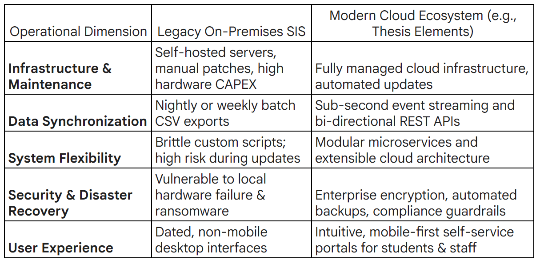
Legacy On-Premises SIS vs. Modernized Cloud Ecosystem
Transitioning off legacy infrastructure unlocks agility while lowering long-term total cost of ownership:
3 Pillars of a Successful SIS Decommissioning Playbook
A structured SIS sunset strategy prevents operational downtime and ensures total historical data integrity:
1. Schema Mapping & Historical Data Archival
Avoid migrating bad data. Audit decades of accumulated student records, establish automated cleansing routines, and map active student entities to your target cloud schema. Archive legacy historical data into immutable, read-only cloud data lakes to meet legal retention requirements without bloating your new cloud SIS.
2. Parallel API Middleware Integration Layer
Build an abstraction layer between legacy storage and modern campus endpoints. Deploying API middleware allows new platforms, such as Element451 CRM and modern learning tools, to communicate seamlessly while the legacy system is systematically decommissioned in phases.
3. Phased Cutover & Parallel System Run
Mitigate risk by avoiding single-day "big bang" cutovers. Run financial aid, registration, and admissions modules in parallel testing environments, validating transactional accuracy across both legacy and new cloud pipelines before fully powering down legacy servers.
Accelerate Your Campus Modernization with Talentus Global
Decommissioning legacy enterprise software while maintaining daily university operations requires senior data architects, cloud integration specialists, and deep Higher Ed domain expertise.
Talentus Global provides dedicated nearshore LATAM software engineering pods to execute, modernize, and scale your campus infrastructure transitions.
For over 30 years, Talentus Global has been a trusted leader in enterprise digital transformation and Higher Ed systems engineering. Our nearshore developers specialize in SIS decommissioning, cloud data migration (Thesis Elements, Ellucian), API middleware development, and enterprise database modernization.
- Operating 100% synchronously in your US timezone (EST/CST), our pre-vetted LATAM engineering pods deploy in as little as 48 hours, eliminating domestic recruitment delays and reducing technical execution risk.
- 100% US Timezone Alignment: Collaborate synchronously with senior engineers during standard EST/CST working hours.
- Deploy in 48 Hours: Bypass domestic hiring bottlenecks and deploy specialized cloud migration pods immediately.
- 95% Developer Retention Rate: Preserve deep institutional knowledge and codebase stability across multi-year modernization roadmaps.
Decommission your legacy SIS with confidence. Partner with Talentus Global today by clicking here