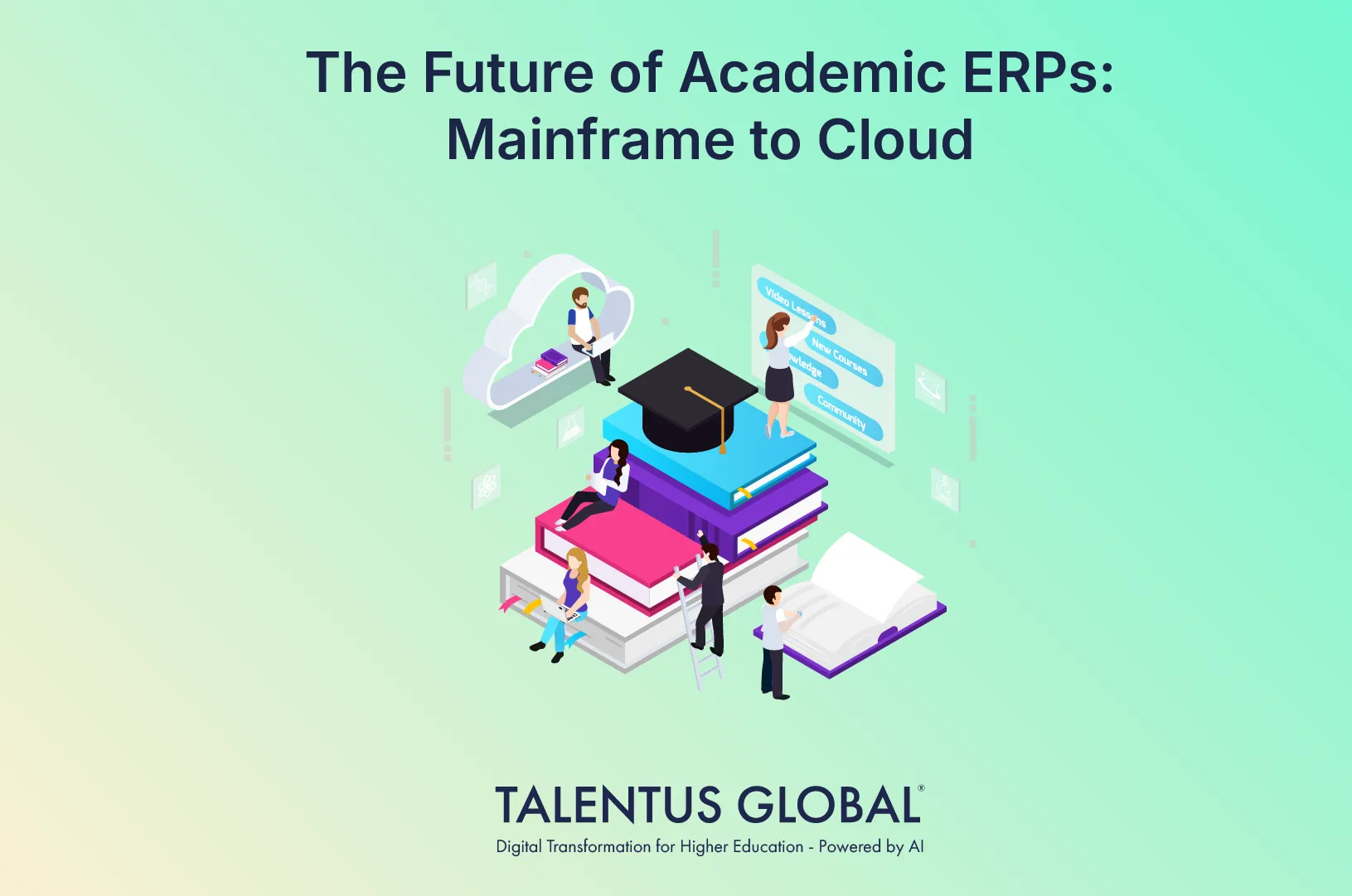
Colleges and universities across the globe face an existential IT bottleneck: legacy enterprise resource planning (ERP) systems running on decades-old mainframe architectures.
Core academic operations, student registration, financial aid processing, transcript generation, and tuition billing, are frequently locked inside monolithic codebases like COBOL or legacy database structures.
Maintaining these legacy mainframes consumes up to 70% of higher ed IT budgets, driven by exorbitant licensing, specialized hardware maintenance, and an aging developer talent pool. Worse, monolithic architectures prevent universities from deploying modern digital services like real-time student mobile apps, instant credit evaluation, or automated financial aid workflows.
Migrating to cloud-native academic ERP platforms, or decoupling legacy cores using API-first microservices and modern platforms is no longer a distant strategic goal. It is an immediate prerequisite for operational resilience and institutional growth.
The High Risk of Maintaining Legacy Academic Mainframes
Relying on legacy mainframe ERPs introduces severe operational vulnerabilities that jeopardize institutional agility:
- The Developer Scarcity Trap: Engineers with deep expertise in legacy mainframe languages like COBOL or RPG are rapidly retiring. Replacing them with domestic talent is increasingly cost-prohibitive.
- Data Silos & Integration Friction: Legacy mainframes rely on slow, overnight batch file transfers (flat files/CSV), preventing real-time data sync across Student Information Systems (SIS), Learning Management Systems (LMS), and CRMs.
- Security & Compliance Gaps: Old mainframe environments struggle to natively support modern cybersecurity protocols, such as granular Zero-Trust access control, automated PII encryption at rest, and multi-factor authentication.
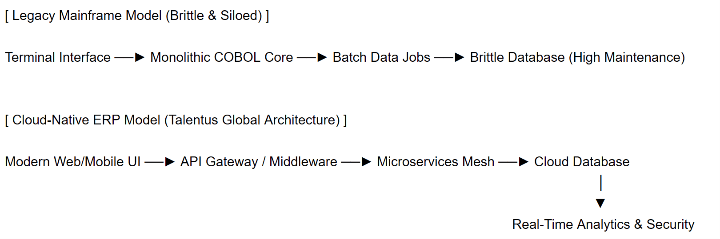
Legacy Mainframe ERP vs. Cloud-Native Academic ERP
Modernizing your core administrative engine shifts university IT from expensive legacy maintenance to continuous digital innovation:
3 Pillars of Cloud-Native ERP Migration
Executing a successful mainframe modernization without disrupting active student services relies on three core architectural strategies:
1. The Strangler Fig Pattern (Incremental Migration)
Avoid "big bang" cutovers that risk catastrophic campus downtime. Apply the Strangler Fig migration strategy, wrapping legacy mainframe endpoints in modern API middleware and incrementally replacing monolithic modules (e.g., admissions first, followed by billing and registration) with cloud microservices over time.
2. Event-Driven Architecture & Real-Time Middleware
Replace fragile overnight batch jobs with event-driven data streaming. When a student registers for a class or pays tuition, that event streams instantly across the SIS, LMS, and financial aid portals in real time.
3. Zero-Trust Security & PII Compliance Controls
Enforce strict cloud security standards across student records. Implement role-based access controls (RBAC), end-to-end encryption for sensitive PII data, and automated audit logging to remain fully compliant with FERPA, HIPAA, and state data privacy laws.
Modernize Your Campus Core with Talentus Global
Migrating legacy mainframes to cloud-native ERP architectures requires senior software engineers, cloud architects, database migration specialists, and integration developers.
Talentus Global provides dedicated nearshore LATAM software engineering pods to build, execute, and secure your cloud migration roadmap.
For over 30 years, Talentus Global has been a trusted technical partner in enterprise software engineering, cloud architecture, and higher ed digital transformation. Our nearshore LATAM development teams specialize in mainframe decoupling, cloud-native refactoring, API middleware construction, and enterprise platform integration across Thesis Elements, Banner, Ellucian, and Workday.
Operating 100% synchronously in your US timezone (EST/CST), our pre-vetted LATAM engineering pods deploy in as little as 48 hours to accelerate your ERP migration without timezone friction.
- 100% US Timezone Alignment: Collaborate synchronously with senior cloud developers during standard EST/CST working hours.
- Deploy in 48 Hours: Bypass domestic recruitment delays and scale specialized engineering pods immediately.
- 95% Developer Retention Rate: Retain deep institutional technical knowledge and codebase stability across multi-year modernization initiatives.
Break free from legacy mainframe constraints. Click here and partner with Talentus Global today.