In an era of rising operational overhead and shifting enrollment demographics, university Chief Financial Officers and Provosts face a complex financial puzzle: determining the true Return on Investment (ROI) of individual academic courses and degree programs.
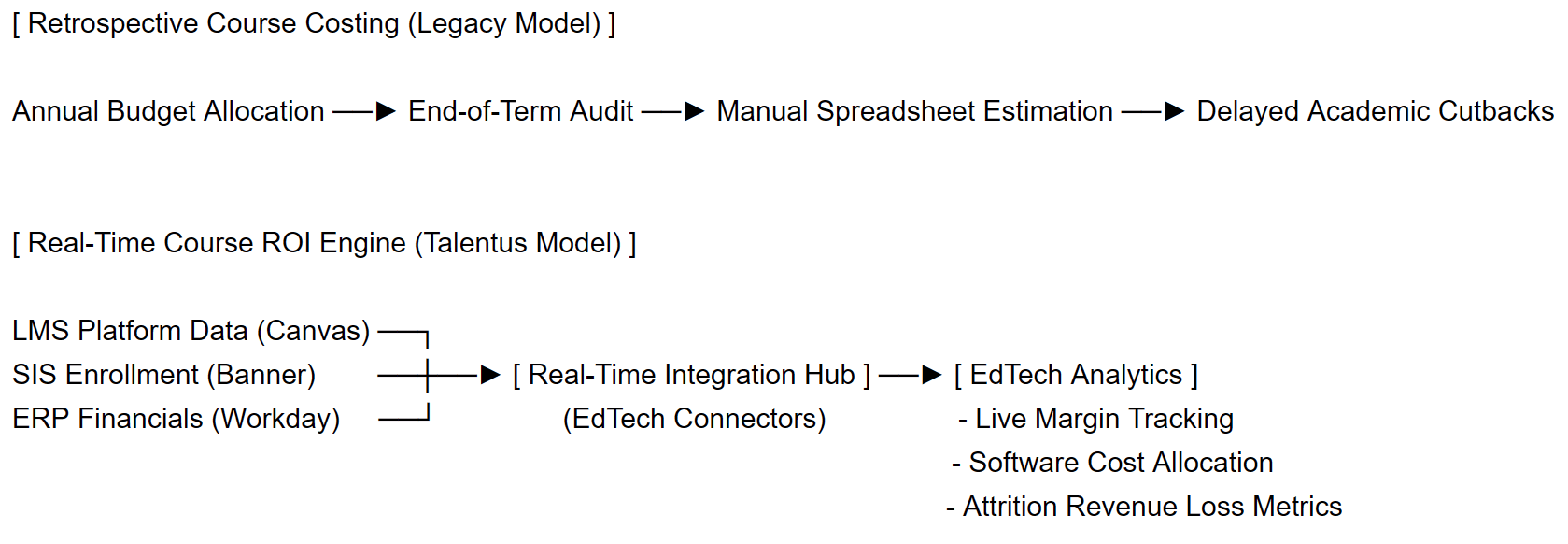
Traditionally, course-level cost accounting has been a retrospective exercise. Finance teams wait until end-of-year financial audits to manually divide departmental budgets by enrolled credit hours. This lagged approach obscures the hidden expenses of low-enrollment electives, unallocated software licensing, and high-attrition lab courses—leaving academic leadership unable to optimize margins before budget deficits accumulate.
To protect institutional health and ensure sustainable academic growth, higher education systems must transition from static annual cost models to real-time course ROI analytics.
The Pitfalls of Retrospective Course Costing
Evaluating academic program profitability through static spreadsheets creates significant financial blind spots for university finance teams:
- Unallocated Digital Tool Surcharges: Modern courses frequently require specialized third-party digital tools, lab simulations, or software licenses. When these expenses are buried in general departmental operational funds rather than mapped directly to course codes, true course overhead is severely understated.
- Invisible Attrition Costs: When a student withdraws from a course during the add/drop window or midway through the semester, the loss of tuition revenue is rarely calculated against the specific course’s fixed operating cost in real time.
- Misaligned Faculty Overhead Allocation: Combining full-time tenured faculty salaries, adjunct compensation, and teaching assistant hours into flat departmental averages distorts the true cost of delivering specific course sections.
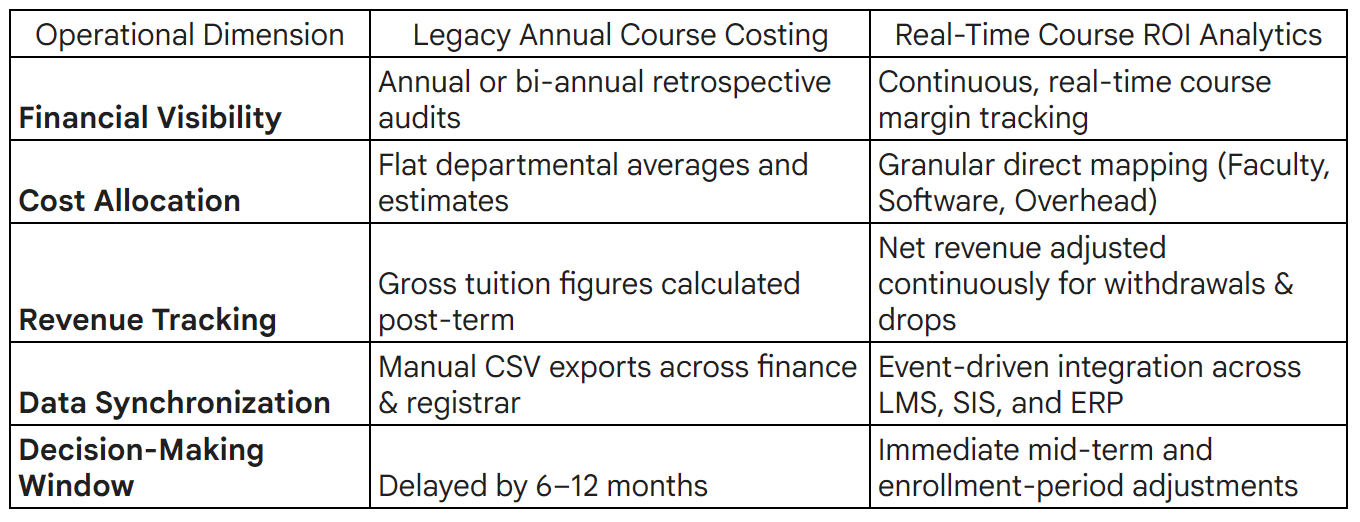
Legacy Annual Costing vs. Real-Time Course ROI Analytics
Automating real-time financial telemetry between academic delivery platforms and financial ledgers turns financial planning from reactive post-mortems into agile strategy.
3 Key Metrics That Redefine Course ROI in Real-Time
Deploying a real-time analytics layer enables finance and academic leaders to track dynamic metrics that reveal the true financial performance of every offering:
1. Dynamic Cost-Per-Enrolled-Student
By continuously ingesting variable costs, such as adjunct pay, specialized software seat licensing, and instructional material fees, alongside live student roster counts from the SIS, financial systems calculate the exact cost-per-student for every section as enrollment fluctuates.
2. Net Tuition Revenue Attrition Yield
By connecting LMS engagement metrics with ERP billing ledgers inside EdTech Analytics, CFOs track how course-level withdrawal rates directly erode projected tuition income, identifying high-cost courses that require academic support interventions to preserve tuition revenue.
3. Capacity & Digital Resource Efficiency
Correlating physical classroom seat utilization and LMS bandwidth consumption against generated credit hours allows university leaders to right-size room assignments, optimize software license counts, and make data-driven decisions on section consolidation.
Build Real-Time Financial Intelligence with Talentus Global
Measuring course-level ROI in real time requires robust, automated data pipelines that connect academic systems like Canvas and Blackboard with financial ERPs like Workday, Banner, or SAP.
Talentus Global provides the engineering expertise to modernize your university’s financial planning architecture.
For over 30 years, Talentus Global has been a trusted leader in enterprise digital transformation and Higher Ed system integration. Through our nearshore LATAM Global Delivery Centers, we deploy pre-vetted software engineering pods skilled in enterprise middleware, cloud data pipelines, and Higher Ed software ecosystems.
Using our pre-built EdTech Connectors and EdTech Analytics framework, university finance teams eliminate manual spreadsheet reconciliation and gain continuous visibility into course margins and program profitability.
- 100% US Timezone Alignment: Our LATAM developers operate synchronously during your business hours (EST/CST), collaborating directly with your IT and finance teams.
- Rapid Team Deployment: Bypass 60-day recruitment delays and deploy specialized data engineering pods in under 48 hours.
- Unmatched Continuity: Maintain architectural stability across your financial transformation roadmap with our 95% developer retention rate.
Eliminate financial blind spots and optimize your university's course margins. Explore EdTech Analytics and partner with Talentus Global today.