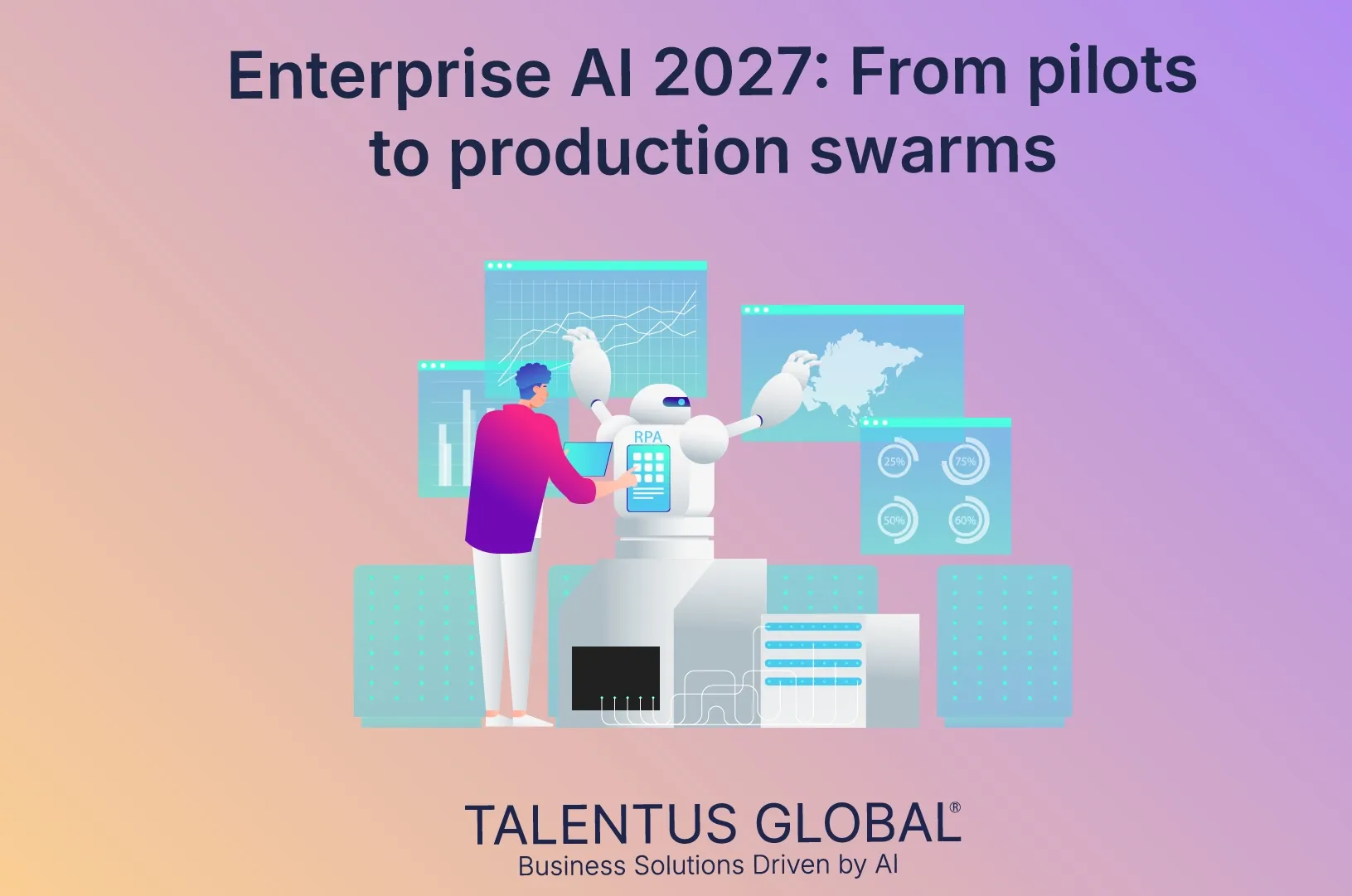
Over the past three years, enterprise adoption of Generative AI has progressed through distinct maturity cycles.
What began as simple Retrieval-Augmented Generation (RAG) chatbots and single-prompt experiments in 2024–2025 evolved into task-specific copilots by 2026. However, as leadership teams look toward their 2027 Enterprise AI Roadmaps, a critical bottleneck has emerged: the "Proof of Concept (POC) Trap."
While single-purpose AI pilots demonstrate impressive isolated capabilities, they fail to deliver sustained operational ROI when asked to handle complex, multi-step enterprise workflows. Moving into 2027, the competitive edge belongs to organizations that transition from fragmented AI pilots to Production Swarms, coordinated architectures of specialized, autonomous micro-agents operating over deterministic middleware with strict governance.
[ ARCHITECTURAL EVOLUTION: PILOT ISOLATION vs. PRODUCTION AGENT SWARM ]

FRAGMENTED AI PILOTS (2024–2025)
  User Input ──► Single Master LLM ──► Isolated Vector DB (RAG) ──► Unstructured Text
  (Problem: Context Rot, Single Point of Failure, No Execution Authority)


PRODUCTION MULTI-AGENT SWARM (2027 Enterprise Standard)
  User / API Trigger ──► [ Event-Driven Middleware Router ]
                                   │
         ┌─────────────────────────┼─────────────────────────┐
         ▼                         ▼                         ▼
  [ Orchestrator Agent ]   [ Data Validation ]     [ Execution Agent ]
  (State & Routing)        (Schema Compliance)     (RBAC API Gateway)
         │                         │                         │
         └─────────────────────────┼─────────────────────────┘
                                   ▼
                   [ Deterministic Ledger / Core ERP ]
1. The POC Trap: Why Single-Prompt Pilots Stall
More than 70% of enterprise AI pilots fail to make the jump into full production environments. The failure modes are rarely tied to foundational model intelligence; instead, they stem from structural execution limits:
- Context Window Degradation: Single-agent models overwhelmed with long context histories experience memory rot, hallucinations, and instruction drift.
- Lack of Deterministic Control: Free-text LLM outputs cannot reliably trigger mission-critical enterprise systems (such as ERP, CRM, or SIS platforms) without strict schema middleware.
- Ambient Privilege & Security Gaps: Granting a single AI agent broad API permissions exposes the enterprise to direct and indirect prompt injection attacks.
- Unclear Operational State: When a single monolithic prompt fails mid-task, diagnosing where the logic broke becomes nearly impossible.
2. What are Production Swarms?
A Production Swarm replaces monolithic LLMs with a network of lightweight, purpose-built micro-agents. Each agent within the swarm is assigned a tight, specialized domain of responsibility, such as data parsing, policy validation, schema conversion, or API execution.
Controlled by a central orchestrator model and governed by event-driven state management (e.g., LangGraph, AutoGen, or custom message queues), agents pass deterministic messages to one another. If an individual agent encounters an error or ambiguous data, the swarm automatically isolates the task, retries with adjusted parameters, or routes the exception to a human-in-the-loop (HITL) administrator without crashing the entire workflow.
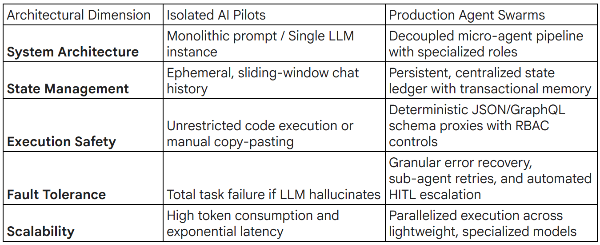
3. Comparing Isolated AI Pilots vs. Production Agent Swarms
4. Three Technical Pillars for Your 2027 Swarm Architecture
Enterprise engineering leaders preparing their 2027 AI architecture must focus on three core infrastructural layers:
A. Canonical Message Schemas & Event Routing
Agents within a production swarm must communicate using standardized, typed data structures rather than unstructured natural language. Implementing a Canonical Data Model (CDM) across agent interfaces ensures that data passed between systems remains clean, predictable, and fully auditable.
B. Deterministic Function Proxies & RBAC Middleware
Never give an AI agent direct access to database credentials or raw API endpoints. Every action requested by an execution agent must pass through an intermediary API middleware proxy. The middleware validates the agent's payload against predefined JSON Schemas and enforces Role-Based Access Control (RBAC) before touching enterprise databases.
C. Real-Time Telemetry & Guardrail Enforcement
Deploy out-of-band security middleware to inspect agent-to-agent interactions continuously. Real-time guardrails monitor for prompt injection vectors, data exfiltration attempts, and runaway execution loops, ensuring the swarm operates within defined security boundaries.
Accelerate Your 2027 AI Roadmap with Talentus Global
Transitioning from isolated AI pilots to enterprise-grade production swarms requires specialized software engineering, API middleware integration, and cloud security expertise.
Talentus Global provides dedicated nearshore LATAM software engineering pods to build, secure, and deploy multi-agent production architectures.
For over 30 years, Talentus Global has been a trusted technical partner in enterprise software development, cloud infrastructure, and AI-driven digital transformation. Our nearshore LATAM engineering teams specialize in multi-agent orchestration, custom API middleware, canonical data pipelines, and zero-trust security architecture.
Operating 100% synchronously in your US timezone (EST/CST), our pre-vetted LATAM development pods deploy in as little as 48 hours to accelerate your 2027 AI roadmap without timezone friction or communication delays.
- 100% US Timezone Alignment: Collaborate synchronously with senior software developers during standard EST/CST business hours.
- Deploy in 48 Hours: Scale specialized AI security, MLOps, and middleware engineering pods immediately without recruiting friction.
- 95% Developer Retention Rate: Retain deep institutional technical knowledge and codebase stability across long-term modernization efforts.