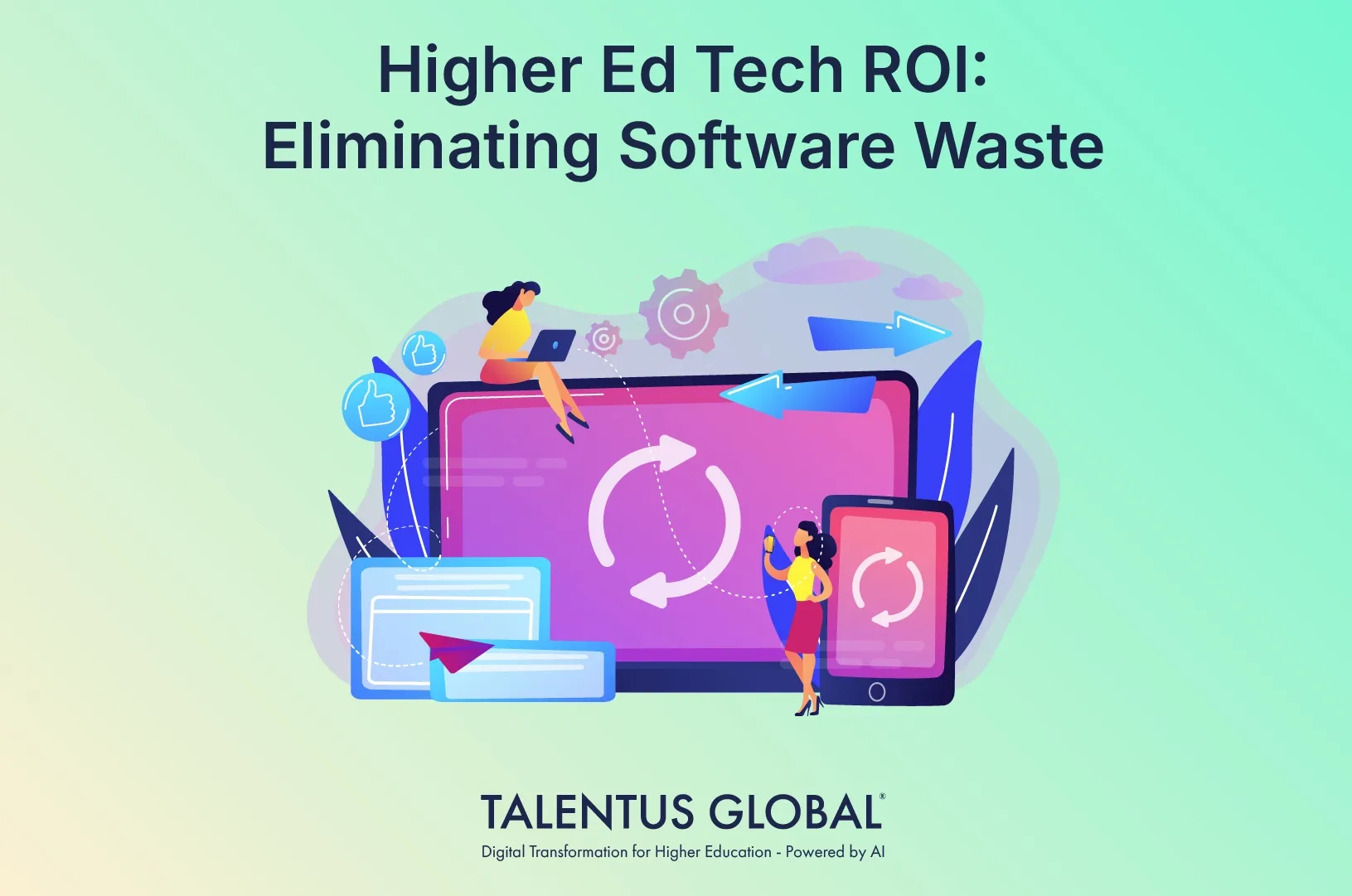
University IT budgets face unprecedented scrutiny, yet campus software stacks remain quietly inflated by shadow IT, departmental silos, and redundant software licensing.
It is common to find different colleges or divisions within the same institution running parallel, overlapping point solutions. Admissions may rely on one enterprise CRM while university advancement operates another. One department maintains the central LMS while a specialized school pays for a separate learning platform. Meanwhile, faculty and staff juggle concurrent licenses across multiple video conferencing and collaboration platforms.
Beyond the direct financial waste of duplicate seat contracts, maintaining redundant software multiplies administrative overhead, complicates compliance, and creates integration friction with core systems of record like the Student Information System (SIS), Enterprise Resource Planning (ERP) engines, and financial aid processing software.
Conducting a rigorous technology stack rationalization eliminates duplicate licensing, streamlines integration pipelines, and reallocates critical budget toward strategic IT initiatives.
[ Fragmented Campus Stack (Redundant Licenses & Silent Budget Drain) ]

  Admissions ──► Secondary CRM ─────┐
  Advancement ──► Primary CRM ──────┼──► Duplicate Maintenance, High Cost,
  School of Biz ──► Alternate LMS ──┤    & Fragmented APIs to the Core SIS
  Main Campus ──► Central LMS ──────┘


[ Consolidated Enterprise Stack (Optimized ROI & Single Pipeline) ]

  All Departments ──► Unified Single-Tenant Architecture
                            │
                            ▼
      API Gateway & Telemetry Management Layer
                            │
        ┌───────────────────┼───────────────────┐
        ▼                   ▼                   ▼
     The SIS             The ERP           Financial Aid
   (SIS Core)          (ERP Core)          (Aid System)
The High Cost of Unaudited Software Overlap
Failing to audit and rationalize enterprise technology contracts leads to compounding technical debt and financial waste:
- Silent License Bloat: Institutions pay for unassigned or underutilized seat tiers across duplicate SaaS products without centralized usage monitoring.
- Integration Complexity & Debt: Building custom data connectors to synchronize multiple CRMs or LMS platforms with the central SIS or primary ERP inflates IT maintenance costs.
- Data Security & Governance Gaps: Fragmented software usage spreads sensitive student academic and financial records across unmonitored vendor environments, increasing compliance risk under FERPA and Title IV regulations.
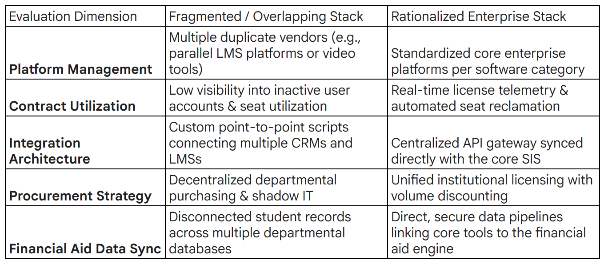
Fragmented Software Stack vs. Rationalized Enterprise Stack
Auditing software telemetry and consolidating duplicate platforms transforms higher ed IT from a reactive cost center into an efficient operational engine:
3 Pillars of Higher Ed Tech Stack Rationalization
Executing a successful software audit and license elimination strategy requires three core engineering and operational phases:
1. Comprehensive Telemetry & Usage Auditing
Deploy automated telemetry logging and single-sign-on (SSO) usage tracking across all institutional applications. Analyze active login frequency, feature utilization, and API ping rates to separate mission-critical platforms from redundant or abandoned software licenses.
2. Categorical Tool Rationalization & Elimination
Group all institutional software into standardized functional buckets:
ERP: Consolidate financial, HR, and operational workflows onto a single enterprise ERP platform.
SIS: Standardize student records, course catalog management, and transcript processing directly on the core SIS.
LMS: Establish a single institutional learning management platform for all colleges and online programs.
CRM: Eliminate duplicate departmental CRMs by standardizing on a single enterprise CRM for enrollment, recruitment, and alumni relations.
Collaboration: Consolidate communication channels onto a primary institutional collaboration suite.
Financial Aid: Streamline aid packaging, disbursement, and compliance exclusively through the central financial aid system.
3. Unified Integration Pipeline Architecture
Once primary platforms are selected, deprecate legacy point-to-point connectors. Build robust, event-driven API middleware that routes clean data between the core SIS, ERPs, and CRMs, ensuring high availability while permanently shutting down legacy software subscriptions.
Maximize Your Tech Stack ROI with Talentus Global
Auditing enterprise software architecture, building custom data integration pipelines, and sunsetting legacy systems requires senior cloud architects, data integration specialists, and higher ed IT engineers.
Talentus Global provides dedicated nearshore LATAM software engineering pods to design, consolidate, and optimize your campus technology ecosystem.
For over 30 years, Talentus Global has been a trusted technical partner in enterprise software engineering, cloud architecture, and higher ed digital transformation. Our nearshore LATAM development teams specialize in API middleware, data warehouse consolidation, cloud migration, and enterprise system integration across core SIS platforms, ERPs, CRMs, LMSs, and financial aid systems.
Operating 100% synchronously in your US timezone (EST/CST), our pre-vetted LATAM engineering pods deploy in as little as 48 hours to accelerate your software optimization roadmap without communication or timezone delays.
- 100% US Timezone Alignment: Collaborate synchronously with senior software developers during standard EST/CST working hours.
- Deploy in 48 Hours: Bypass domestic recruiting friction and launch specialized integration pods immediately.
- 95% Developer Retention Rate: Retain deep institutional technical knowledge and codebase stability across long-term modernization efforts.