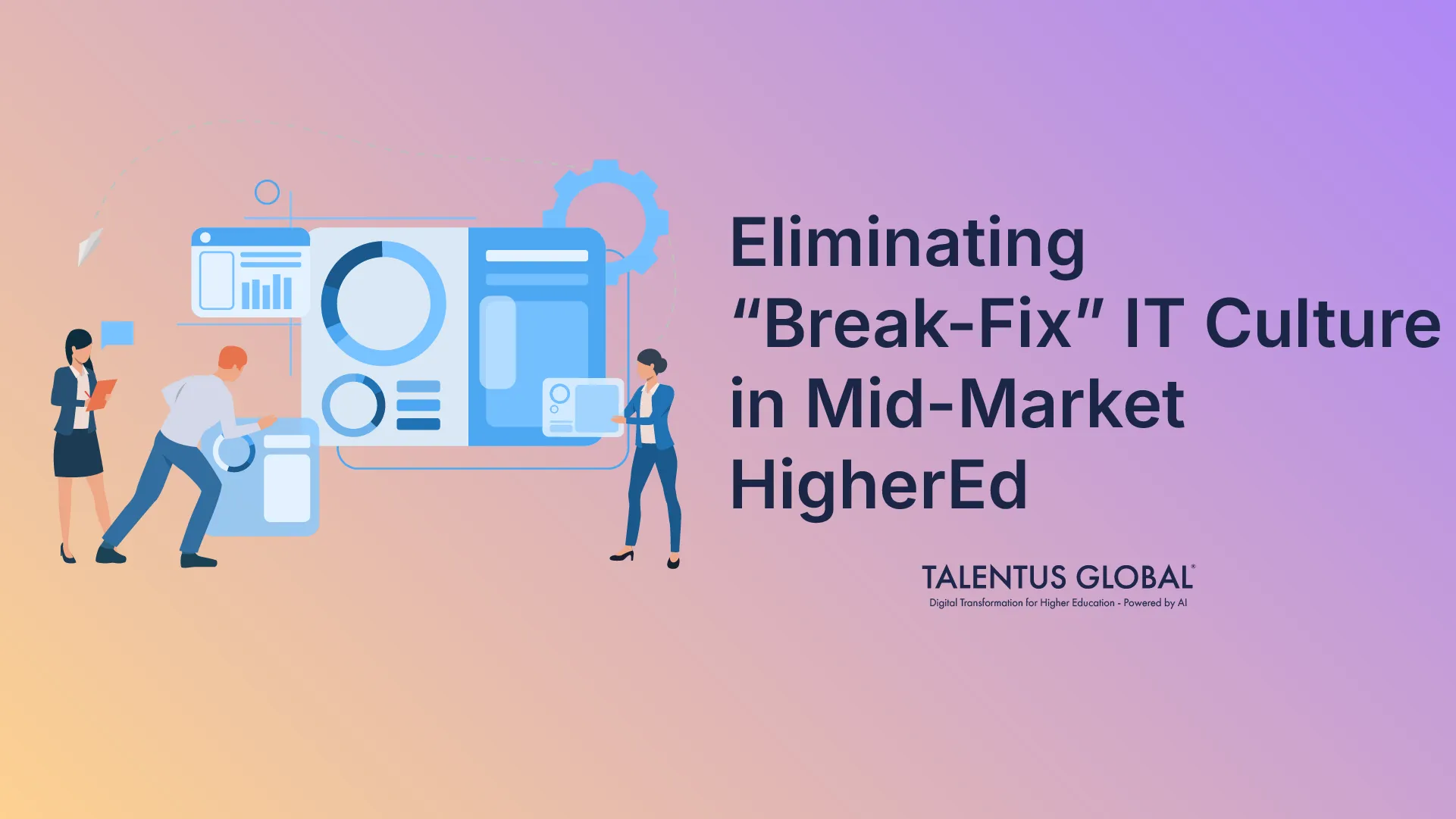
In mid-market higher education, the IT department is often treated like a digital fire department. Instead of driving strategic technological innovation, internal teams spend their days reacting to crises: an API connection between the admissions CRM and the Student Information System (SIS) suddenly drops, a dorm Wi-Fi router fails during finals week, or a forgotten SSL certificate expires and takes down the student portal.
This is the "break-fix" IT culture. It is inherently reactive, operating on the premise that IT only needs to act when something stops working.
While this model may have sufficed a decade ago, modern universities run on complex, interconnected digital ecosystems. Relying on a break-fix approach in 2026 leads to severe IT staff burnout, compromised data security, and a frustrating digital experience that directly impacts student retention. It is time for higher education IT leaders to transition from reactive troubleshooting to proactive digital management.
The Hidden Costs of Reactive IT
The most significant cost of a break-fix culture is the loss of strategic bandwidth. When database administrators and network engineers are constantly resetting passwords or patching localized outages, they cannot focus on high-value initiatives like deploying cognitive assistants, migrating legacy databases to the cloud, or optimizing institutional data governance.
Furthermore, relying on a reactive stance for modern marketing and admissions workflows is catastrophic. If your marketing automation platform, such as HubSpot, which many institutions favor for its intuitive CRM and robust email metrics, loses sync with your legacy SIS, you aren't just facing a technical error; you are actively losing prospective students in the enrollment funnel.
Shifting to a Proactive IT Paradigm
Eliminating break-fix culture requires implementing comprehensive Managed IT Services focused on continuous monitoring, automated issue remediation, and strategic lifecycle management.

By implementing predictive analytics and autonomous network monitoring, IT departments can identify and resolve a degrading server or a failing integration before the end-user ever experiences an interruption.
Reclaim Your Strategic Bandwidth with Talentus Global
Shifting to a proactive IT model sounds ideal, but mid-market universities face a harsh reality: their internal IT teams are too buried under existing tickets to build the automated infrastructure required to escape the cycle. Furthermore, attempting to hire domestic systems architects often results in 60-day hiring delays and severe budget constraints.
This is where Talentus Global bridges the gap.
With over 30 years of experience in higher education digital transformation, we provide the architectural bandwidth that overwhelmed university IT desks lack. Through our LATAM Global Delivery Centers, we deploy specialized, pre-vetted nearshore software engineering pods and comprehensive Managed IT Services.
Operating synchronously in your exact timezone (EST/CST), our engineers handle the continuous monitoring, middleware integration (MuleSoft/Boomi), and Tier 2/3 proactive maintenance. By offloading the operational baseline to our high-retention teams, your university's internal IT leadership is finally free to focus on the strategic initiatives that drive enrollment and student success.