When US technology organizations outsource software development to traditional offshore destinations across 9- to 12-hour timezone offsets, they unknowingly pay a steep, hidden operational levy: The Asynchronous Latency Tax.
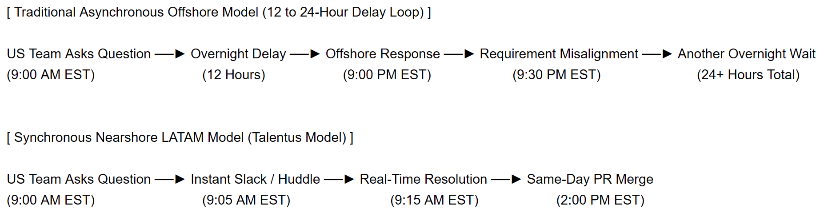
While hourly billing rates offshore may look attractive on a spreadsheet, the daily reality of asynchronous handoffs degrades velocity. A simple code clarification, PR review, or architectural question submitted at 3:00 PM EST sits idle overnight. If the offshore developer misunderstands the requirement, another 24-hour cycle is wasted.
To maintain continuous deployment cycles and rapid product iterations, tech leaders are abandoning off-hours handoffs in favor of timezone-aligned nearshore LATAM pods operating synchronously during standard US business hours.
The Hidden Costs of Asynchronous Development
Relying on developers half a world away creates systemic friction that quietly inflates project budgets and drags down engineering throughput:
- Context Switching Fatigue: US engineers must constantly stop their current work to review code or answer questions logged by offshore teams during the middle of the night.
- Stalled Pull Request Pipelines: Bug fixes and feature branches sit unmerged for days while awaiting round-trip communication across incompatible business hours.
- Decentralized Problem Solving: Complex bugs that could be resolved in a 10-minute real-time huddle turn into multi-day back-and-forth email and ticket exchanges.
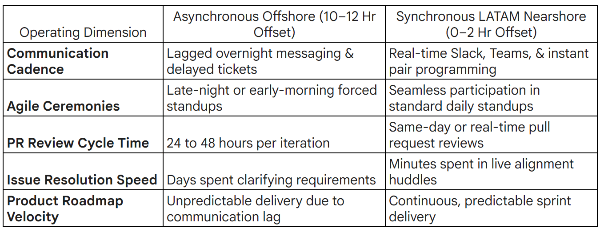
Asynchronous Offshore vs. Synchronous LATAM Nearshore Pods
Eliminating timezone drift aligns engineering momentum and restores agile predictability:
3 Pillars for Eliminating the Latency Tax
Maximizing engineering output requires embedding timezone-aligned talent into your live workflow:
1. Real-Time Pair Programming and Instant Huddles
When a complex logic bug or API integration roadblock occurs, nearshore LATAM engineers jump on a live video call or Slack Huddle immediately. Issues that typically take days to resolve asynchronously are fixed in minutes through synchronous pair programming.
2. Same-Day Code Reviews and Continuous Integration
In modern DevSecOps environments, code needs to move quickly from development to staging. Nearshore LATAM pods submit pull requests during your active workday, allowing internal tech leads to review, test, and merge code before signing off for the evening.
3. Shared Cultural and Professional Dynamics
Geographic proximity fosters natural alignment in working styles, communication expectations, and agile methodology execution. Nearshore LATAM software developers actively participate in sprint planning, retro meetings, and architecture whiteboarding without cultural friction.
Maximize Engineering Velocity with Talentus Global
Your product roadmap shouldn't have to wait 12 hours for a response to a simple code review.
Talentus Global deploys pre-vetted nearshore LATAM software engineering pods working synchronously in your exact US timezone.
For over 30 years, Talentus Global has helped enterprise organizations scale engineering capacity with zero operational friction. Our nearshore LATAM delivery centers provide specialized software developers who integrate seamlessly into your existing agile workflows during standard business hours (EST/CST).
- 100% US Timezone Alignment: Collaborate synchronously in real time with developers operating during your standard EST/CST workday.
- Deploy in 48 Hours: Skip 60-day domestic hiring lags and deploy pre-assembled, battle-tested engineering pods immediately.
- 95% Retention Rate: Protect institutional memory and preserve architectural stability with long-tenured nearshore talent.
Stop paying the asynchronous latency tax. Accelerate your sprint velocity with Talentus Global today, explore our options here