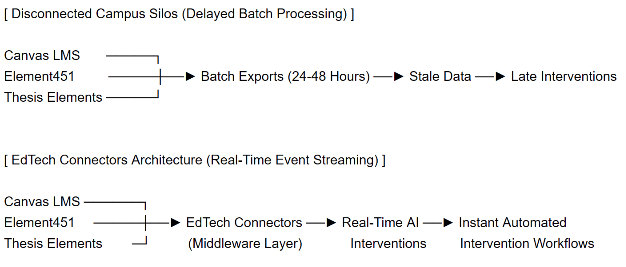
Higher education IT departments face a fundamental integration bottleneck: critical student data remains trapped in functional silos. Learning metrics reside in Canvas LMS, engagement logs live in Element451, and academic records sit inside Thesis Elements. Without real-time synchronization across these core platforms, campus AI initiatives fail to deliver proactive student support, relying instead on delayed, batch-processed alerts weeks after a student disengages.
EdTech Connectors solve this architectural gap by serving as a standardized middleware layer that streams event-driven data across your campus stack, turning isolated operational software into a unified intelligence engine for real-time AI interventions.
The Hidden Cost of Disconnected Campus Systems
Operating separate software platforms without a real-time integration layer creates severe operational blind spots across the institution:
- Fragmented Student Risk Profiles: An academic advisor viewing Element451 cannot see that a student missed consecutive assignments in Canvas or incurred an administrative hold in Thesis Elements until batch processing runs hours or days later.
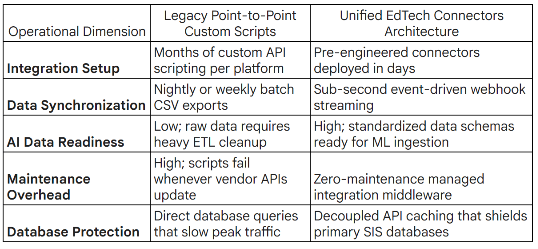
- Brittle Point-to-Point Custom Scripts: Custom Python scripts or SQL jobs built to link Banner, Canvas, and CRMs break whenever vendor API schemas update, consuming hundreds of developer maintenance hours.
- Delayed AI Training Loops: Predictive machine learning models require real-time telemetry; stale batch data reduces early-warning accuracy and delays critical intervention workflows.
Legacy Point-to-Point Integration vs. Unified EdTech Connectors Architecture
Standardizing your campus data layer with EdTech Connectors modernizes your integration pipeline while protecting core system uptime:
3 Pillars of Building Real-Time AI Pipelines with EdTech Connectors
Transforming isolated campus software into a proactive intervention network requires three core integration strategies:
1. Unified Event-Driven Data Streaming
Capture immediate student actions across all touchpoints. Utilizing EdTech Connectors streams active eventssuch as a missed quiz submission in Canvas, an unread outreach message in Element451, or a tuition balance update in Thesis Elements, into a centralized data pipeline instantaneously.
2. Standardized Data Schema Normalization
Eliminate custom data transformations. EdTech Connectors map raw API responses from Canvas, Element451, Thesis Elements, and Banner into a unified, standardized schema, allowing your AI and analytics engines to evaluate student behavioral patterns without complex data wrangling.
3. Automated Closed-Loop Interventions
Connect predictive AI insights directly back to advisor workflows. When an AI model flags a compound risk pattern (e.g., declining LMS activity paired with an unread CRM message), automated webhooks trigger personalized outreach in Element451 or notify academic support specialists in real time.
Modernize Campus Data Pipelines with Talentus Global
Unifying Canvas, Element451, and Thesis Elements into an AI-ready data ecosystem requires specialized middleware and deep Higher Ed integration expertise.
Talentus Global provides dedicated nearshore LATAM software engineering pods to build, manage, and scale your campus integration architecture.
For over 30 years, Talentus Global has been a trusted technology partner in enterprise transformation and Higher Ed system engineering. Through our nearshore LATAM Global Delivery Centers, we deploy pre-vetted engineering pods specialized in campus API middleware, cloud data pipelines, and real-time AI implementations.
Our LATAM developers work 100% synchronously in your US timezone (EST/CST), functioning as a seamless extension of your IT team to eliminate integration backlog without domestic recruitment friction.
- 100% US Timezone Alignment: Collaborate in real time with senior developers during standard EST/CST business hours.
- Deploy in 48 Hours: Launch dedicated nearshore engineering pods immediately and bypass 60-day hiring delays.
- 95% Developer Retention Rate: Protect institutional context and maintain multi-year integration stability.
Unify your campus software stack and enable real-time AI interventions. Partner with Talentus Global today. Click here to know how