
High developer turnover is often treated as a human resources metric or an operational inconvenience.
In reality, constant developer churn is an architectural hazard. When senior engineers leave, they take with them the implicit context, undocumented decision rationale, and historical domain knowledge that keep enterprise codebases resilient.
The result is architectural drift: new engineers rewrite functioning logic because they don't understand past trade-offs, tech debt accumulates, and system stability degrades.
Maintaining high developer retention, such as a 95% retention rate, is not just an HR win; it is a core software engineering practice. Long-term team continuity directly correlates with codebase health, predictable velocity, and structural application security.
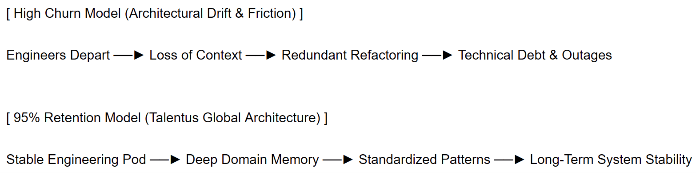
The Invisible Cost of Engineering Turnover
When developer churn plagues software teams, the damage extends far beyond recruitment fees and onboarding ramp-ups:
- Loss of Implicit System Knowledge: Architectural decisions, edge-case fixes, and complex legacy integrations rarely exist in full technical documentation. When an engineer leaves, that tribal knowledge vanishes.
- Architectural Drift & Refactoring Loops: Replacement developers frequently misinterpret past design patterns, leading to duplicate code paths, conflicting microservice contracts, and unnecessary refactoring cycles.
- Increased Vulnerability & Tech Debt: Disjointed ownership creates dark spots in codebases, unmaintained dependencies, bypasses in error handling, and security blind spots that increase operational risk.
High Developer Churn vs. 95% Team Retention
Sustaining high retention across engineering teams transforms software delivery from a cycle of continuous onboarding into a steady engine of innovation:
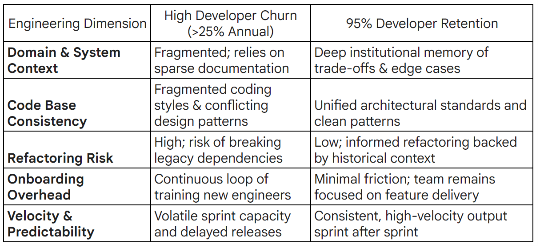
3 Pillars of Architectural Stability Through Retention
Building enterprise-grade systems that scale relies on three architectural benefits unlocked by team stability:
1. Preservation of System Lineage & Trade-off Context
Every enterprise architecture represents hundreds of micro-decisions. A team with a 95% retention rate preserves the "why" behind original database schemas, security middleware choices, and API contracts. This historical awareness prevents modern teams from re-introducing past failures or tearing down deliberate structural constraints.
2. Standardized Design Patterns & Clean Code Continuity
Long-tenured engineering teams establish natural operational rhythms and shared coding standards. Over time, code reviews become sharper, pull requests merge faster, and architectural patterns remain consistent across microservices, preventing the patchwork code structure common in high-turnover environments.
3. Accelerated Feature Velocity Without Quality Degradation
When engineering pods remain intact long-term, their cycle time drops dramatically. Developers spend less time decoding legacy pipelines or waiting for domain clarification and more time delivering production features, conducting thorough code reviews, and optimizing core performance.
Secure Your Engineering Continuity with Talentus Global
Building stable, high-performing engineering teams without domestic hiring delays requires access to dedicated, long-term technical talent.
Talentus Global provides dedicated nearshore LATAM software engineering pods boasting a 95% retention rate to protect and scale your architecture.
For over 30 years, Talentus Global has been a trusted technical partner in enterprise software engineering, cloud architecture, and MLOps. Our nearshore LATAM engineering teams specialize in full-stack development, cloud modernization, enterprise integrations, and AI pipelines.
Operating 100% synchronously in your US timezone (EST/CST), our pre-vetted LATAM engineering pods deploy in as little as 48 hours while maintaining industry-leading retention standards.
- 100% US Timezone Alignment: Collaborate synchronously with senior developers during standard EST/CST working hours.
- Deploy in 48 Hours: Bypass domestic hiring friction and launch pre-vetted LATAM engineering pods immediately.
- 95% Developer Retention Rate: Eliminate continuous retraining cycles and protect your codebase with long-term team stability.
Eliminate technical debt and secure your architectural roadmap. Click here and partner with Talentus Global today