As multi-agent LLM workflows scale in enterprise production, managing context window utilization becomes a primary architectural bottleneck.
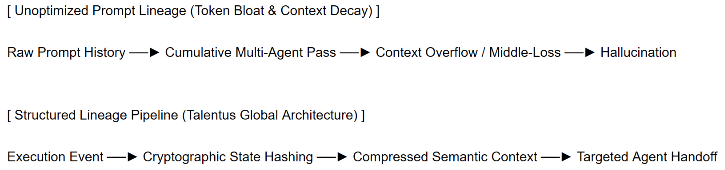
Passing raw, cumulative conversation histories across multi-step agent networks quickly leads to context window bloat, model hallucinations, and exponential token costs.
When system context exceeds optimal boundaries, models struggle with "middle-loss" phenomena, failing to recall critical instructions buried in long prompt sequences.
Resolving context degradation without losing execution history requires structured prompt lineage pipelines. By decoupling state management from raw prompt logs, MLOps teams maintain strict reasoning accuracy while optimizing token consumption.
The Operational Friction of Unmanaged Context Lineage
Relying on raw prompt accumulation across long-running agent workflows introduces severe MLOps challenges:
- Attention Degradation (Middle-Loss): As context windows grow, LLM retrieval performance drops significantly for information located in the middle of the prompt history.
- Runaway Token Overhead: Re-sending static historical context across every execution step inflates API costs exponentially without increasing response quality.
- Loss of Auditability & Lineage Tracking: Without explicit prompt provenance, debugging why an autonomous agent took a specific action becomes nearly impossible.
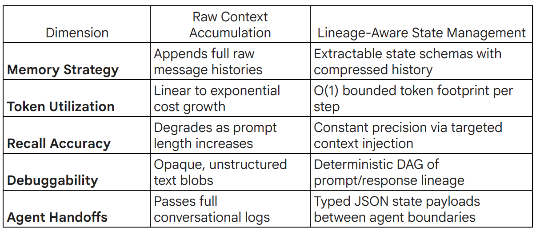
Raw Context Accumulation vs. Lineage-Aware State Management
Shifting to structured prompt lineage transforms agent performance and cost predictability:
3 Pillars of Lineage-Aware Context Management
Building enterprise-grade MLOps pipelines for long-running AI workflows requires three core operational strategies:
1. Deterministic Token Compression & Selective Pruning
Replace naive sliding-window context drops with semantic state summarization. Isolate immutable system directives, extract key entity states into structured schemas, and prune redundant intermediate execution logs before routing prompts to downstream agents.
2. Cryptographic Prompt Lineage & Directed Acyclic Graphs (DAGs)
Track every prompt transformation, tool output, and model response as a node in a Directed Acyclic Graph (DAG). Assigning unique execution hashes to prompt states allows engineers to inspect exact decision trees and replay failing steps during post-mortems.
3. Strongly-Typed Agent Handoff Schemas
Eliminate unstructured natural language handoffs between autonomous agents. Enforce strict Pydantic or JSON Schema boundaries for inter-agent communication, ensuring agents receive only the exact state variables necessary to execute their assigned task.
Optimize Your MLOps Pipelines with Talentus Global
Designing token-efficient LLM architectures, multi-agent orchestrations, and context management systems requires senior MLOps engineers and AI systems developers.
Talentus Global provides dedicated nearshore LATAM software engineering pods to build, scale, and optimize your production AI infrastructure.
For over 30 years, Talentus Global has been a trusted technical partner in enterprise software engineering, cloud architecture, and MLOps. Our nearshore LATAM development teams specialize in agentic AI networks, vector database architecture, custom middleware, and production LLM integration.
Operating 100% synchronously in your US timezone (EST/CST), our pre-vetted LATAM engineering pods deploy in as little as 48 hours to accelerate your AI roadmap with zero timezone drag.
- 100% US Timezone Alignment: Collaborate synchronously with senior AI/MLOps engineers during standard EST/CST working hours.
- Deploy in 48 Hours: Bypass domestic recruiting bottlenecks and launch specialized engineering pods immediately.
- 95% Developer Retention Rate: Retain deep architectural knowledge and codebase stability across long-term AI initiatives.
Control your LLM API costs and eliminate context degradation. Explore our AI options for your business by clicking here.