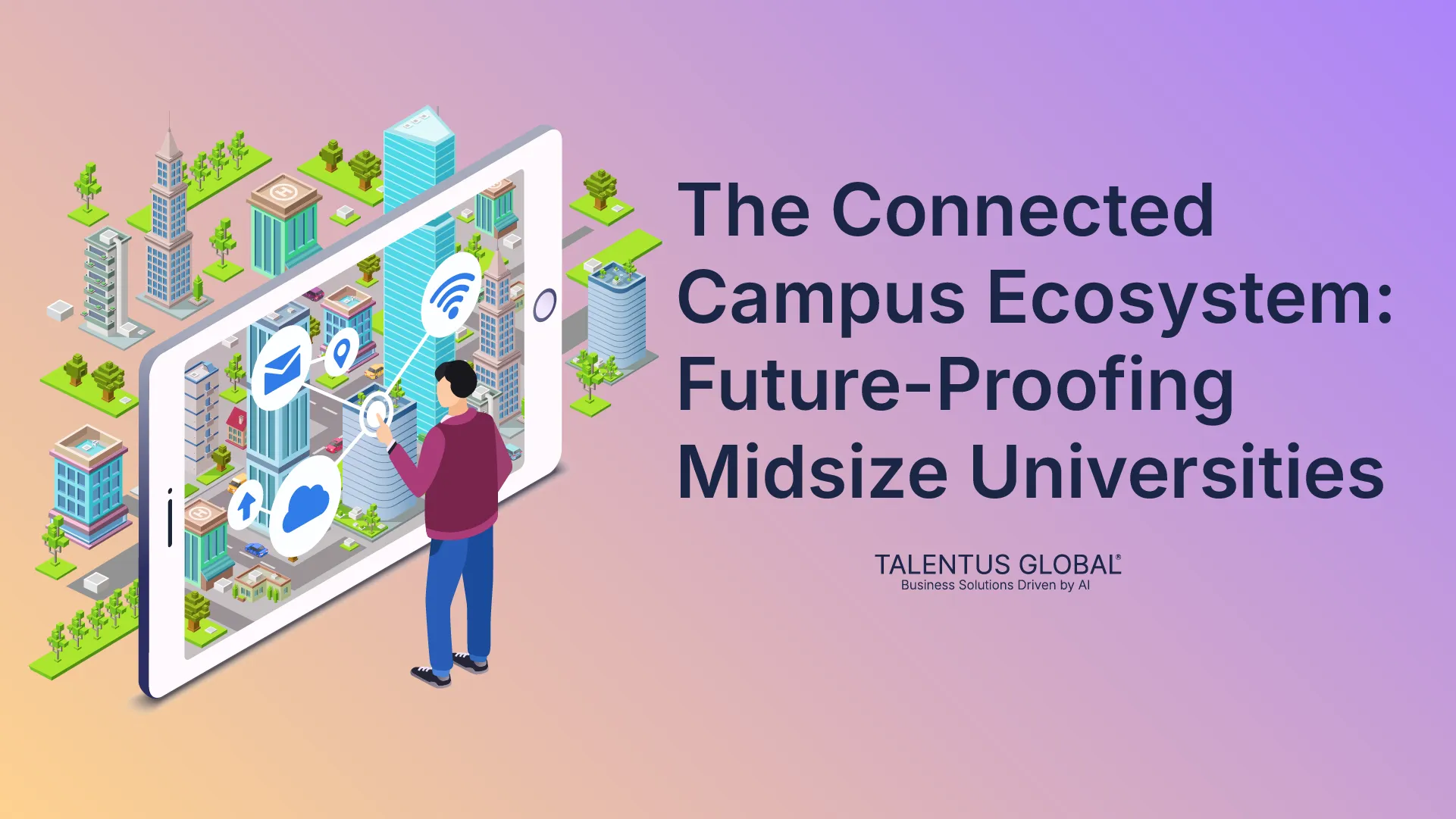
In higher education, midsize universities occupy a challenging operational space. They face the exact same digital expectations as massive tier-1 research institutions, students demand seamless mobile experiences, advisors require real-time risk alerts, and leadership expects advanced analytics. Yet, midsize institutions must deliver these modern capabilities with a fraction of the budget and a lean, often overextended IT department.
Historically, achieving a fully unified campus tech stack meant entering into multi-year, multi-million-dollar custom integration projects.
In 2026, that legacy approach is a recipe for stagnation. To remain competitive, optimize enrollment, and protect operational margins, midsize universities must pivot toward a connected campus ecosystem, a cloud-native, configuration-first architecture that unifies systems quickly without breaking the bank.
1. The Midsize Challenge: High Expectations, Brittle Systems
For midsize institutions, technical debt accumulates silently behind departmental walls. When the Student Information System (SIS), Learning Management System (LMS), and admissions CRM exist as isolated software islands, operational friction skyrockets:
The Sourcing Bottleneck: Domain expertise becomes tied to single individuals. If your solo custom-middleware programmer leaves, your entire integration pipeline stalls.
The "Shadow IT" Explosion: When central IT is too backed up to connect new tools, individual departments bypass security and buy standalone software, creating risky data silos.
Delayed Decision Making: Midsize leadership cannot afford to steer institutional strategy based on reports pulled from stale data compiled weeks prior.
Siloed Infrastructure: SIS Pool ←(Stale Nightly Batch)→ LMS Pool ←(Manual Export)→ CRM Pool
Connected Ecosystem: SIS Data 🔁 Cloud Integration Gateway 🔁 LMS Data 🔁 CRM Data
2. The Pillars of a Connected Campus Architecture
Future-proofing a midsize institution doesn't require a total software replacement cycle. Instead, it requires establishing a secure, real-time data layer that allows your current systems to act as a singular, cohesive ecosystem.
Bi-Directional Live Synchronization
True connectivity means moving away from slow, one-way batch scripts. When your SIS and LMS communicate continuously in both directions, an administrative hold or a change in enrollment status updates the student’s digital learning environment instantly. This eliminates manual cross-referencing and minimizes administrative security risks.
A Unified Student 360 View
By breaking down silos, academic advisors, financial aid officers, and registrar teams finally gain access to a single source of truth. Seeing behavioral engagement metrics from the LMS right alongside financial and administrative records in the CRM allows for faster, highly contextualized student support.
3. The Automation Leap: Preparing for Agentic AI
For midsize universities, the ultimate return on investment (ROI) of a connected ecosystem is its ability to support advanced automation. You do not need a massive staff if your software infrastructure can think and act proactively.
Clean, multi-directional data flows lay the exact foundation required to deploy Agentic AI solutions. Autonomous software agents can continuously monitor live campus data streams to detect complex indicators of student risk. Instead of waiting for midterm grades to drop, an intelligent agent can recognize a decline in LMS participation, cross-reference it with financial aid status, and automatically trigger a personalized outreach workflow across departments instantly.
For a midsize university, this type of cognitive automation acts as an immediate force multiplier for student retention teams.
The Talentus Velocity: Midsize universities don't need a massive internal IT army to build an elite digital campus. At Talentus Global, we specialize in accelerating institutional transformation by pairing our cloud-native EdTech Connectors Marketplace with specialized nearshore software engineering and data pods. We help you deploy secure, bi-directional integrations in days rather than months, slashing your Total Cost of Ownership (TCO) and setting up the data pipelines required to run next-generation Agentic AI frameworks safely.
Let’s turn your integration backlog into immediate institutional velocity, let's connect by clicking here