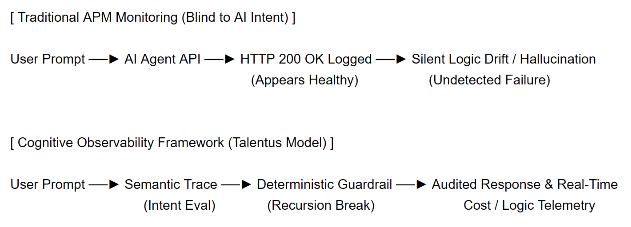
Standard APMs logging an HTTP 200 just mean the server responded. For autonomous AI agents, this reveals nothing about hallucinations, intent drift, or infinite token loops.
As organizations deploy multi-agent systems to handle complex workflows across platforms like Canvas LMS, Element451, and Thesis Elements, relying on legacy server metrics creates massive operational blind spots.
To safely scale autonomous AI without risking budget overruns or logic failures, enterprise technology leaders must transition from server-level telemetry to Cognitive Observability and Deterministic Guardrails.
The High Risk of Unmonitored Agentic Workflows
Deploying autonomous AI agents without semantic telemetry exposes enterprise and higher education networks to silent, high-impact failure modes:
- Silent Logic Drift and Hallucinated Actions: An agent handling automated student advising might return a successful API status code while accurately passing incorrect prerequisite requirements from Thesis Elements to a student in Element451.
- Runaway API Token Expenses: When an autonomous agent hits an unexpected edge case or ambiguous input, open-ended retry loops can resubmit expanding prompt histories indefinitely, consuming thousands of dollars in API credits within minutes.
- Opaque Decision Pathways: Without step-by-step semantic logging, engineering teams cannot audit how an agent arrived at a given output, making debugging and root-cause analysis nearly impossible.
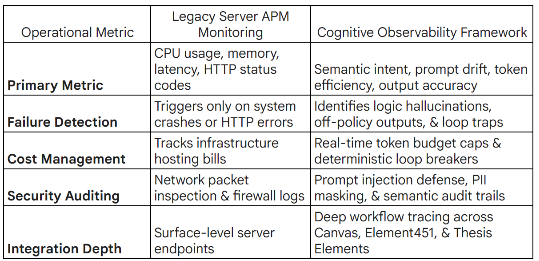
Legacy Server APM vs. Cognitive Observability Framework
Upgrading your telemetry architecture replaces basic ping checks with deep cognitive evaluation of model behavior:
3 Pillars of Cognitive AI Observability
Building a resilient, controllable AI agent architecture requires three core engineering safeguards:
1. Real-Time Semantic Reasoning Traces
Go beyond logging input and output strings. Implement intermediate step tracing that evaluates an agent's reasoning chain at every node. By parsing tool calls, retrieval parameters, and confidence scores in real time, engineers can intercept non-deterministic errors before they impact end-users.
2. Deterministic Recursion Breaks and Token Limits
Never allow an autonomous agent to run open-ended retries. Implement hard, deterministic execution boundaries that enforce maximum recursion depths and token caps per transaction. If an agent fails to resolve a prompt within defined parameters, the system cleanly gracefully degrades to human-in-the-loop oversight.
3. Unified Middleware Integration via EdTech Connectors
Embed cognitive observability directly into your core business applications. Utilizing EdTech Connectors ensures that agentic workflows interacting with Canvas LMS, Element451 CRM, and Thesis Elements SIS are fully logged, FERPA-compliant, and governed by centralized security policies.
Secure Your AI Architecture with Talentus Global
Deploying enterprise-grade AI agents requires advanced LLMOps telemetry, cloud data architecture, and disciplined DevSecOps execution.
Talentus Global provides dedicated nearshore LATAM software engineering pods to build, observe, and scale your autonomous AI infrastructure.
For over 30 years, Talentus Global has been a trusted leader in enterprise digital transformation and advanced technology integration. Our nearshore developers specialize in agentic AI networks, cognitive observability frameworks, private LLM deployments, and seamless integrations across Canvas, Element451, Thesis Elements, and enterprise ERP systems.
- Operating 100% synchronously in your US timezone (EST/CST), our pre-vetted LATAM engineering pods deploy in as little as 48 hours to secure your AI roadmap.
- 100% US Timezone Alignment: Collaborate in real time with senior developers during standard EST/CST business hours.
- Deploy in 48 Hours: Bypass domestic hiring delays and scale specialized AI engineering pods immediately.
- 95% Developer Retention Rate: Preserve deep architectural context across multi-year AI governance initiatives.
Gain complete control over your autonomous AI networks. See how we shape the future with AI by clicking here