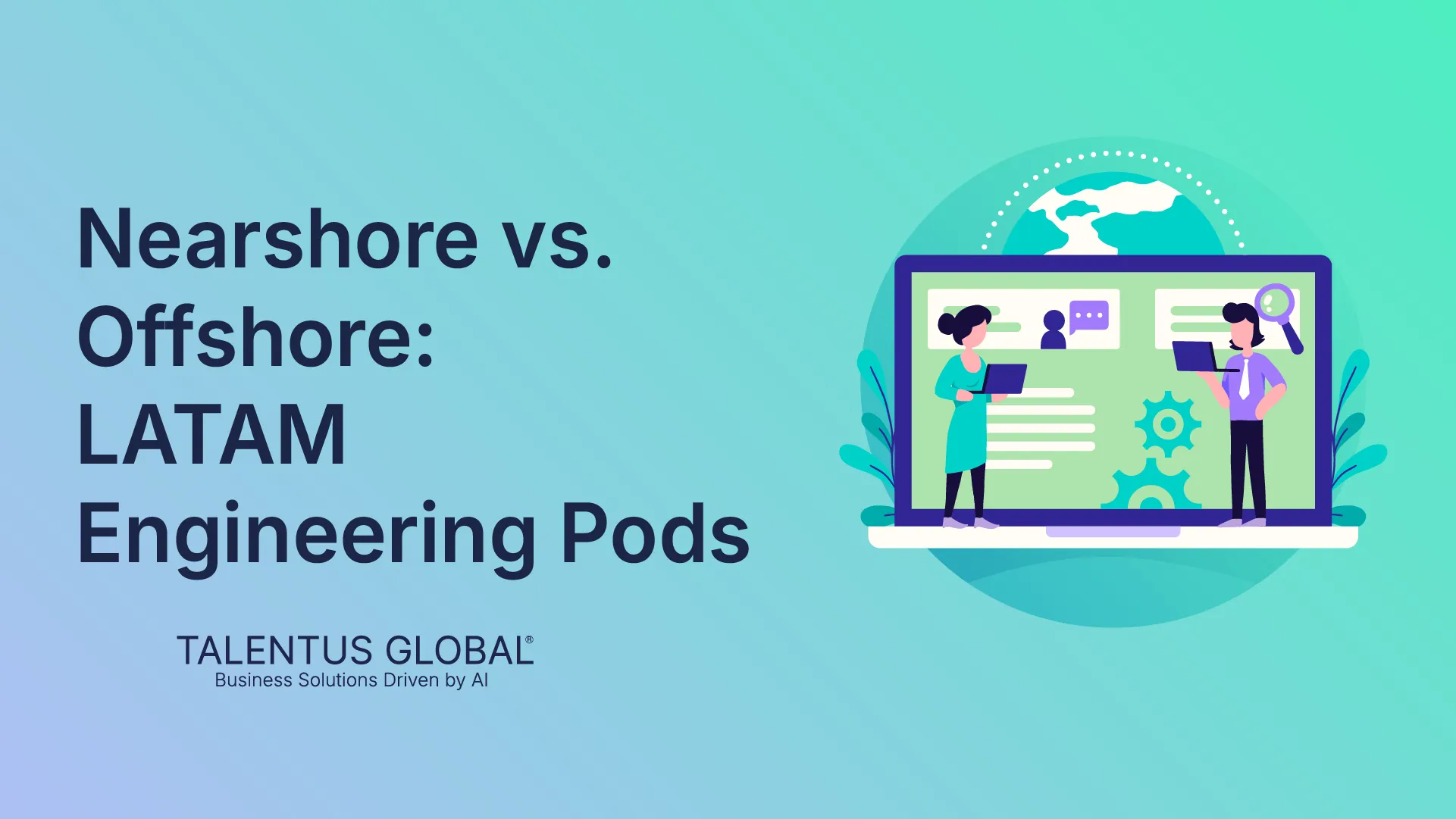
Engineering leaders scaling software engineering capabilities face a critical operational crossroads: traditional offshore outsourcing versus nearshore LATAM development teams.
While traditional offshore destinations in Eastern Europe or South Asia often advertise low hourly rates on paper, high timezone friction, delayed code reviews, and communication barriers frequently erode delivery velocity—significantly increasing total cost of ownership (TCO).
Nearshore Latin American (LATAM) engineering pods eliminate these hidden operational costs by combining 100% US timezone alignment, strong cultural cohesion, and real-time Agile execution.
The Hidden Costs of Traditional Offshore Engineering
Evaluating software development partners requires looking beyond baseline hourly rates to measure true engineering throughput and operational friction:
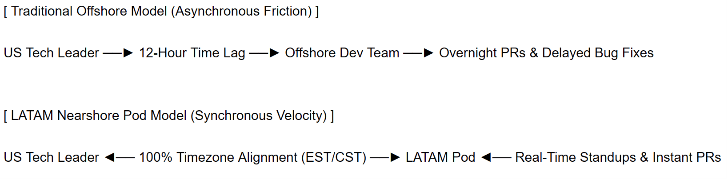
- The 12-Hour Feedback Loop: When US engineering leads submit pull requests, architecture feedback, or urgent bug tickets at 4:00 PM EST, offshore teams on the opposite side of the globe do not process them until midnight. A simple block that should take 15 minutes to resolve stretches into a 24-to-48-hour cycle.
- Agile Ceremonies in Isolation: Handing off tasks asynchronously forces engineering managers to operate as air-traffic controllers rather than collaborative leaders. Daily standups occur outside standard working hours, degrading team morale and limiting spontaneous problem-solving.
- High Turnover and Knowledge Decay: Traditional offshore software agencies frequently suffer from high developer attrition. Rotating engineers out of projects destroys institutional knowledge, requiring constant onboarding and increasing code decay.
LATAM Nearshore Pods vs. Traditional Offshore Models
Comparing execution metrics across key operational dimensions highlights the structural advantages of nearshore LATAM teams:
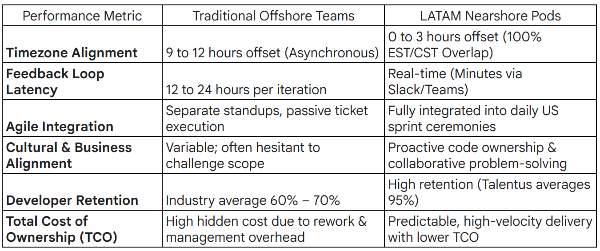
3 Drivers of LATAM Engineering Velocity
Transitioning to nearshore LATAM engineering pods unlocks three fundamental structural advantages for US technology organizations:
1. 100% Timezone Overlap & Real-Time Collaboration
Operating synchronously within standard EST, CST, or PST business hours allows LATAM engineers to work alongside your in-house staff. Code reviews, pair programming, architecture spikes, and emergency hotfixes happen live during your core working hours, eliminating overnight bottlenecks.
2. Proactive Engineering Culture & Communication
LATAM software engineers bring a proactive, ownership-driven approach to product development. Rather than passively completing Jira tickets without context, LATAM pods actively question flawed requirements, suggest architectural optimizations, and contribute directly to product strategy.
3. Rapid Onboarding and Codebase Continuity
Latin America has matured into a premier global hub for senior full-stack, cloud, DevSecOps, and AI software talent. Combined with low turnover rates, nearshore pods preserve deep domain context across long-term initiatives without the threat of unexpected team turnover.
Accelerate Software Delivery with Talentus Global
Scaling your engineering capacity shouldn't mean sacrificing code quality, team cohesion, or delivery speed.
Talentus Global provides dedicated nearshore LATAM software engineering pods engineered for immediate integration and continuous delivery.
For over 30 years, Talentus Global has helped enterprise technology leaders and Higher Ed organizations build, modernize, and scale complex software ecosystems. Our nearshore LATAM developers specialize in web architecture, microservices, API integrations, cloud engineering, and AI/LLM implementations.
Operating 100% synchronously in your US timezone (EST/CST), our pre-vetted LATAM engineering pods deploy in as little as 48 hours, allowing you to bypass domestic hiring bottlenecks without offshore friction.
- 100% US Timezone Alignment: Work side-by-side with senior engineers during your standard business hours.
- Deploy in 48 Hours: Scale specialized front-end, back-end, DevSecOps, and data pods immediately.
- 95% Developer Retention Rate: Maintain continuous codebase familiarity and long-term project stability.
Upgrade your engineering velocity. Explore our solutions clicking here