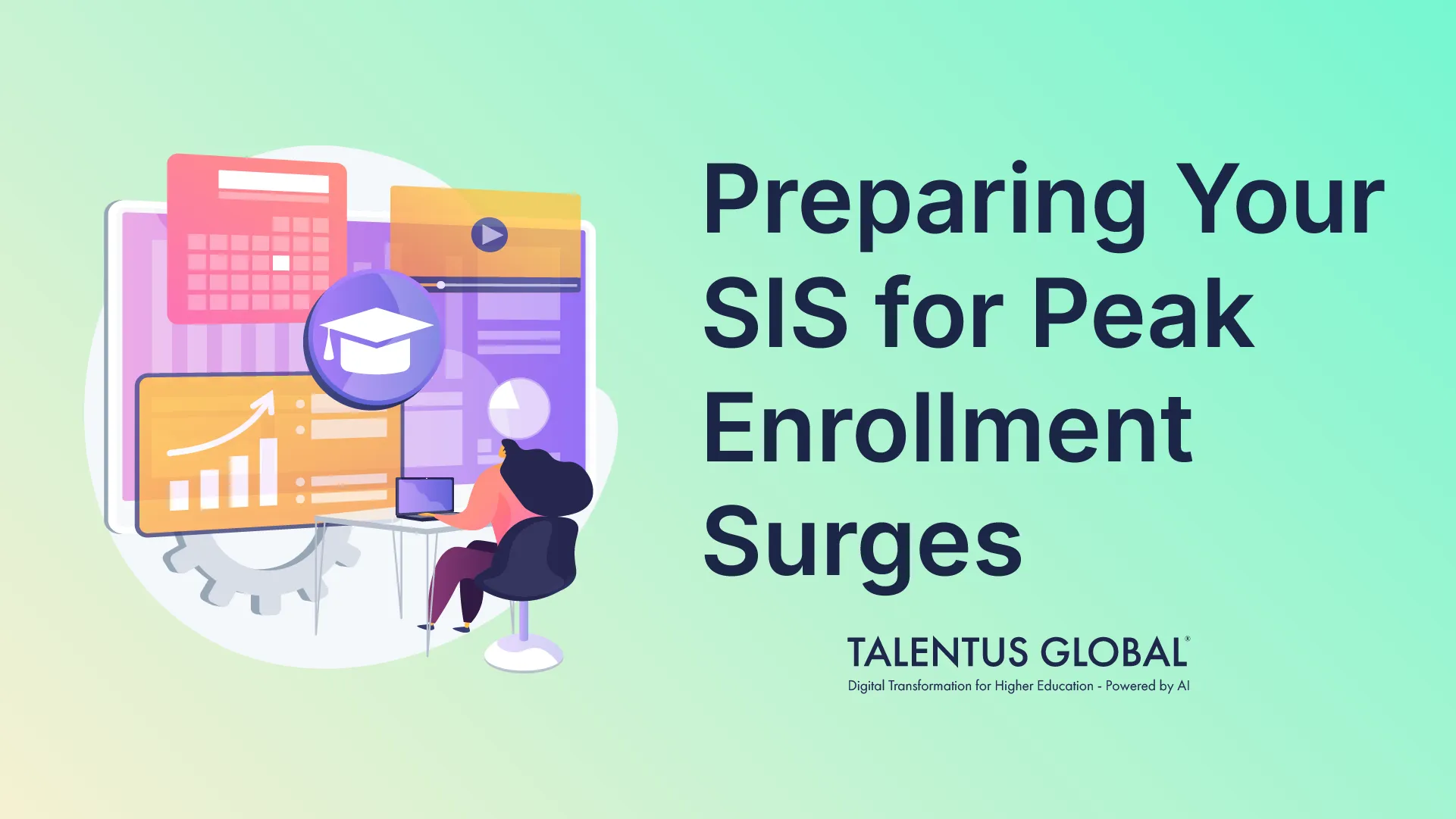
Peak enrollment registration brings thousands of concurrent students, faculty, and administrators to your Student Information System (SIS) simultaneously. Without elastic scalability and decoupled integrations, database locks and API timeouts stall course registration, delay financial aid disbursements, and overwhelm campus IT support.
Building architectural resilience into your SIS infrastructure ensures 100% system availability, preserving institutional revenue and delivering seamless enrollment experiences during critical academic windows.
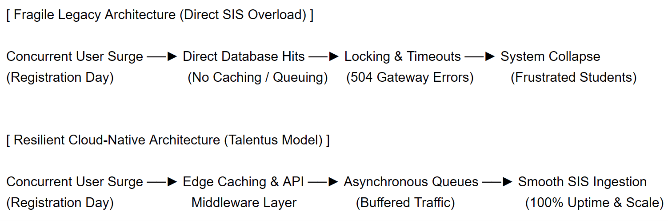
The Operational Risk of Peak-Load Failure
When legacy or tightly coupled SIS platforms crash under registration volume, higher education institutions suffer severe financial and operational setbacks:
- Lost Tuition and Registration Drops: System crashes disrupt student registration flows, causing drop-offs during high-intent enrollment periods.
- Database Locking and Cascading Failures: Unbuffered database writes across connected systems, such as Thesis Elements, Banner, Element451, and Canvas , trigger thread exhaustion and 504 gateway timeouts.
- Helpdesk Overload: IT departments are forced into crisis mode, burning hundreds of hours handling manual course registration overrides and password resets.
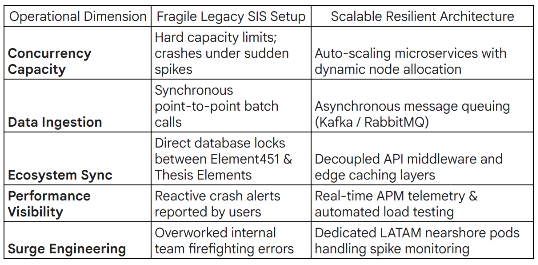
Fragile Legacy SIS Setup vs. Scalable Resilient Architecture
Modernizing your campus data architecture transitions your institution from vulnerable monolithic setups to high-concurrency elastic platforms:
3 Pillars of Architectural Resilience for SIS
Preparing your higher education technology stack for massive enrollment surges requires three structural engineering practices:
1. Asynchronous API Middleware and Traffic Buffering
Decouple front-end user portals and external CRMs like Element451 from your primary transactional database. Utilizing pre-built EdTech Connectors and message queues buffers incoming API payloads, allowing the core SIS (such as Thesis Elements or Banner) to ingest data at a controlled, stable rate.
2. Read-Replica Offloading and Edge Caching
Over 80% of registration traffic consists of read-only queries (viewing course catalogs, checking schedule availability, and reading financial aid status). Implement Redis edge caching and direct non-transactional traffic to read-replicas, reserving the primary database engine strictly for write operations like course enrollments.
3. Pre-Surge Load Simulation and Nearshore Pod Augmentation
Execute comprehensive stress testing months ahead of registration cycles to identify query bottlenecks and indexing gaps. Augmenting your engineering team with dedicated nearshore software pods provides the specialized bandwidth required to optimize database indexes, configure auto-scaling rules, and manage real-time spike operations.
Protect your campus registration experience. Ensure architectural resilience with Talentus Global today by clicking here