Modern software delivery demands high-velocity deployment, but broken CI/CD builds, dependency conflicts, and security test failures routinely stall release pipelines.
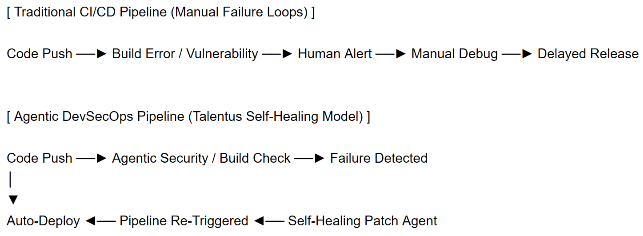
Traditional DevSecOps automation relies on static, rule-based scripts that break whenever environment configurations, API schemas, or code dependencies shift.
Agentic AI transforms CI/CD pipelines by introducing autonomous, self-healing execution loops. By embedding intelligent AI agents directly into build, testing, and security scanning phases, DevSecOps teams can automatically detect failures, diagnose root causes, generate code patches, and re-trigger pipeline execution in real time without human intervention.
The High Cost of Fragile CI/CD Automation
Relying on traditional, static pipeline automation introduces severe operational bottlenecks and developer fatigue:
Developer Context-Switching: Engineers lose hundreds of hours every quarter stopping feature work to troubleshoot minor dependency mismatches, broken linting rules, or failed integration tests.
Pipeline Deployment Freezes: A broken main branch or failing staging environment halts deployments across entire engineering teams while awaiting manual pull-request fixes.
Security Remediation Backlogs: Static Application Security Testing (SAST) tools generate thousands of vulnerability alerts, but manual patching backlogs leave critical CVEs unaddressed for weeks or months.
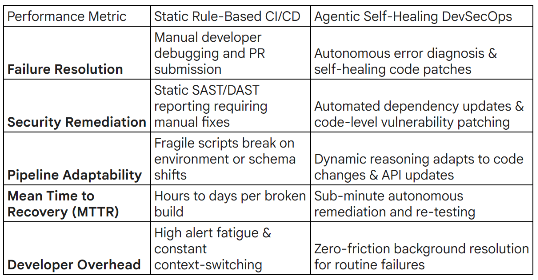
Static Rule-Based CI/CD vs. Agentic Self-Healing DevSecOps
Integrating agentic execution loops modernizes delivery velocity while dramatically reducing mean time to recovery (MTTR):
3 Pillars of Agentic AI in DevSecOps
Constructing a self-healing, agentic CI/CD pipeline requires three core architectural pillars:
1. Autonomous Error Diagnostics & Root-Cause Analysis
Deploy LLM-powered diagnostic agents at every pipeline stage. When a build or test fails, the agent instantly parses stack traces, build logs, and recent commit diffs to isolate the exact cause of failure in seconds, eliminating manual log hunting.
2. Context-Aware Code Patch Generation
Enable agents to generate precise code fixes. Upon diagnosing a syntax error, broken import, or failing test assertion, the agent writes a corrective patch, runs local unit tests within an isolated container, and commits the fix back to the pipeline branch.
3. Automated Vulnerability & Dependency Remediation
Streamline software composition analysis (SCA) and container security. Agentic workflows automatically identify vulnerable packages, evaluate breaking changes across version updates, upgrade dependencies, and verify pipeline pass criteria autonomously.
Scale Your Agentic DevSecOps Infrastructure with Talentus Global
Building autonomous, self-healing CI/CD pipelines and agentic AI architectures requires senior DevSecOps expertise, cloud data engineering, and disciplined AI governance.
Talentus Global provides dedicated nearshore LATAM software engineering pods to design, implement, and scale your automated engineering workflows.
For over 30 years, Talentus Global has been a trusted technical partner in enterprise software engineering, cloud architecture, and DevSecOps modernization. Our nearshore LATAM developers specialize in agentic AI frameworks, CI/CD automation (GitHub Actions, GitLab CI, Jenkins), container security, and LLMOps telemetry.
- Operating 100% synchronously in your US timezone (EST/CST), our pre-vetted LATAM engineering pods deploy in as little as 48 hours to accelerate your AI and DevSecOps roadmaps without domestic hiring friction.
- 100% US Timezone Alignment: Collaborate in real time with senior engineers during standard EST/CST working hours.
- Deploy in 48 Hours: Bypass domestic hiring bottlenecks and launch specialized AI and DevSecOps pods immediately.
- 95% Developer Retention Rate: Protect institutional knowledge and codebase stability across long-term initiatives.
Automate your software delivery pipeline. Explore our AI options clicking here