Autonomous AI agents achieve real-world utility through function calling, the ability to invoke external APIs, execute database queries, and trigger workflows across enterprise software systems.
However, granting AI agents active write access to production backends introduces critical security vulnerabilities. Indirect prompt injection, malicious tool parameter tampering, and unintended multi-step execution loops can lead to severe operational damage: unauthorized database mutations, sensitive data exfiltration, or accidental API call floods across core enterprise tools.
Without strict, deterministic security guardrails intercepting the tool execution pipeline, an autonomous agent given tool access is an unauthenticated, non-deterministic root user waiting to be exploited.
[ Unsecured Function Calling (High Exploit & Corruption Risk) ]

  Malicious Input / Injection ──► LLM Agent ──► Unsanitized Tool Call ──► Enterprise ERP / SIS / CRM
                                                                                │
                                                                                ▼
                                                                  (Data Leakage / Unintended Deletion)


[ Guardrailed Agent Execution Pipeline (Talentus Global Security Model) ]

  User Prompt ──► LLM Agent ──► Schema & Input Validator ──► Scoped Token RBAC ──► HITL Approval Gate ──► Safe API Execution
                                                                                                               │
                                                                                                               ▼
                                                                                                           SIS / ERP
The High Risk of Uncontrolled Agent Tool Execution
Deploying function-calling LLM agents directly to enterprise production environments exposes systems to unique vector threats:
- Indirect Prompt Injection: A malicious payload hidden within an unverified data source (e.g., a PDF transcript or CRM support ticket) tricks the agent into calling sensitive backend functions like administrative privilege escalation.
- Parameter Drift & Type Violation: LLMs frequently hallucinate or alter function parameters, passing invalid data types, out-of-bound numerical ranges, or malformed JSON into enterprise API endpoints.
- Unbounded Privilege Escalation: Executing tool calls under a single high-privilege service account allows agents to bypass traditional application-level authorization controls, executing mutations far beyond the active user's permissions.
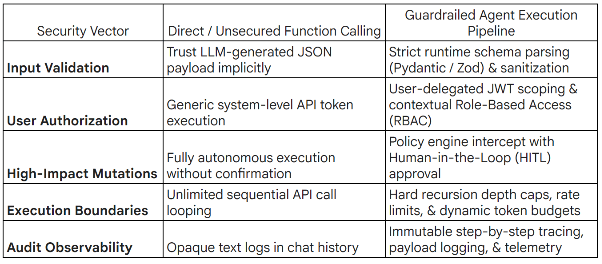
Unsecured Tool Calling vs. Guardrailed Agent Architecture
Securing agentic workflows requires shifting from direct LLM-to-API execution to an enterprise MLOps proxy model:
3 Pillars of Function Calling Security Guardrails
Securing agentic tool execution relies on three fundamental engineering guardrails placed between the LLM orchestration layer and enterprise backends:
1. Deterministic Schema Validation & Input Sanitization
Never pass raw LLM tool outputs directly to an API handler. Insert an intermediate validation proxy that parses generated arguments against strict runtime schemas (e.g., Pydantic or Zod models). The proxy validates data types, enforces numerical boundaries, strips potential SQL injection or script payloads, and fails safely before an API request is dispatched.
2. Context-Aware RBAC & Delegated Token Scoping
Decouple agent execution from service-account superuser privileges. Pass the original user's contextual authorization token (OAuth 2.0 / JWT) through the tool execution pipeline. When an agent attempts to query the SIS for student grades or update employee records in the ERP, the tool proxy evaluates the request against the active user’s explicit RBAC permissions, blocking unauthorized calls regardless of what the prompt instructions request.
3. Policy-Based Interceptors & Human-in-the-Loop (HITL) Gates
Classify all agent functions into risk tiers:
- Low Risk (Read-Only): Querying course schedules in the LMS or checking account balances in the ERP. Autonomously executed.
- High Risk (Mutations & Financials): Disbursing aid packages in PowerFAIDS, modifying lead records in Salesforce (CRM), or triggering bulk emails via HubSpot.
- High-risk functions pause execution, posting an interactive approval card directly to Microsoft Teams, Zoom, or an admin dashboard requiring explicit human verification before proceeding.
Secure Your AI Infrastructure with Talentus Global
Engineering secure agentic workflows, custom MLOps middleware, and enterprise API guardrails requires experienced cloud architects, security developers, and backend integration engineers.
Talentus Global provides dedicated nearshore LATAM software engineering pods to design, build, and harden your enterprise AI pipelines.
For over 30 years, Talentus Global has been a trusted technical partner in enterprise software engineering, cloud architecture, MLOps, and higher ed digital transformation. Our nearshore LATAM development teams specialize in AI agent orchestration, secure function-calling middleware, API gateway security, and enterprise integrations across Workday, Oracle, Thesis Elements, Salesforce, Canvas, and PowerFAIDS.
Operating 100% synchronously in your US timezone (EST/CST), our pre-vetted LATAM engineering pods deploy in as little as 48 hours to accelerate your AI security roadmap without timezone or communication friction.
- 100% US Timezone Alignment: Collaborate synchronously with senior MLOps developers during standard EST/CST working hours.
- Deploy in 48 Hours: Bypass domestic hiring bottlenecks and scale specialized AI engineering pods immediately.
- 95% Developer Retention Rate: Retain deep architectural knowledge and codebase stability across long-term AI initiatives.
Harden your autonomous AI agents and protect enterprise data. Partner with Talentus Global today.