Students decide long before they call admissions. Walk the path from first search to a submitted application and see where your site, program pages, forms and follow-up lose people, with one practical fix and one number to track at each step.
Digital marketing for universities works when it makes each step from first search to submitted application easy for the student. Most prospective students research online long before they talk to anyone, and they leave when pages are slow, program information is unclear or forms ask too much. Fix those moments, one step at a time, and more visits turn into applications.
This guide walks through that path and the practical fix at each step: search, website, program pages, forms, follow-up and measurement.
Digital marketing for universities: how students choose a school today
Prospective students now do most of their research on their own. The 2025 E-Expectations Trend Report from RNL shows that college-bound students look for clear information on programs, application steps and cost, and that their top website frustrations include program information that is hard to find, no search tool, contact details that are hard to locate and online forms that ask for too much.
Competition makes every lost visitor count. The National Student Clearinghouse Research Center reports that total enrollment was essentially flat in fall 2026 (up 0.2%), with a slight decline among 18-year-olds (down 0.7%). When the pool is not growing, higher education marketing has to waste less of the interest it already earns.
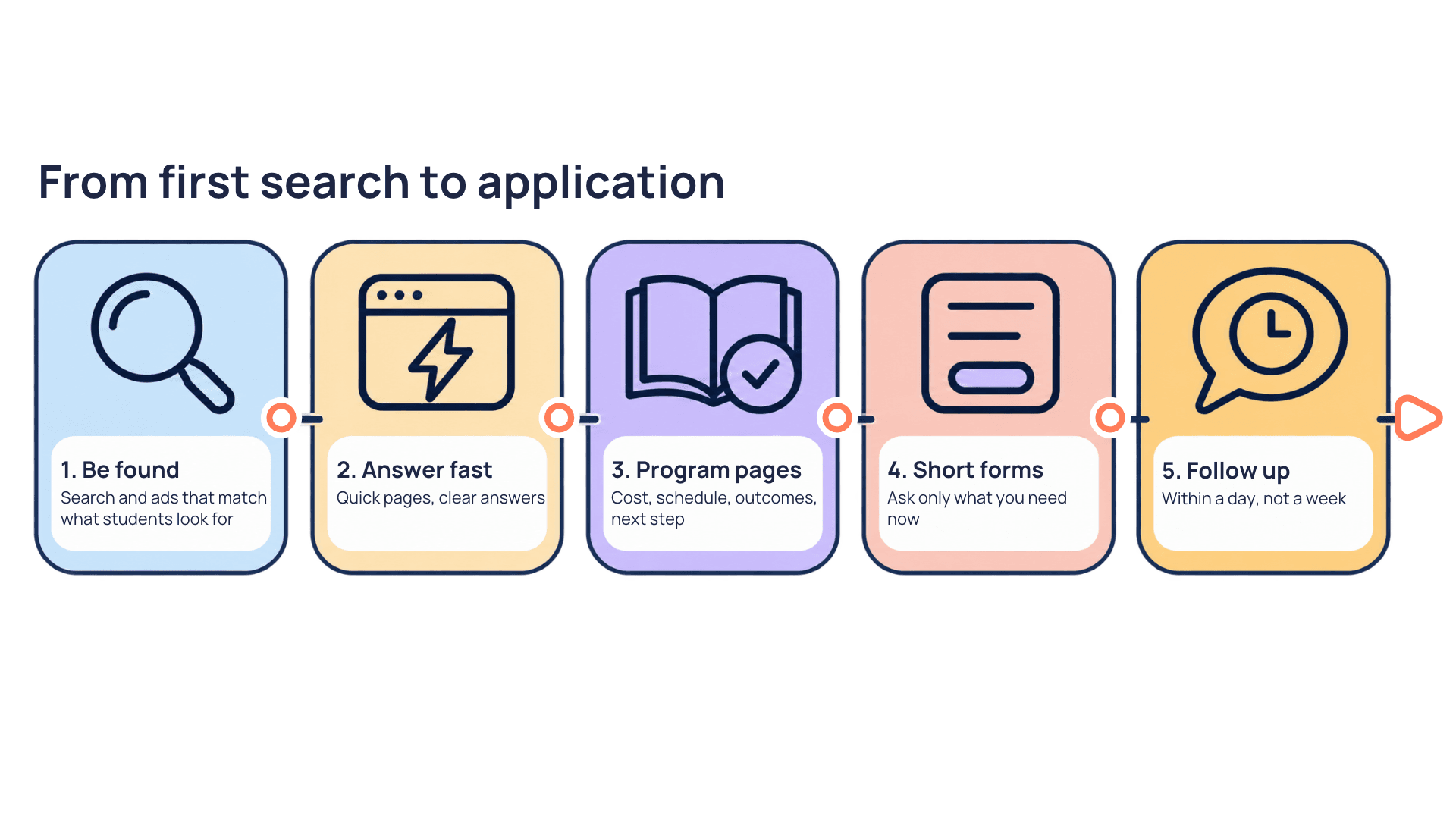
The path from first click to application has five steps. Each one can lose people, and each one has a fix.
Step 1: being found (search and paid media)
Students start with a question, not with your name. They search for a program, a career or a city. Your pages need to answer those searches in the words students use.
- Match real searches. Use your search data to learn how students describe the programs you offer, and use those words in page titles and headings.
- One page per program. A single page for each program ranks better and converts better than a long list of programs.
- Paid media with a clear landing page. Send each ad to the program page it talks about, never to the home page.
- Stay consistent. Program names, costs and deadlines should match across ads, search listings and your university website.
Social media belongs in this step too. Many students meet a university on social platforms before they ever visit its website, so short videos and posts from real students and faculty can do as much as an ad. Every post should still lead somewhere useful: the right program page, not a general landing page.
Step 2: a website that answers questions fast
A slow or confusing site loses students before they read a word. Google's Core Web Vitals give three simple targets for a good experience: the main content loads in 2.5 seconds or less, the page responds to a tap or click in 200 milliseconds or less, and the layout does not jump while it loads.
Beyond speed, check the basics:
- Mobile first. Many students browse on a phone, so test every key page on one.
- A working search box. Students expect to type "nursing" and find the nursing program.
- Easy contact. Show a way to reach admissions on every program page.
- Plain words. Replace internal terms and acronyms with the words students use.
Step 3: program pages that convert
Program pages are where interest turns into action. The NACAC Guide to Ethical Practice in College Admission asks institutions to describe their programs, costs and financial aid accurately and clearly. Good marketing and good ethics point in the same direction: honest, complete answers.
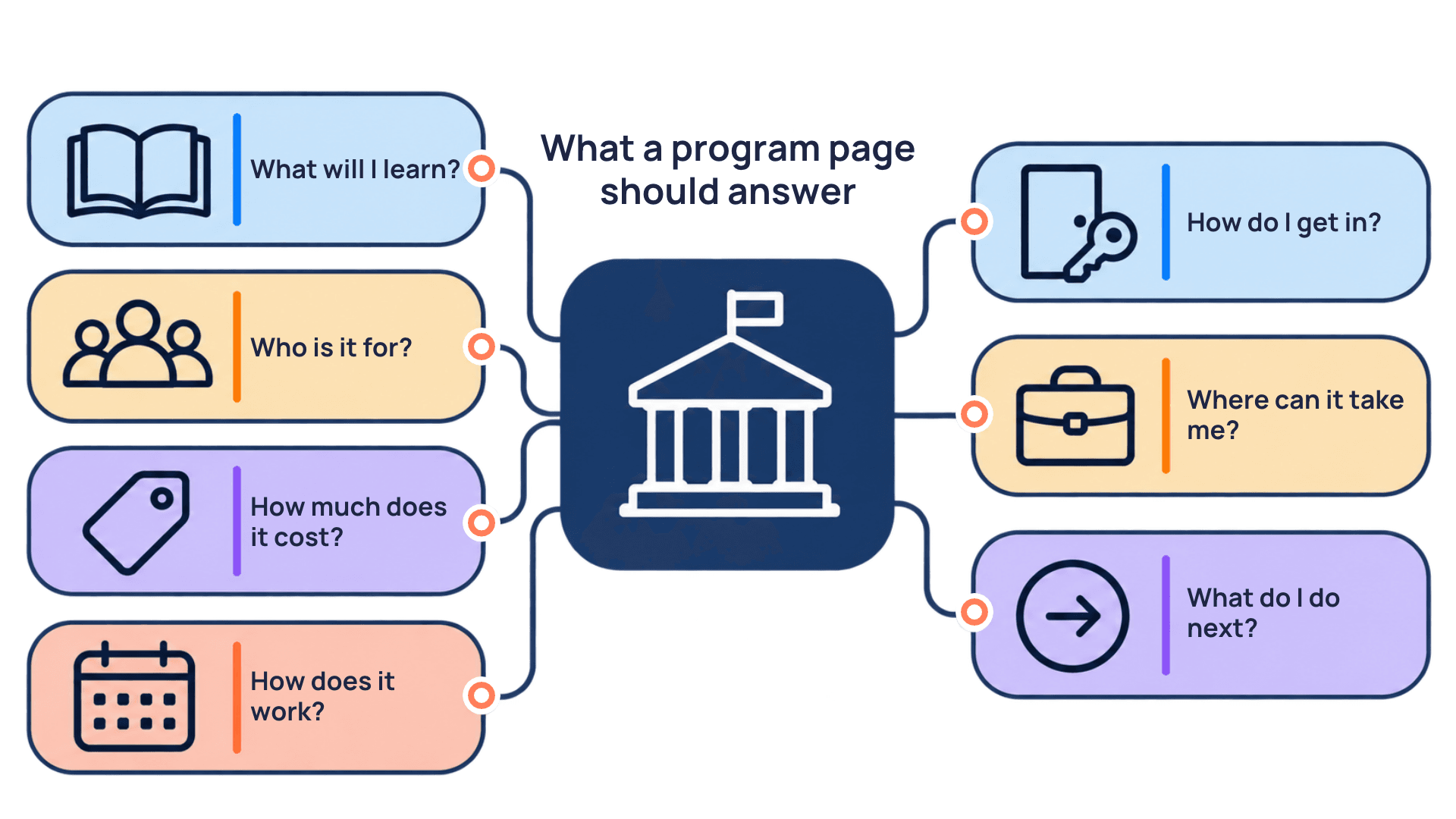
A strong program page answers these questions above the fold or close to it:
- What will I learn? A short, plain description of the program.
- Who is it for? First-year students, transfer students, working adults or graduate students.
- How much does it cost? Tuition, fees and the financial aid and scholarships available.
- How does it work? Schedule, format (on campus, online or hybrid) and length.
- How do I get in? Admission requirements and deadlines.
- Where can it take me? Careers and next steps after graduation.
- What do I do next? One clear call to action, such as "Request information" or "Start your application."
Step 4: forms and follow-up that do not lose people
Every extra field on a form is a reason to leave. Ask only for what you need now: name, email, program of interest and, if needed, phone number. You can learn the rest later.
Follow-up matters as much as the form. Student recruitment marketing works when a real person or a useful, personal message reaches the student quickly, within a day rather than a week. That message should answer the question the student asked and point to one next step.
Fast, personal follow-up depends on connected systems. When the customer relationship management (CRM) platform talks to the student information system (SIS), marketing data can follow the student from first inquiry to enrollment, and counselors see the full history. Talentus Global connects CRM platforms such as Salesforce, Element451 and HubSpot with SIS platforms. Learn more about integrating CRM and SIS.
Step 5: measuring what matters, from visit to application
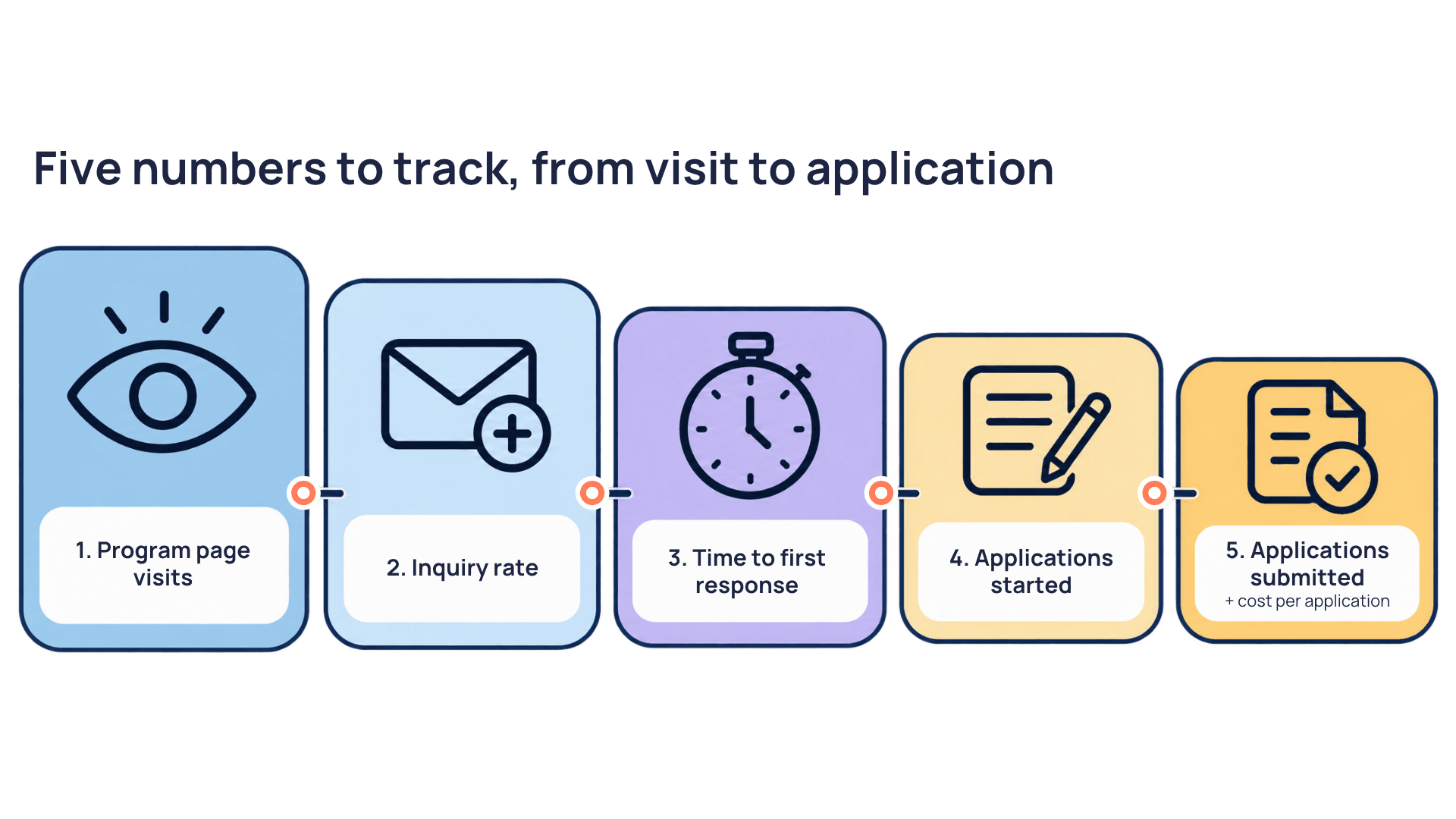
Clicks and likes are easy to count, but they do not show whether marketing works. Enrollment marketing needs numbers that connect each step to applications. Start with these five:
- Program page visits from the audiences you want to reach.
- Inquiry rate: the share of visits that turn into a form or a request.
- Time to first response: how long it takes to answer a new inquiry.
- Applications started from those inquiries.
- Applications submitted, and the cost to get each one.
Review these numbers every month, by program. When one step drops, you know exactly where to look. A program with plenty of visits but few inquiries needs a better page or a shorter form. A program with many inquiries but few applications needs faster, more personal follow-up.
Talentus Global's EdTech practice includes digital marketing for higher education, from brand positioning to campaigns, websites and the systems that connect them.
FAQ
What is digital marketing for universities?
It is the use of search, paid ads, websites, email and social media to help prospective students find a university, understand its programs and apply. Good university digital marketing focuses on the full path from first search to submitted application, not only on clicks or followers.
How fast should a university website load?
Google's Core Web Vitals suggest that the main content should load in 2.5 seconds or less, the page should respond to a tap in 200 milliseconds or less, and the layout should stay stable while it loads. Test program pages on a phone first, since many students browse on mobile.
What should a university program page include?
A clear description, who the program is for, cost and financial aid, schedule and format, admission requirements and deadlines, career outcomes and one clear next step. Students should find these answers without calling admissions. Accurate, complete information builds trust and helps students decide faster.
How should universities measure enrollment marketing?
Track five numbers by program: program page visits from target audiences, inquiry rate, time to first response, applications started and applications submitted, along with the cost per application. These numbers show where students drop off, so your team knows which step to fix first.
Next step
Want to see where your enrollment funnel is losing students? Talk to an EdTech specialist about your enrollment marketing.