As enterprises embed Large Language Models (LLMs) and generative agents into production applications, security teams are encountering a fundamental paradigm shift: in AI-driven systems, untrusted user input becomes executable code.
Traditional cybersecurity relies on perimeter defense, assuming that once a user or API call passes authentication, internal instructions remain safe. However, generative models treat developer instructions (system prompts), external data (RAG contexts), and untrusted user inputs as a single, combined text stream.
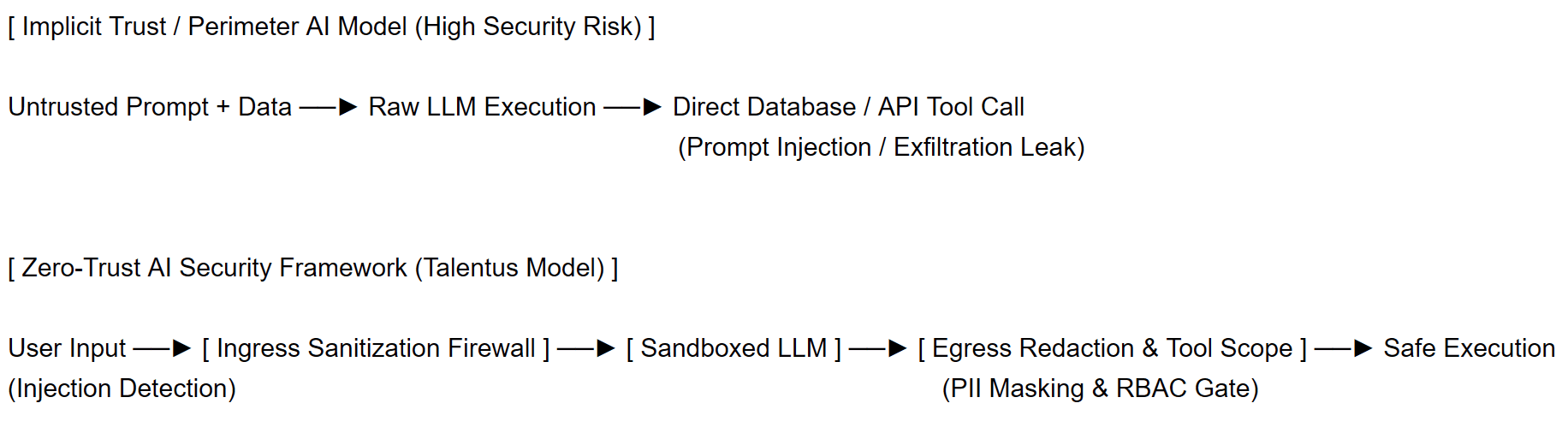
This architectural reality opens the door to severe vulnerabilities, most notably direct and indirect prompt injections, where malicious payloads hijack model behavior to exfiltrate database records, bypass system controls, or trigger unauthorized API actions.
To deploy generative AI without risking data breaches or compliance violations, DevSecOps leaders must apply a Zero-Trust AI Framework: Never trust user input, never trust model output, always verify every step of the reasoning chain.
The New Vulnerability Vector of Generative AI
Securing non-deterministic models requires defending against attack vectors that traditional Web Application Firewalls (WAFs) cannot detect:
- Direct Prompt Injection (Jailbreaking): Crafting adversarial prompts designed to override system instructions, force model policy violations, or leak the underlying system prompt.
- Indirect Prompt Injection: Hiding malicious instructions inside external data sources (e.g., a poisoned PDF, web page, or customer email processed via RAG) that execute when ingested by an autonomous agent.
- Data Exfiltration via Model Output: Tricking an agent into incorporating internal API keys, customer PII, or proprietary source code into external responses or third-party web requests.
- Confused Deputy Exploitation: Granting an AI agent broad backend API access, allowing an attacker to execute administrative actions through natural language prompts.
Implicit Trust vs. Zero-Trust AI Architecture
Moving to a Zero-Trust AI posture ensures security controls wrap around every model input, inference step, and tool invocation.
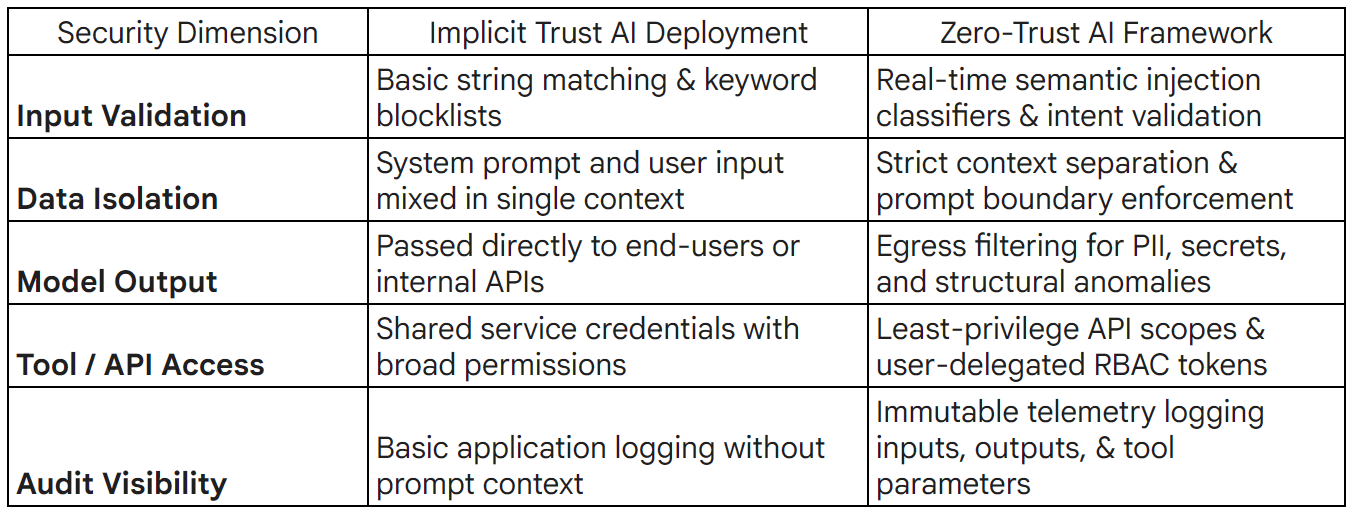
3 Pillars of Zero-Trust AI Security
Implementing a robust defense against prompt injection and exfiltration requires embedding three core security layers into your AI infrastructure:
1. Ingress Guardrails & Context Boundary Isolation
Before user text reaches the LLM, deploy dedicated lightweight classification models to detect adversarial intent and injection patterns. Enforce strict system-user context boundary markers, ensuring the model explicitly distinguishes between developer instructions and external user data.
2. Egress Filtering & Automated PII/Secret Redaction
Never allow raw model outputs to interact with end-users or downstream databases without inspection. Implement real-time output scanners that check for leaked API keys, credentials, PII (SSNs, medical records, financial data), or unauthorized code execution payloads.
3. Least-Privilege Tool Scope & Sandboxed Execution
AI agents should never execute tools using system-level privileges. Enforce granular Role-Based Access Control (RBAC) where agent actions are strictly constrained by the active user's permissions. Run code-execution tools inside ephemeral, network-isolated sandboxes to prevent unauthorized lateral movement.
Secure Your Enterprise AI Stack with Talentus Global
Building, auditing, and hardening Zero-Trust AI architectures requires specialized engineering talent capable of bridging cloud security, DevSecOps, and LLM orchestration.
Talentus Global provides the technical capacity to build secure, enterprise-grade AI pipelines.
For over 30 years, Talentus Global has been a trusted technology partner in digital transformation. Through our nearshore LATAM Global Delivery Centers, we deploy pre-vetted software engineering pods skilled in DevSecOps, enterprise AI security, API middleware, and custom telemetry.
Our senior engineers work directly alongside your CISO and development teams to implement robust AI firewalling, PII redaction filters, and sandboxed agent environments, allowing you to deploy generative capabilities with total security compliance.
- 100% US Timezone Alignment: Our LATAM developers operate synchronously during your business hours (EST/CST) for seamless collaboration.
- Rapid Pod Deployment: Bypass 60-day recruitment delays and deploy specialized DevSecOps engineering pods in under 48 hours.
- 95% Developer Retention: Ensure long-term stability and deep institutional knowledge across your security roadmap.
Protect your intellectual property and customer data. Secure your generative models with Talentus Global today.