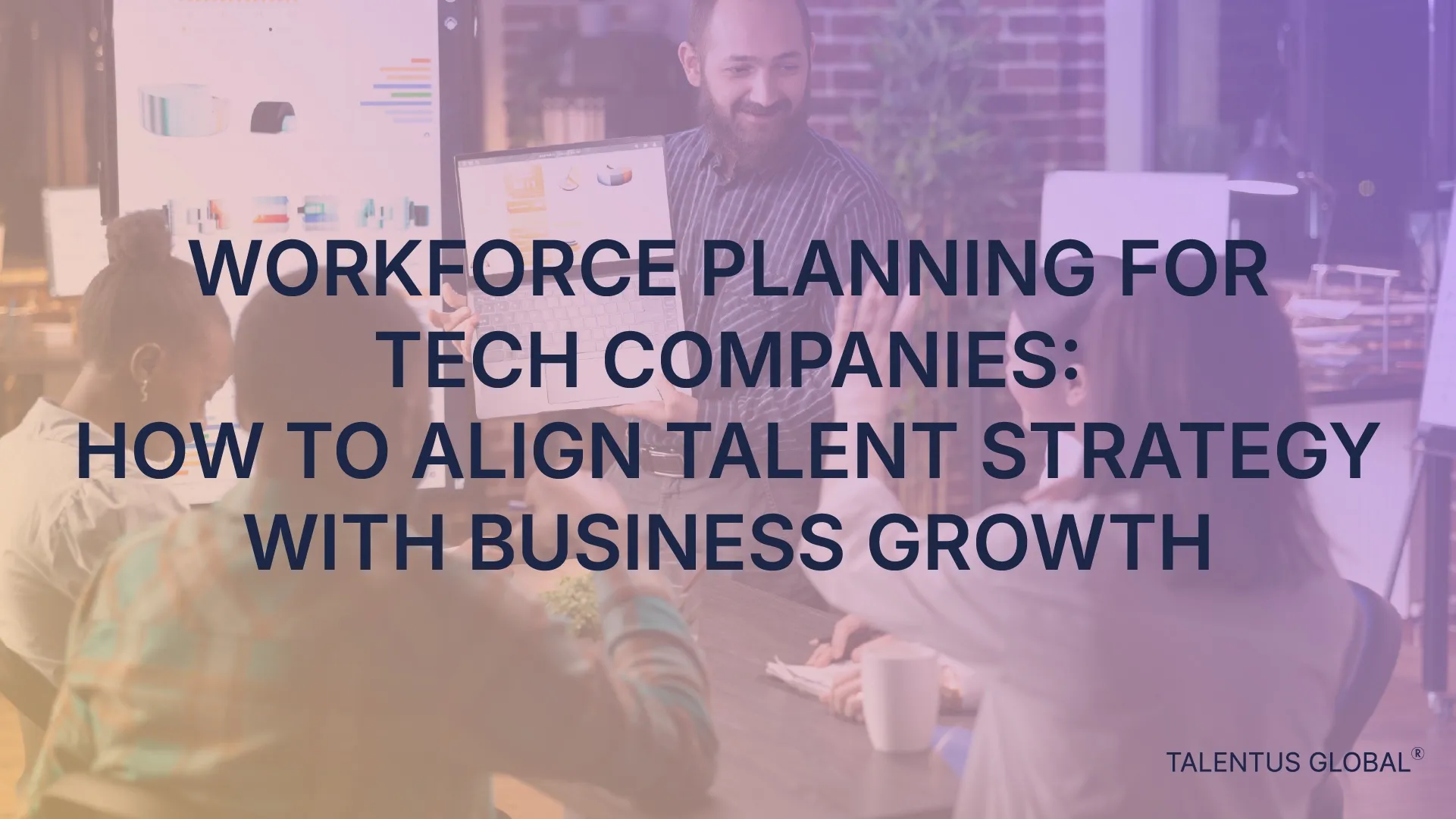
In the high-velocity market of 2026, a tech company’s roadmap is only as strong as its headcount strategy. Traditional hiring, reactive, slow, and localized, is no longer a viable way to scale. To maintain a competitive edge, leadership must move toward Strategic Workforce Planning: a predictive model that aligns talent acquisition with long-term business objectives.
At Talentus Global, we’ve seen that the most successful companies don’t just "fill seats." They architect Synchronized Clusters that bridge the gap between financial milestones and technical execution.
1. Moving from Reactive Hiring to Predictive Modeling
Most tech companies wait for a "bottleneck" to occur before opening a job req. By the time that role is filled (often 30–60 days later), the delay has already cost the company a month of product development.
The 2026 Strategy: Use Data-Driven Forecasting. Analyze your product roadmap for the next 12 months and identify the specific skill "spikes" you’ll need (e.g., a surge in Cloud FinOps during a migration or Agentic AI during an automation phase).
The Talentus Solution: Our Marketplace allows you to Select vs. Search. Instead of a 4-week lag, you can integrate pre-vetted leads into your workflow in just 48 hours, keeping your talent supply in perfect sync with your growth demands.
2. The "Core-and-Flex" Model
Maintaining a massive Onshore full-time staff for every niche requirement is a primary driver of high Burn Rate. In 2026, agile companies utilize a "Core-and-Flex" architecture.
The Core: A lean, high-level leadership team (Onshore) that owns the product vision and intellectual property.
The Flex: Specialized Dedicated Engineering Pods (Nearshore) that can be scaled up or down based on the current project phase.
The Result: This model provides the technical horsepower needed for growth without the permanent overhead of a bloated local payroll.
3. Nearshore Synchronization: The Secret to High-Performance Planning
Workforce planning fails when communication friction enters the equation. If your "Flex" team is 12 hours away, the cost of management often outweighs the savings of outsourcing.
The Alignment: By sourcing from Latin American Nearshore hubs, your workforce planning remains synchronized in real-time. Your US-based leads and LatAm engineers operate on the same business clock, ensuring that "Agile" isn't just a buzzword, but a daily reality.
4. Supporting the Plan with Managed IT
A workforce plan is only as effective as the tools the workers use. Strategic planning must include Managed IT Infrastructure to ensure that as you scale your remote clusters, your security protocols, hardware distribution, and software compliance remain standardized.
The Goal: Zero-friction onboarding. When a new cluster starts, they should be "code-ready" on Day 1, supported by a bulletproof IT environment.
Conclusion: Architect Your Growth
Workforce planning in 2026 is an exercise in Smart Sourcing. By aligning your talent strategy with your business roadmap, and utilizing a marketplace that prioritizes speed and time-zone synchronization, you turn your team into a scalable growth engine.
Is your workforce plan ready for your next milestone?
Find the specialized leads and pods you need in 48 hours at the Talentus Marketplace.