In 2026, the "War for Talent" has evolved into the "War for Engagement." With the widespread adoption of Agentic AI and the total normalization of Smart Sourcing, elite engineers have more autonomy and more global options than ever before. For tech leaders, the challenge is no longer just offering a competitive salary, it’s about preventing "Quiet Quitting" and "Brain Drain" in a hyper-distributed world
At Talentus Global, we’ve analyzed retention data across hundreds of Dedicated Engineering Clusters. The results are clear: retention in 2026 is driven by Synchronization, Support, and Substantive Impact.
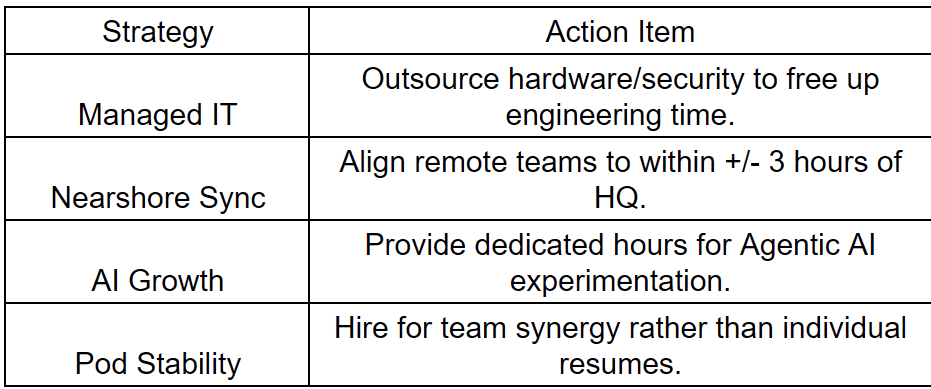
1. Kill "Operational Noise" with Managed IT
The fastest way to burn out a Senior Architect is to make them act as their own IT support. In 2026, top talent expects a seamless "Plug-and-Play" experience. If an engineer is spending hours troubleshooting hardware, VPNs, or software licenses, their job satisfaction plummets.
The Strategy: Implement a Managed IT framework that handles the entire lifecycle of your team’s equipment, from last-mile delivery in Latin America to automated security patches.
The Retention Gain: When you remove the friction of "work-about-work," your engineers spend 100% of their time on innovation, which is why they joined your company in the first place.
2. Prioritize "Time-Zone Synergy" (Nearshore > Offshore)
Isolation is the silent killer of remote teams. Engineers who work 12 hours out of sync with their leadership (the "Offshore Lag") often feel like "task-takers" rather than "team members." This lack of belonging is a primary driver of attrition.
The Strategy: Shift your distributed workforce to Latin American Nearshore hubs. Working in the same time zone allows for real-time Agile ceremonies, spontaneous "virtual hallway" chats, and instant PR reviews.
The Retention Gain: Proximity creates a "One Team" culture. When a developer in Medellin or Buenos Aires can collaborate live with a Product Owner in New York, they feel a deep sense of ownership and connection to the roadmap.
3. Provide a Roadmap for "Agentic Upskilling"
In 2026, engineers are terrified of stagnation. If your company isn't helping them master Agentic AI Orchestration and Cloud FinOps, they will find a company that does.
The Strategy: Don't just give them AI tools; give them the autonomy to build AI agents that optimize their own workflows. Encourage "Value Engineering" where developers are rewarded for optimizing cloud costs and architectural efficiency.
The Retention Gain: You aren't just giving them a job; you are increasing their market value. Engineers stay with companies that invest in their transition from "coders" to "orchestrators."
4. Move to "Pod-Based" Continuity
Hiring individual "lone wolves" is a retention risk. When one person leaves, the knowledge gap is catastrophic. In 2026, the most stable teams are Dedicated Clusters (Pods).
The Strategy: Scale using pre-assembled teams that have existing synergy. If you need to add capacity, add a pod that has already worked together.
The Retention Gain: Social glue is a powerful retention tool. Engineers are significantly less likely to leave when they have strong professional bonds with their immediate peers in a synchronized cluster.
Conclusion: Retention is an Architecture
You cannot "perk" your way into retention in 2026. Free snacks and Zoom happy hours have been replaced by the need for meaningful work in a frictionless environment. By focusing on Smart Sourcing and technical support, you build a culture that engineers don't want to leave.
Are your retention metrics trending the wrong way?
Find pre-vetted, synchronized leads and pods that fit your culture in 48 hours at the Talentus Marketplace.