Autonomous AI agents and multi-agent networks are transforming modern software development, automated testing, and enterprise workflows. By allowing agents to reason, write code, run terminal commands, and attempt self-correction, organizations are achieving unprecedented development velocity.
However, giving autonomous agents the ability to execute recursive retry loops without strict execution boundaries creates a severe operational and financial liability: infinite token loops.
When an AI agent encounters a syntax error, a breaking dependency, or a logical deadlock, its default prompt instructions often dictate that it analyze the error and try again.
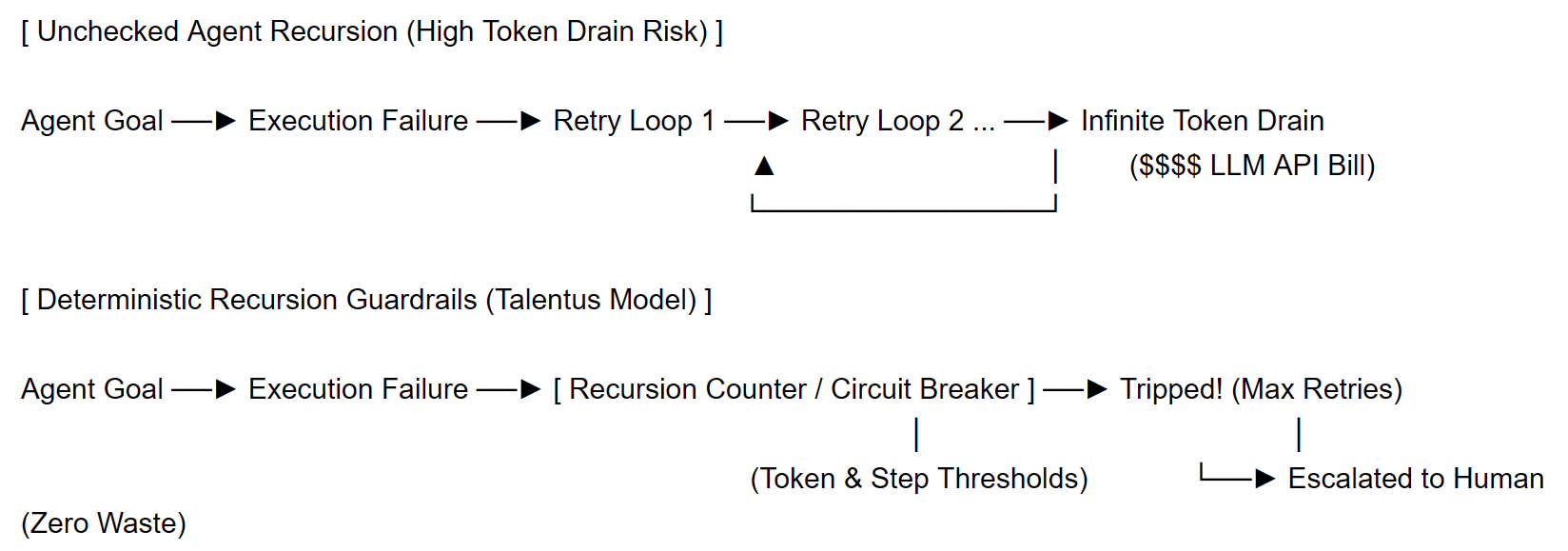
Without deterministic circuit breakers, the agent will repeatedly rewrite, re-evaluate, and re-submit the same flawed logic. Because LLM context windows grow with every iteration, these recursive loops resubmit expanding prompt histories, consuming millions of API tokens and burning through thousands of dollars in minutes.
To safely scale Agentic AI in enterprise software engineering, engineering leaders must replace open-ended retry loops with deterministic recursion breaks.
The Anatomy of an Infinite Token Loop
Infinite token loops occur when an autonomous system gets trapped in a cycle of failed self-correction. Understanding why these loops happen is the first step toward preventing them:
- Semantic Deadlocks: An agent attempts to satisfy two mutually exclusive constraints (e.g., resolving a linter error while maintaining a deprecated function signature). The agent toggles between two failing solutions indefinitely.
- Exponential Context Expansion: On attempt #1, the agent sends 2,000 tokens. On attempt #5, having accumulated error logs, terminal outputs, and previous code drafts, the agent sends 30,000 tokens per request. The cost per retry grows exponentially.
- API Rate Limit Exhaustion: A single rogue agent stuck in an rapid-fire loop can exhaust an organization's OpenAI or Anthropic rate limits, throttling production microservices across the enterprise.
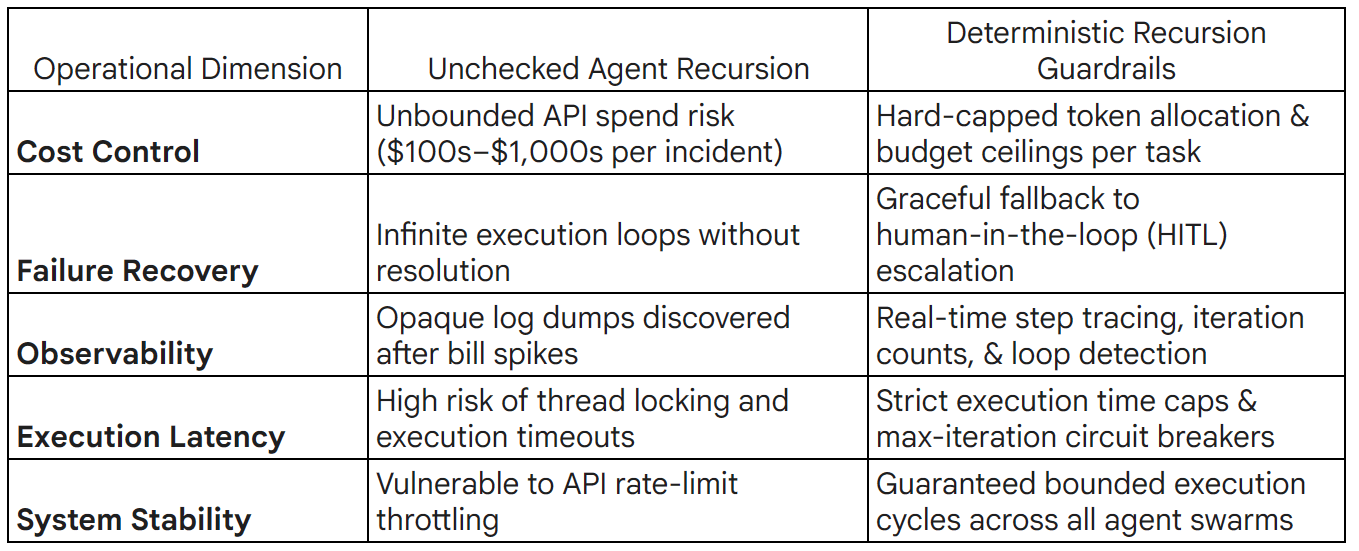
Unchecked Loops vs. Deterministic Recursion Guardrails
Guarding agentic pipelines requires replacing probabilistic expectations ("the agent should figure it out") with deterministic code controls.
3 Strategies for Implementing Deterministic Recursion Breaks
Preventing runaway agent execution requires embedding programmatic controls into your AI orchestration framework (such as LangChain, AutoGen, or LlamaIndex):
1. Hard Iteration and Token Budget Caps
Enforce strict, non-overridable ceilings within your agent execution wrapper. Set a maximum step count (e.g., max_iterations = 3) and a maximum token allocation (e.g., max_tokens = 20,000) per task chain. Once a threshold is crossed, the execution context is frozen immediately.
2. Semantic Similarity Loop Detection
Simple step counters can be insufficient if an agent alternates between different failing approaches. By hashing or calculating vector embedding similarities across successive agent code outputs, your middleware can detect when an agent is generating code that is >90% semantically identical to a previously failed attempt, tripping the circuit breaker instantly.
3. Human-in-the-Loop (HITL) Escalation Gateways
When a deterministic circuit breaker trips, the system shouldn't simply fail silently. The orchestration layer should bundle the agent's goal, failure logs, and attempted solutions, and hand off the task to a senior engineer via a pull request or Slack alert, preserving context while halting API spend.
Govern Your Agentic Workflows with Talentus Global
Building, monitoring, and securing multi-agent AI networks requires specialized software engineers who understand LLM orchestration, middleware architecture, and DevSecOps.
Talentus Global provides the engineering depth to build safe, cost-efficient AI automation pipelines.
For over 30 years, Talentus Global has been a leader in enterprise digital transformation and software engineering. Through our nearshore LATAM Global Delivery Centers, we deploy pre-vetted engineering pods specialized in Agentic AI, LLMOps, custom middleware, and cloud infrastructure.
Our senior developers integrate directly into your teams to implement enterprise AI guardrails, deterministic circuit breakers, and cognitive observability frameworks, allowing you to innovate with agentic AI without risking runaway API bills.
- 100% US Timezone Alignment: Our LATAM engineering pods operate during your exact business hours (EST/CST) for real-time collaboration and daily agile standups.
- Zero Recruitment Delay: Bypass 60-day domestic hiring lags and deploy senior AI integration developers in under 48 hours.
- Unmatched Retention: Maintain architectural continuity with our industry-leading 95% developer retention rate.
Stop letting rogue AI loops threaten your engineering budget. Safeguard your agentic workflows with Talentus Global today with our AI Solutions clicking here