Student retention is one of the most critical challenges facing modern higher education institutions.
When a student drops out, the consequences reverberate across the entire university: the student’s academic journey is interrupted, the institution suffers a direct loss in tuition revenue, and long-term graduation metrics decline.
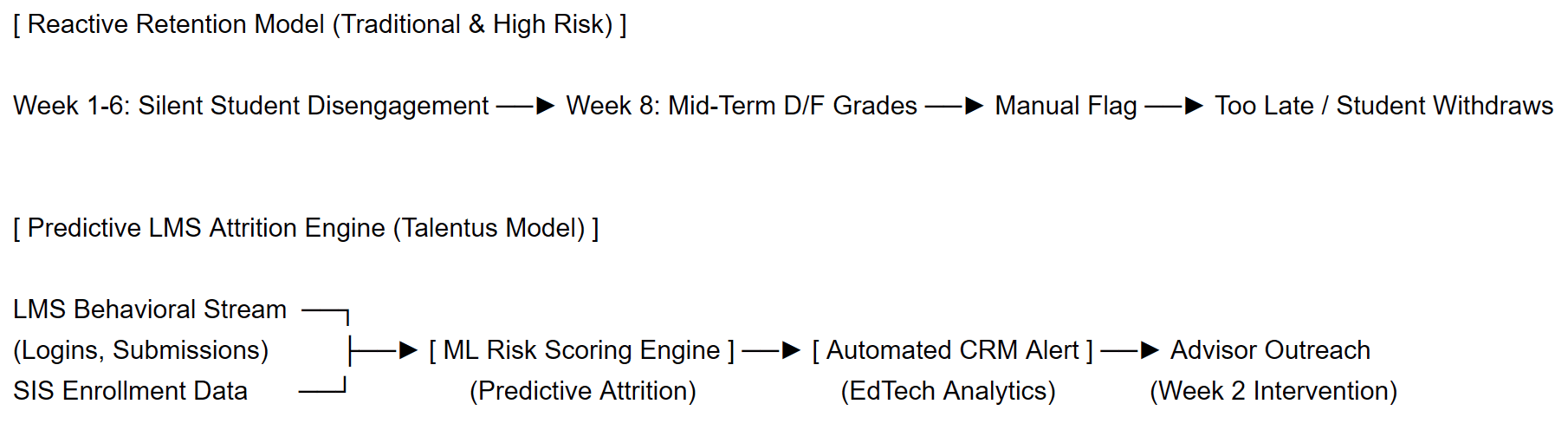
Traditionally, universities have managed student retention reactively. Academic advisors rely on mid-term grade reports or early-alert referrals submitted manually by faculty six to eight weeks into the semester.
However, by the time mid-term grades post, a struggling student may have already disengaged from coursework, missed vital assignment deadlines, and mentally checked out. Mid-term grades are lagging indicators.
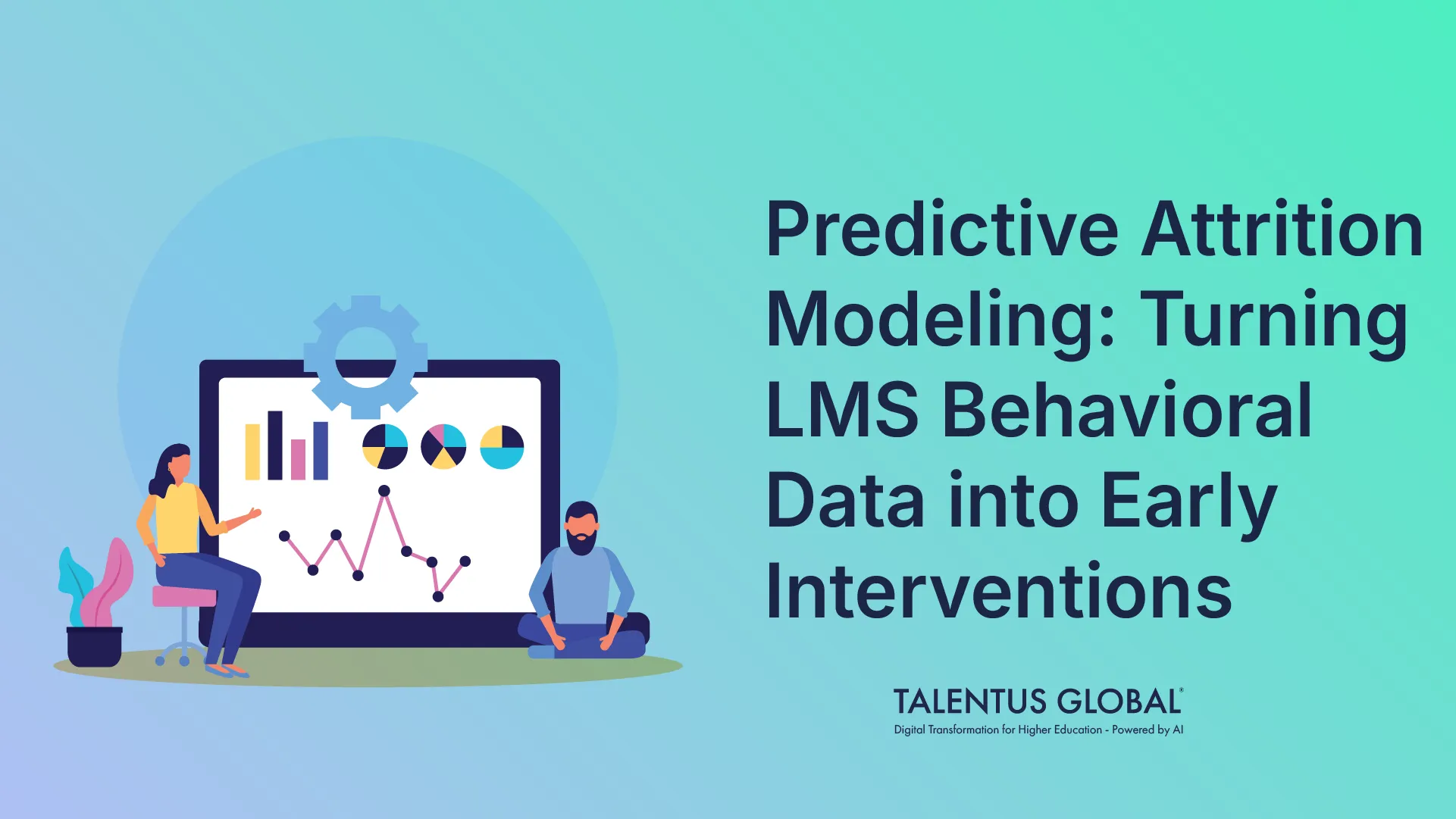
To prevent student dropouts before they occur, higher education institutions must pivot from reactive grade monitoring to predictive attrition modeling, capturing subtle, real-time behavioral digital footprints inside the Learning Management System (LMS) to trigger immediate, targeted support interventions.
The Fatal Flaw of Reactive Attrition Management
Relying solely on midterm grades or end-of-semester evaluations creates severe structural liabilities for university student success initiatives:
- The "Silent Withdrawal" Pattern: Students rarely drop out overnight. Disengagement is a gradual process characterized by decreasing login frequencies, late assignment submissions, and unread course announcements weeks before grades reflect a crisis.
- Faculty Referral Bottlenecks: Manual early-alert systems rely entirely on overloaded adjuncts and professors to identify struggling students and submit portal flags. Coverage is inconsistent across departments.
- Uncaptured Digital Footprints: Every day, students generate thousands of behavioral data points within LMS platforms like Canvas, Blackboard, or Brightspace. Leaving this data unanalyzed wastes the single richest predictor of student persistence.
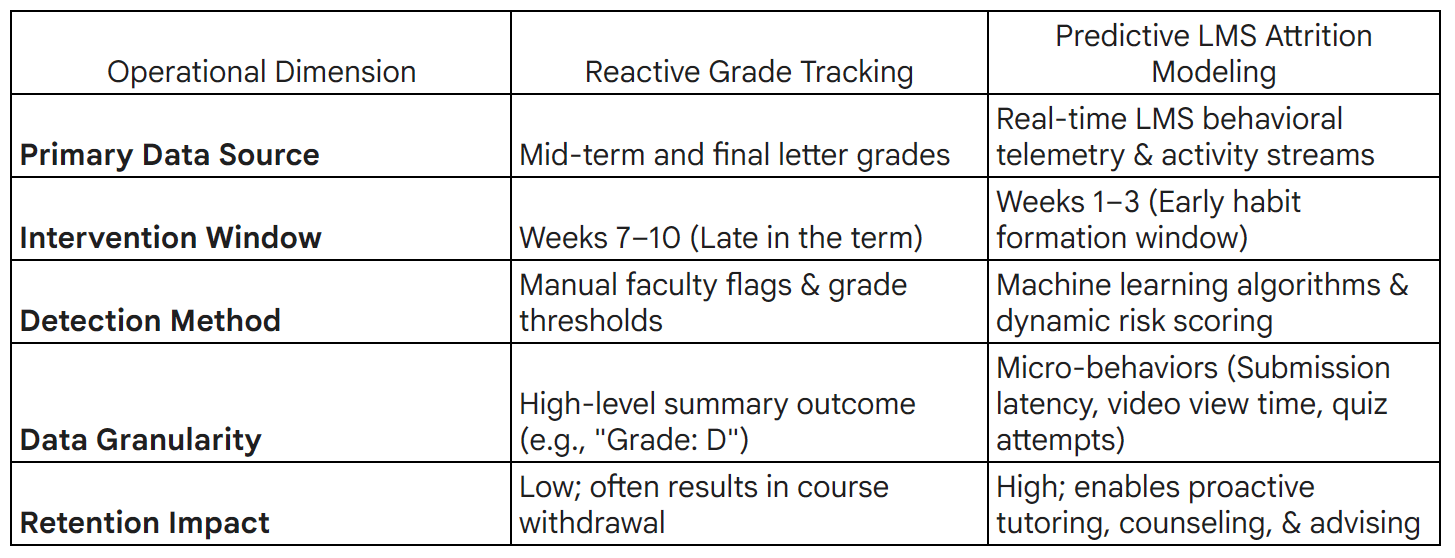
Reactive Grade Tracking vs. Predictive LMS Attrition Modeling
Transforming raw LMS activity into predictive risk scores allows academic success teams to intervene while there is still time to alter academic outcomes.
3 High-Impact LMS Behavioral Signals for Early Warning
Predictive attrition models do not rely on static demographics; they analyze dynamic behavioral patterns within the LMS to identify at-risk students during the first 21 days of a term:
1. Submission Velocity & Latency Drift
A sudden increase in assignment submission latency, submitting quizzes minutes before deadlines or missing low-stakes initial assignments, is often the single strongest early-warning indicator of academic distress.
2. LMS Content Interaction Frequency
Tracking portal login cadence, syllabus downloads, and lecture recording view durations reveals student engagement levels. A student who logs in only once a week for a hybrid or blended course exhibits a significantly higher attrition risk profile.
3. Peer & Discussion Thread Participation
In online and hybrid courses, disengagement manifests as reduced participation in peer discussion boards and group project channels. Natural Language Processing (NLP) models can evaluate interaction sentiment and response rates to flag social and academic isolation.
Turn LMS Data into Retention Power with Talentus Global
Building a predictive attrition model requires unifying disparate data streams from your LMS (Canvas, Blackboard), SIS (Banner, Workday), and CRM (Slate, Salesforce) into a centralized, real-time analytics pipeline.
Talentus Global provides the engineering depth to build, scale, and maintain your predictive retention ecosystem.
With over 30 years of enterprise tech transformation experience, Talentus Global deploys pre-vetted nearshore LATAM software engineering pods specialized in data engineering, machine learning, cloud architecture, and EdTech integrations.
Through our proprietary EdTech Analytics framework and pre-built EdTech Connectors, we help university IT and student success leaders convert raw LMS logs into predictive risk scores and automated advisor workflows.
100% US Timezone Alignment: Our LATAM developers operate synchronously in your business hours (EST/CST), attending standups and working seamlessly alongside your internal team.
Rapid Deployment: Skip 60-day domestic hiring cycles and deploy specialized data engineering pods in under 48 hours.
Institutional Continuity: Maintain long-term architectural stability with our industry-leading 95% developer retention rate.
Stop waiting for mid-term grades to save struggling students. Build predictive LMS attrition models with Talentus Global today.