For chancellors, university system presidents, provosts, and CFOs overseeing multi-campus higher education systems, getting a clear, real-time view of institutional health is an ongoing operational challenge.
Whether managing a state university system with regional campuses, a private university with international satellite locations, or an institution expanding its online division, executive leadership faces a recurring problem: every campus operates as a data island.
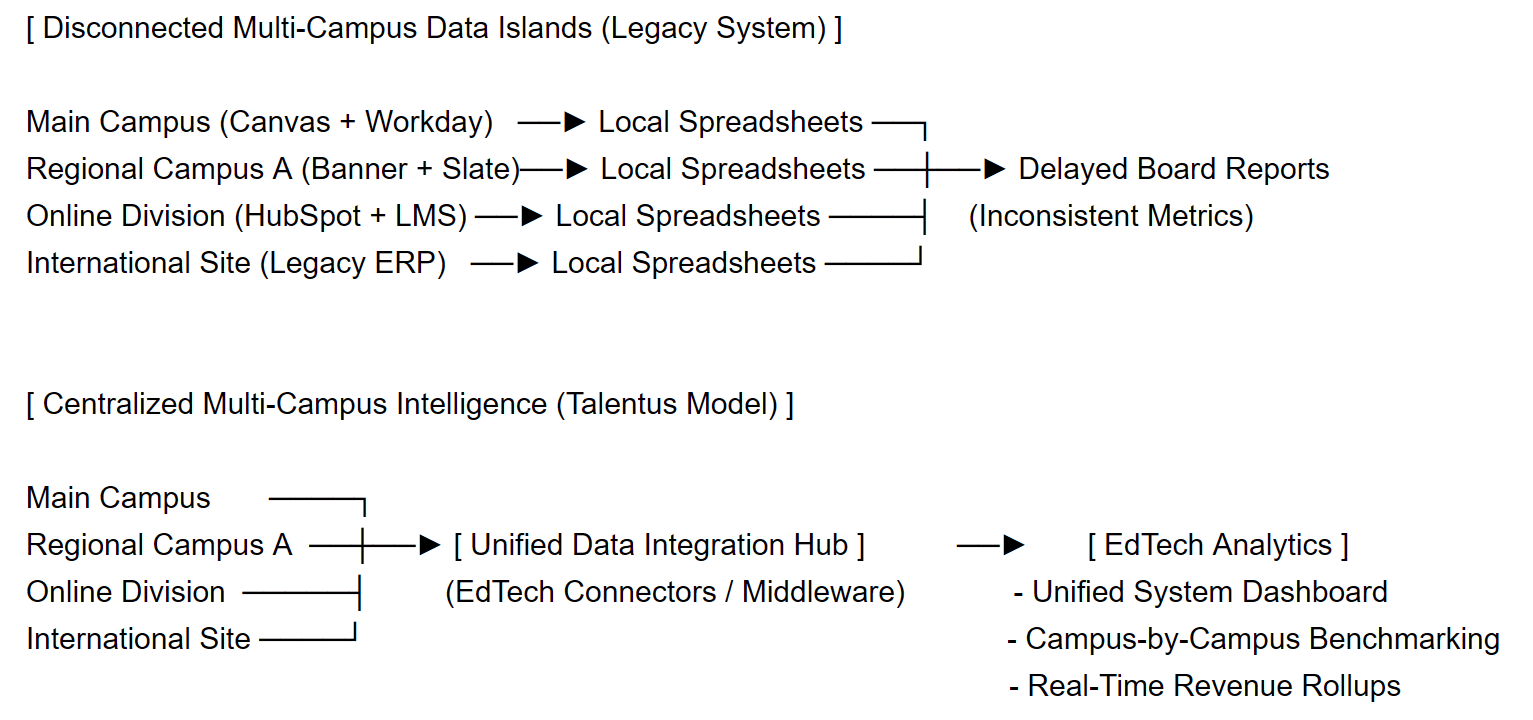
The main campus might rely on Workday and Canvas, while a regional branch utilizes Banner and Blackboard. An online division might run its own custom admissions funnel inside Salesforce or HubSpot.
When system leaders attempt to consolidate enrollment figures, student retention metrics, faculty overhead, or tuition revenue across all locations, they encounter a maze of inconsistent definitions, mismatched GL accounts, and static spreadsheets.
By the time multi-campus metrics are manually reconciled and presented at board meetings, the data is weeks old.
To make agile, data-driven strategic decisions, higher education systems must eliminate executive data blind spots by centralizing multi-campus metrics into a unified intelligence framework.
The Heavy Cost of Multi-Campus Data Fragmentation
Operating a multi-campus university system without centralized reporting creates major structural liabilities:
- Taxonomy & Metric Mismatches: Campus A might define "Full-Time Equivalent (FTE)" or "Student Retention" using different criteria than Campus B. When raw numbers are aggregated without standardization, executive reports produce misleading conclusions.
- Inconsistent Institutional Benchmarking: Without unified metrics, leadership cannot accurately compare resource utilization, student-to-faculty ratios, or cost-per-credit-hour across regional campuses to identify operational efficiencies or underperforming programs.
- Delayed System-Wide Interventions: When a regional campus experiences a sudden dip in enrollment or student engagement, system executives often discover the trend months after the term begins, missing the critical window to reallocate marketing budgets or advising resources.
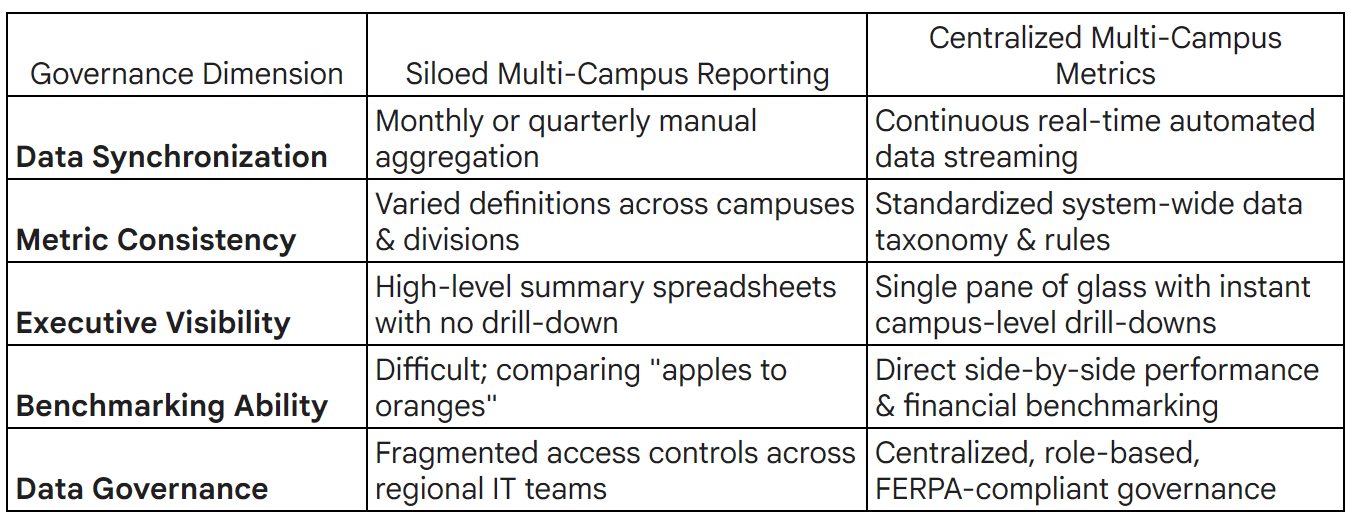
Siloed Campus Reports vs. Centralized Multi-Campus Metrics
Transitioning from localized campus spreadsheets to a centralized intelligence layer transforms system-wide governance.
3 Pillars for Centralizing Multi-Campus Metrics
Eliminating executive blind spots across multi-campus networks requires an enterprise architecture designed for scale, flexibility, and security:
1. System-Wide Data Taxonomy Standardization
Before aggregating data, system leadership must establish a unified data dictionary. Standardizing key performance indicators (KPIs), such as course completion rates, tuition yield, retention markers, and GL account structures, ensures every campus speaks the same operational language.
2. Enterprise Middleware & Data Lakehouse Architecture
Instead of forcing every campus to rip and replace their existing legacy platforms, deploy an enterprise integration layer (using platforms like MuleSoft or Boomi alongside pre-engineered EdTech Connectors). This layer continuously streams data from disparate LMS, SIS, and ERP systems into a secure, centralized data lakehouse.
3. Role-Based Executive Dashboards
Through EdTech Analytics, system executives access a single pane of glass displaying high-level system metrics, with the ability to instantly drill down into specific regional campuses, academic departments, or demographic cohorts. Simultaneously, campus deans receive tailored views restricted to their specific operational domains.
Centralize Your Multi-Campus Intelligence with Talentus Global
Building a scalable, real-time data architecture across multiple university campuses requires deep technical expertise in data engineering, enterprise middleware, and higher ed software integration.
Talentus Global provides the engineering capacity to unify your multi-campus technology ecosystem.
With over 30 years of digital transformation leadership, Talentus Global deploys pre-vetted nearshore LATAM software engineering pods specialized in cloud data engineering, API middleware, and analytics integration.
Our pre-built EdTech Connectors and EdTech Analytics suite enable university systems to bridge disparate campus platforms, such as Canvas, Banner, Workday, Slate, and Salesforce, into a single source of truth without custom scripting headaches or domestic hiring delays.
100% US Timezone Synchronization: Our LATAM engineering pods operate during your exact business hours (EST/CST), collaborating in real time with your system IT leadership and campus teams.
Rapid Team Deployment: Bypass 60-day recruitment cycles and deploy senior data integration pods in under 48 hours.
Unmatched Retention: Maintain long-term architectural stability across your multi-campus roadmap with our 95% developer retention rate.
Eliminate executive data blind spots across your university system. Unify your multi-campus metrics with Talentus Global today.