For higher education institutions, achieving true "AI-Readiness" is no longer about launching a standalone web chatbot on the university homepage. While early pilot programs introduced conversational AI for basic admissions FAQs, these isolated tools operate in a vacuum, requiring students, faculty, and administrators to leave their primary working environments to seek answers
True institutional transformation occurs when cognitive assistants are embedded directly into native campus workflows: the Learning Management System, the Student Information System, and the Admissions CRM.
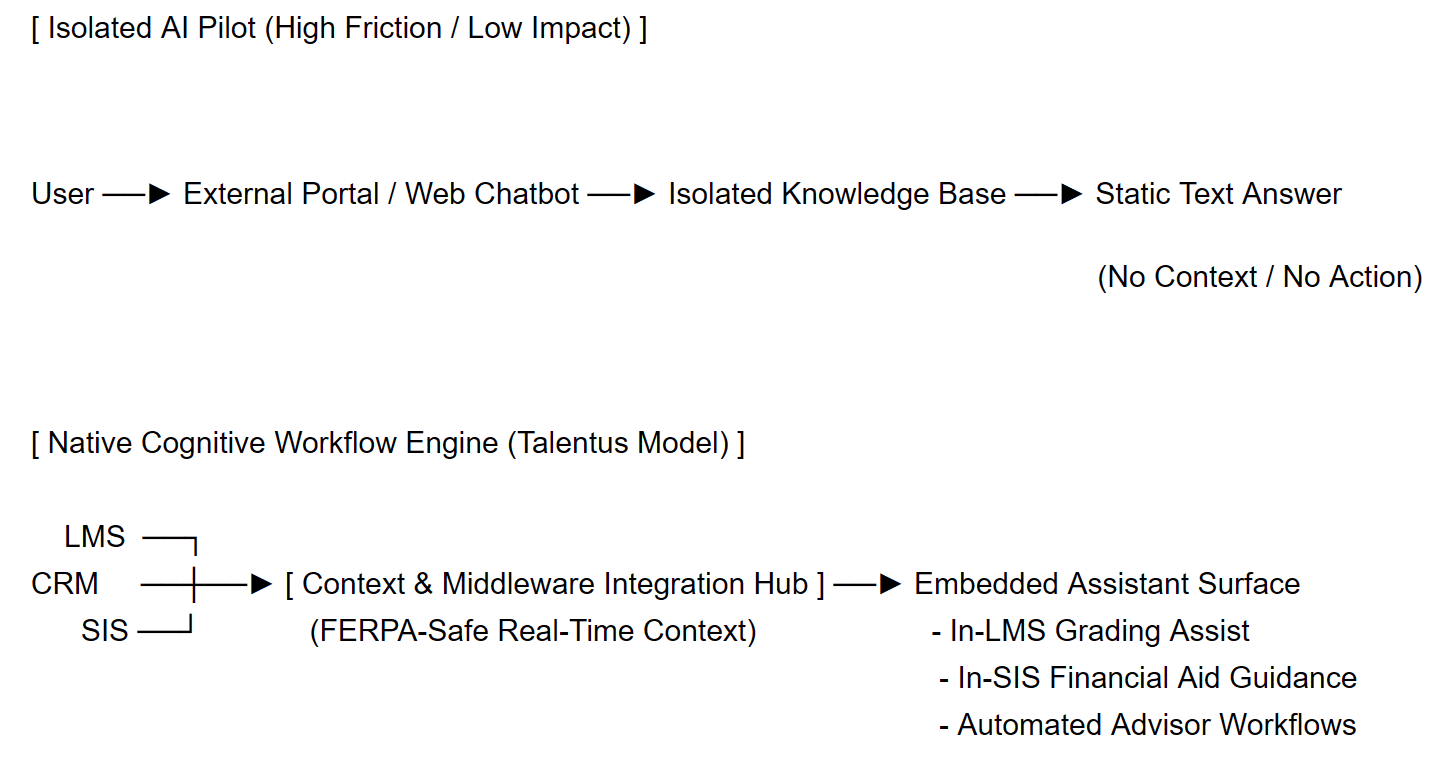
When cognitive agents have secure, contextual access to real-time student data and operational systems, they evolve from passive Q&A engines into proactive workflows assistants. They assist faculty with grading rubric design inside the LMS, guide students through financial aid verification within the student portal, and surface predictive retention alerts directly to academic advisors inside their CRM.
To transition from novelty AI pilots to enterprise-grade AI readiness, university leadership must embed intelligence where work already happens.
The Limits of Standalone Campus AI
Relying on external, portal-based AI widgets creates operational friction that limits adoption across faculty and student bodies:
Context Blindness: A generic chatbot on a public website cannot see a student's current enrollment status, hold state, or assignment deadlines, resulting in vague, generalized advice.
Workflow Fragmentation: Forcing faculty or staff to copy-paste data between their daily tools and a separate AI window introduces friction, leading to rapid tool abandonment.
Inability to Execute Actions: Isolated chatbots can only tell a user what to do; they cannot initiate a course registration add/drop, submit a tutoring request, or trigger an advising follow-up directly within institutional systems.
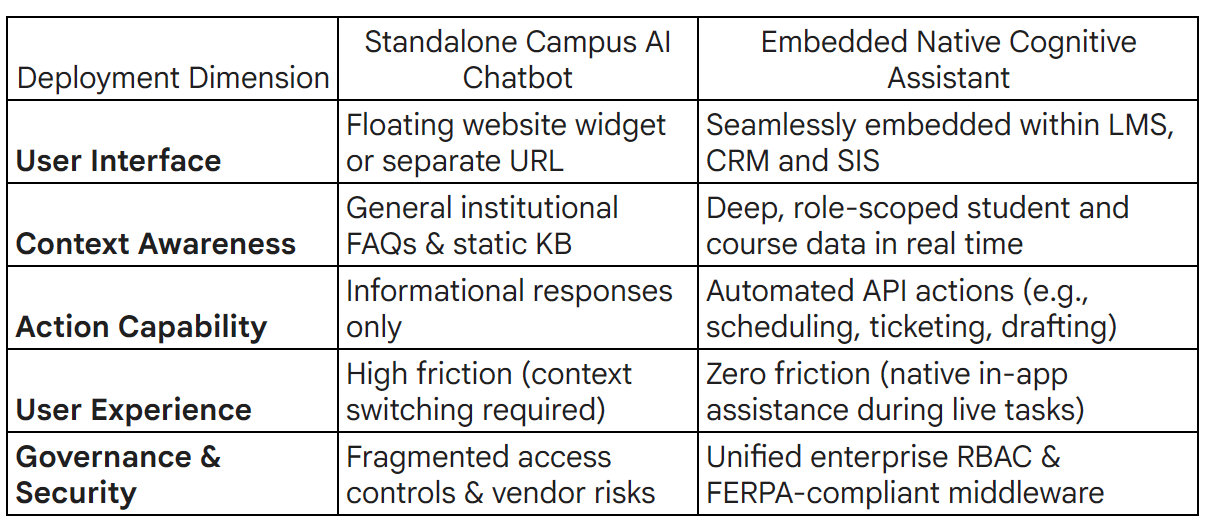
Standalone AI Chatbots vs. Embedded Native Cognitive Assistants
Upgrading campus architecture to support native cognitive assistants turns passive AI interactions into active operational efficiency.
3 Pillars of Campus AI-Readiness
Embedding cognitive assistants into native higher ed systems requires a modern, integrated software foundation built on three core capabilities:
1. Unified Event-Driven Data Integration
Cognitive assistants require immediate access to context to be truly useful. Connecting Canvas, Slate, and Workday via enterprise integration middleware allows the assistant to pull live course rosters, financial aid statuses, and academic holds in real time.
2. Native Interface Extension & In-App Triggers
Rather than building new portals, engineering teams leverage native extension frameworks to surface AI assistance directly within existing staff and student screens.
3. Role-Scoped Guardrails and FERPA Security
Every cognitive action must honor existing institutional access policies. Embedded assistants must be bound by strict Role-Based Access Control (RBAC), ensuring a student's assistant only accesses their own records, while a professor's assistant is strictly isolated to their active course sections.
Accelerate Campus AI-Readiness with Talentus Global
Integrating cognitive AI agents into legacy and modern higher ed systems requires deep expertise in API middleware, security compliance, and EdTech platform architectures.
Talentus Global provides the engineering capacity to make your campus AI-ready.
For over 30 years, Talentus Global has been a trusted leader in enterprise system integration and software engineering. Through our nearshore LATAM Global Delivery Centers, we deploy pre-vetted engineering pods specialized in higher ed software ecosystems (Canvas, Slate, Banner, Workday), custom API integration, and enterprise AI orchestration.
Using our pre-built EdTech Connectors and modern data pipeline frameworks, our senior engineers help university IT teams embed secure, FERPA-compliant cognitive assistants directly into native campus software, eliminating context switching and driving real digital adoption.
- 100% US Timezone Alignment: Our LATAM software engineering pods operate synchronously in your timezone (EST/CST) for real-time agile collaboration.
- Rapid Team Deployment: Bypass 60-day hiring cycles and deploy specialized integration pods in under 48 hours.
- Unmatched Continuity: Maintain architectural stability across your AI roadmap with our 95% developer retention rate.
- Move beyond standalone chatbots. Embed intelligent workflows into your campus ecosystem with Talentus Global today.