Take a look at the digital architecture of the average mid-market university today, and you will likely see a fragmented landscape. The admissions team relies on HubSpot to manage the CRM and marketing automation pipelines, academics operate inside a sprawling Learning Management System (LMS) like Canvas, and the registrar governs the legacy Student Information System (SIS).
Individually, these platforms are powerful. Collectively, they are often a disconnected mess.
For years, IT departments solved this problem with point-to-point integrations, custom scripts written by a single engineer to connect System A to System B. But as universities race to deploy predictive analytics and campus-wide AI in 2026, this fragile "spaghetti architecture" has become a massive bottleneck. When every new software deployment requires untangling a web of custom code, enterprise velocity grinds to a halt.
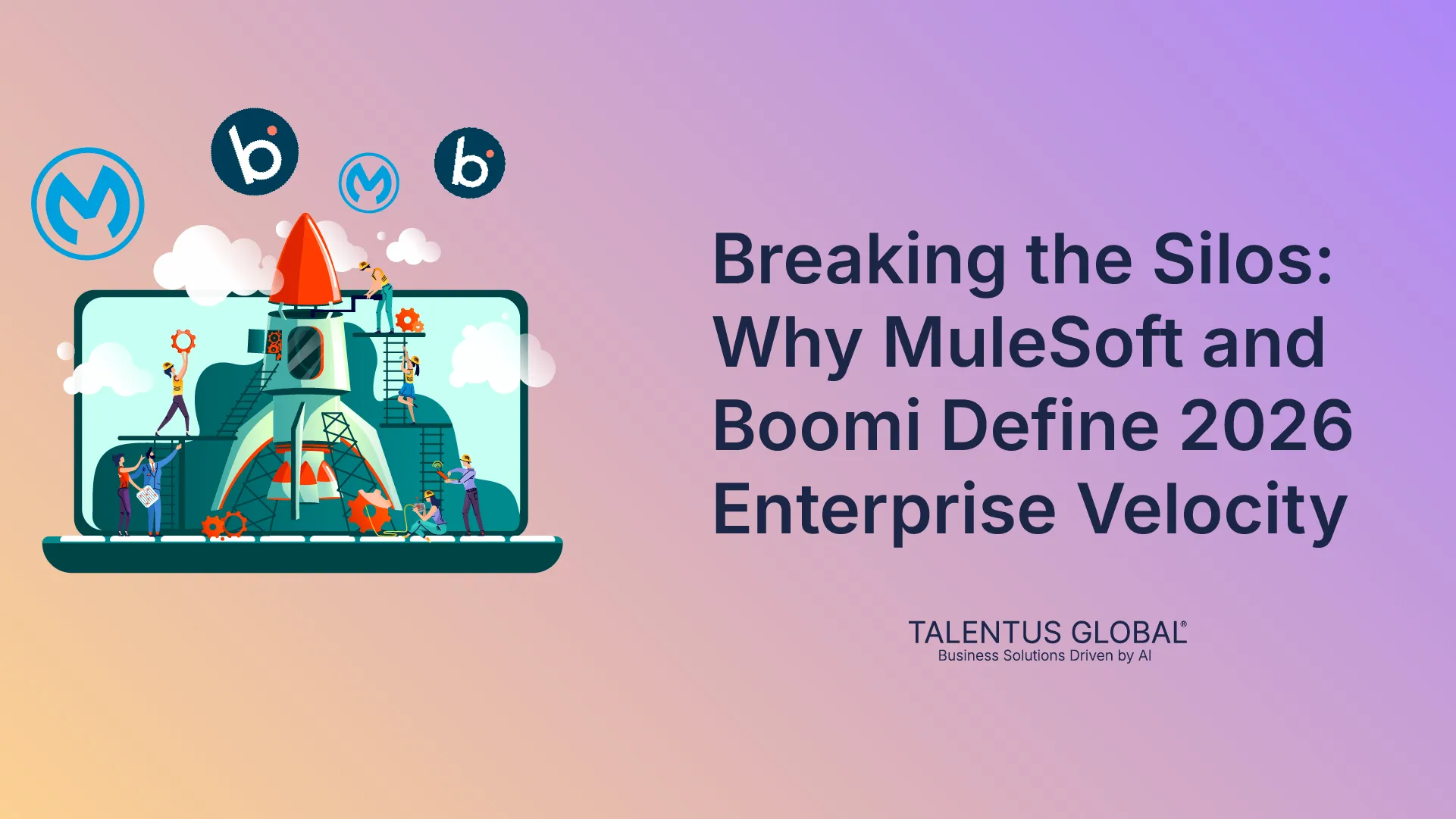
To break these silos and regain operational agility, higher education IT leaders are abandoning point-to-point connections in favor of API-first middleware platforms like MuleSoft and Boomi.
The Problem with "Spaghetti" Integrations
Point-to-point integrations are inherently brittle. If your marketing automation software undergoes a major version update, the custom script connecting it to your SIS will likely break, taking vital enrollment data down with it.
Furthermore, point-to-point architecture does not scale. Connecting five systems requires 10 distinct integrations. Connecting 10 systems requires 45. In this environment, IT teams spend all their bandwidth maintaining legacy connections rather than launching new digital initiatives.
The API-Led Solution: MuleSoft and Boomi
Integration Platform as a Service (iPaaS) solutions like MuleSoft and Boomi fundamentally change how campus data flows. Instead of wiring applications directly to one another, these platforms serve as a centralized, intelligent middleware layer.
By adopting an API-led architecture, IT teams create reusable digital building blocks. If you build an API to extract student enrollment data from the SIS for your financial ERP, you can reuse that exact same API to feed your LMS or your alumni CRM.
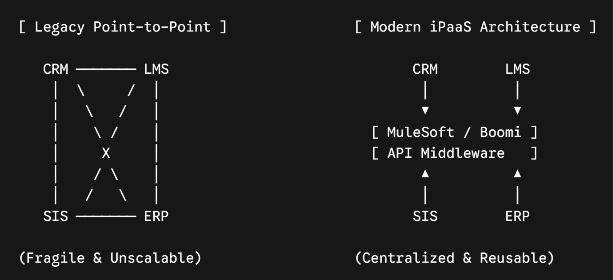
This decoupled approach ensures that if you decide to replace a legacy ERP, you only have to unplug it from the middleware and plug the new system in. The rest of the campus ecosystem remains completely undisturbed. This is the definition of enterprise velocity: the ability to adapt, scale, and swap technologies rapidly without breaking the core infrastructure.
Accelerate Your API-First Architecture with Talentus
Transitioning to an iPaaS architecture is a strategic imperative, but executing it requires highly specialized integration architects. Finding, hiring, and retaining certified MuleSoft or Boomi engineers in the US market often involves 60-day hiring delays and premium salary demands that strain university IT budgets.
Talentus Global eliminates this bottleneck.
With over 30 years of experience in higher education digital transformation, we provide the architectural bandwidth your university needs to modernize its infrastructure. Through our LATAM Global Delivery Centers (Colombia, Peru, Mexico, Argentina), we deploy pre-vetted nearshore software engineering pods specialized in API-first architectures and enterprise middleware.
Our systems integration experts operate synchronously in your exact timezone (EST/CST), seamlessly integrating with your internal IT leadership. We build the robust API pipelines required to unify your LMS, CRM, SIS, and ERP, delivering true enterprise velocity without the hiring friction. With our industry-leading 95% engineer retention rate, you gain a stable, long-term strategic partner.